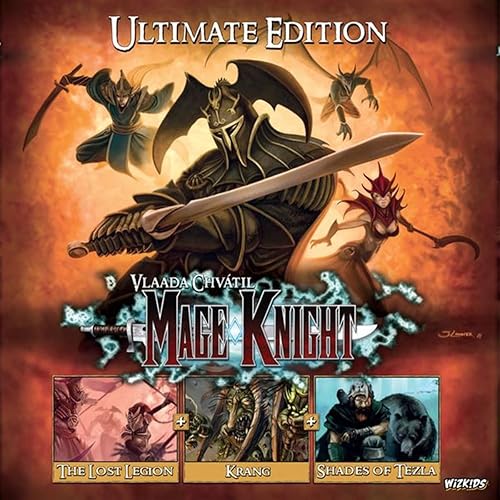
Mage Knight

Mage Knight

Board Game

Games & Accessories, Board Games

WISE
81%

WISE Score

8.1

Board Game Geek

A brutally complex fantasy deck-builder that rewards masochistic strategists willing to climb Mount Rulebook for one of gaming's deepest solo experiences.

Amazon4.7
Board Game Geek8.1
Common Sense Media

Where to Play

Our reviews and ratings are 100% unbiased, but as an Amazon Associate, Screenwise earns an affiliate fee if you buy a book or game by clicking one of our links. We don't get any credit if you just Google it instead :)

Screenwise Verdict

Mage Knight is the Mount Everest of board games—beautiful, punishing, and deeply rewarding for those willing to make the climb.

The 8.1 BGG rating from 35K voters and 4.7 Amazon rating tell you it's excellent, but the 4.37/5 complexity weight tells you why: this is genuinely hard. The rulebook is infamous. Your first game will be rough. But for teens and adults who love deep strategy, the payoff is enormous. The solo mode especially shines—it's a tactical puzzle box that unfolds over 2-3 hours of satisfying brain-burning.

This isn't for everyone. If your family enjoys Catan or Ticket to Ride and wants to "level up," this is skipping several levels. But if you have a 14-year-old who devours strategy games, loves optimization puzzles, and doesn't mind reading dense rules, Mage Knight offers one of the richest strategic experiences in modern board gaming.

The fantasy conquest theme is handled abstractly—you're moving meeples and playing cards, not narrating violence. The real content here is mathematical optimization dressed in fantasy clothing. Perfect for the teen who wants to feel like they're commanding armies while actually learning advanced resource management and strategic planning.

Age Fit

Best for ages 14+ who already enjoy complex strategy games and have the patience for a steep learning curve. The 14+ rating is about cognitive complexity, not mature content. Younger teens (12-13) with strong strategic gaming experience could handle it with parental support during the learning phase. This is not for casual gamers or family game night with mixed ages—it's for dedicated strategy enthusiasts.

WISE Breakdown
Wholesome
72

Fantasy combat and conquest themes are present but handled abstractly through cards and tokens rather than graphic depictions. The cooperative mode encourages teamwork, though competitive scenarios can create tension. The game rewards strategic thinking and planning over aggression. Fantasy violence is thematic rather than visceral—you're building armies and conquering cities, but it's all represented through game mechanics rather than narrative gore.

Imaginative
88

Exceptional creativity in combining deck-building, RPG exploration, and tactical combat into a cohesive fantasy adventure. Each game generates unique scenarios as players explore randomized terrain, discover dungeons, and make strategic choices about character development. The deck-building mechanism creates genuine emergent storytelling as your Mage Knight grows in power. Designer Vlaada Chvátil is known for innovative mechanics, and this delivers—won the 2012 Golden Geek Best Thematic Board Game award for good reason.

Safe
85

Board games are inherently safe from digital concerns—no ads, no data collection, no online toxicity. The 14+ age rating is appropriate for complexity rather than mature content. Fantasy combat themes are abstract and strategic rather than graphic. The main 'safety' concern is social: competitive scenarios can create tension between players, and the game's complexity (4.37/5 weight) can lead to analysis paralysis and downtime that frustrates some groups. Solo and cooperative modes mitigate competitive friction.

Enriching
86

Brutally complex strategic thinking required—this is a 4.37/5 complexity game that demands resource management, long-term planning, tactical combat decisions, and hand management. Players learn to optimize card combos, manage multiple resources simultaneously, and adapt to changing board states. The learning curve is steep (commonly cited as a weakness), but mastering it builds genuine cognitive skills. Strong solo mode means players can learn at their own pace. The time investment (60-240 minutes) rewards deep engagement rather than quick dopamine hits.

Parent Info

Why It Might Be Great

  • Genuinely innovative design that combines deck-building, RPG progression, and tactical combat in ways that feel fresh and interconnected
  • Outstanding solo mode—widely praised as one of the best solo board game experiences available, perfect for teens who want to lose themselves in a strategic puzzle
  • Massive replayability with randomized maps, multiple scenarios, and character asymmetry (48K people own this, 13K have it wishlisted)
  • Teaches advanced strategic thinking: resource optimization, long-term planning, combo execution, and adaptive decision-making under constraints
  • Cooperative mode available for families who want to tackle challenges together rather than compete

What to Watch For

  • The learning curve is legitimately brutal—expect multiple plays before things click, and the rulebook is notoriously dense
  • Playing time can stretch to 4 hours, especially when learning; not a quick weeknight activity
  • Complexity (4.37/5) means this is genuinely for experienced gamers or highly motivated teens, not casual players
  • Competitive mode can create friction as players block each other's plans—cooperative or solo modes are gentler socially
  • Downtime between turns can be significant with 3-4 players as people puzzle through complex decisions

Conversation Starters

  • "What's your strategy for building your deck—are you going for magic, combat strength, or trying to balance everything?"
  • "Which Mage Knight character did you pick and why? How does their special ability change your approach?"
  • "When you conquered that city, what was the turning point where you knew you could win?"
  • "Is it more satisfying to play cooperatively as a team or competitively to see who can claim the most territory?"
  • "What was the most frustrating rule to learn, and did it make more sense once you saw it in action?"

Ask Anything

Get a personalized guide on any topic