The "Mignola-verse" aesthetic
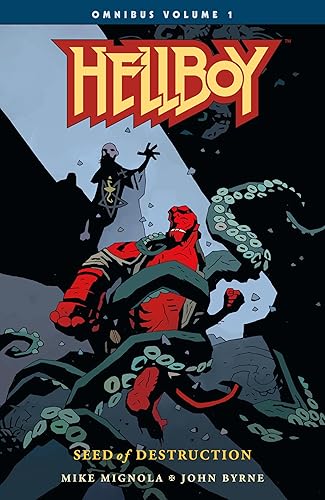
If your kid is used to the hyper-detailed, muscle-bound art of modern Marvel or DC, Hellboy is going to be a shock to the system. Mike Mignola doesn't do "busy." He works in heavy blocks of shadow and sharp, geometric shapes. It’s less about seeing every link in a chain and more about the atmosphere of the room that chain is hanging in.
This isn't just a stylistic choice; it changes how you read the book. You spend more time looking at the environment—the crumbling gothic statues, the weird artifacts, the empty space—than you do watching people talk. It’s visual storytelling at its most efficient. For a teen interested in art or film, this is a masterclass in how to use "negative space" to create dread without actually showing anything graphic.
Why the Omnibus matters
Before this 2018 collection, reading Hellboy was a bit of a scavenger hunt. You had to jump between various trade paperbacks and short story collections to figure out how a demon ended up working for the U.S. government. This volume fixes that by putting everything in chronological order.
It starts with the 1944 origin story—where a bunch of desperate Nazis and a very creepy Rasputin accidentally summon a baby demon—and moves straight into the 1994 "Seed of Destruction" arc. For a reader, this makes the world-building feel intentional rather than scattered. You see the "plague of frogs" seeds being planted early, and you get a clear sense of the B.P.R.D. (Bureau for Paranormal Research and Defense) as a lived-in, slightly bureaucratic workplace.
The blue-collar demon
The biggest hook for a skeptical reader is Hellboy himself. Despite the horns and the giant stone hand, he isn't an "edgy" anti-hero. He’s a guy with a job. He’s frequently tired, often annoyed, and would clearly rather be anywhere else than fighting a multi-dimensional worm-god in a basement.
This "working man" vibe makes the high-concept occult stuff much easier to digest. When Hellboy reacts to a floating ghost with a dry "Huh," it gives the reader permission to find the weirdness cool rather than confusing. It’s a great entry point for kids who find the self-seriousness of traditional horror or fantasy a bit much.
The "Friction" of the Occult
The book leans heavily into Nazi occultism and folklore. You’re going to see swastikas in the flashback scenes and pentagrams in the summoning circles. It’s all framed within a classic "pulp adventure" context—think Indiana Jones where the supernatural elements are real and much darker.
If your kid is sensitive to religious imagery or the darker corners of World War II history, be aware that these aren't just background details; they are the engine of the plot. However, the book is very clear about who the villains are. The horror isn't meant to be "edgy" for the sake of it; it’s there to provide a massive, cosmic backdrop for a hero who just wants to do the right thing.
If they liked the movies
If they’ve seen any of the film adaptations, they might expect a lot of quips and fast-paced action. The comic is quieter. It’s more interested in the mystery and the "weird fiction" vibes of authors like H.P. Lovecraft. It’s a slower burn, but the payoff is a much deeper connection to the mythology. If they enjoyed the "found family" aspect of the movies, they’ll find it here too, especially in the early interactions between Hellboy, Abe Sapien, and Liz Sherman. It’s just more subtle on the page.