Captain Fantastic

Captain Fantastic

movie

R, 2016, Comedy, Drama

WISE
72%

WISE Score

82

Avg. Tomatometer

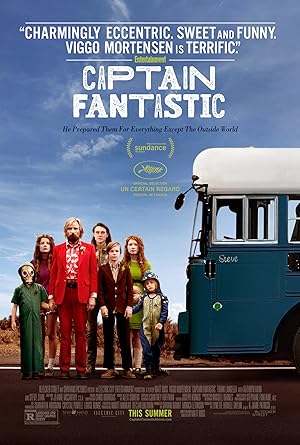
Viggo Mortensen raises six kids in the wilderness with philosophy and parkour—then reality crashes the utopia.

IMDb7.8
RT Critics82%
MC72
Common Sense Media
Where to Watch
Loading streaming options...
Screenwise Verdict

Captain Fantastic is that rare film that actually earns its 'thought-provoking' label. It takes a premise that could have been smug or preachy—homeschooling in the extreme—and turns it into a genuine exploration of what we owe our kids and what happens when ideology meets reality.

Viggo Mortensen's father character is neither hero nor villain. He's raised six kids who can speak six languages, debate political philosophy, and survive in the wilderness. They're also socially awkward, potentially traumatized, and completely unprepared for normal human interaction. The film doesn't tell you what to think about this, which is refreshing.

The mature content is significant and non-negotiable: suicide as a central theme, brief nudity, grave desecration, explicit sexual discussions. This is not a movie you accidentally put on during family movie night with a 12-year-old. But for 16+ viewers who can handle heavy themes, it's genuinely enriching—the kind of film that sparks real conversations about education, parenting, grief, and what 'normal' even means.

It's well-made, beautifully shot, and Mortensen is excellent. The 82% Rotten Tomatoes score and 7.8 IMDb rating reflect its quality. Just know what you're getting into, and plan to talk about it afterward.

Age Fit

This is firmly a 16+ film for mature teens and adults. The suicide theme, nudity, sexual content, and emotional weight make it inappropriate for younger viewers. But for older teens who can handle complex moral questions, it's excellent viewing—just plan to discuss it afterward.

WISE Breakdown
Wholesome
68

The film portrays a tight-knit family with genuine love and respect, but the father's extreme parenting methods create tension and ethical gray areas. The kids are physically and intellectually capable, but socially isolated in ways that feel uncomfortable. There's real emotional complexity here—grief, mental health struggles, and a parent grappling with whether he's helping or harming his children. The tone is thoughtful rather than chaotic, but the content includes mature themes: the mother's suicide (discussed openly), brief nudity (a son's coming-of-age ritual), and sexual content discussions that are frank but not gratuitous. It models intellectual rigor and family loyalty, but also shows the cost of extremism.

Imaginative
81

This film takes a genuinely original premise—a family living completely off-grid with a rigorous intellectual and physical education system—and explores it with nuance. The Pacific Northwest setting is gorgeously shot, and the contrast between wilderness life and suburban America creates thought-provoking tension. It invites viewers to question conventional education, parenting norms, and what 'success' means. The kids speak multiple languages, debate philosophy, and perform physical feats, all while living in a bus in the forest. It's not a fantasy world, but it sparks imagination about alternative ways of living and learning. Viggo Mortensen's performance adds depth to what could have been a one-note character.

Safe
42

This is definitively not safe for younger viewers. The film opens with discussions of the mother's recent suicide, which is a central plot point throughout. There's a scene where a teenage son strips naked as part of a coming-of-age ritual (brief full-frontal nudity). The kids engage in dangerous activities like hunting with knives and rock climbing without safety equipment. There's strong language scattered throughout. A graphic scene shows the family exhuming the mother's body from her grave. Sexual content is discussed matter-of-factly (the father gives his teenage son explicit advice). While none of this is gratuitous or exploitative, it's heavy, mature content that would be shocking and inappropriate for children under 16. Common Sense Media's age 16 recommendation is spot-on.

Enriching
88

This is a deeply thought-provoking film that raises genuine questions about education, parenting philosophy, grief, mental health, and the balance between protecting children and preparing them for reality. It doesn't provide easy answers—the father's methods produce brilliant, capable kids who are also socially awkward and potentially damaged. The film explores Noam Chomsky, the Bill of Rights, critical thinking, and physical fitness alongside real human vulnerability. It challenges viewers to examine their own assumptions about what children need and what parents owe their kids. The Roger Ebert review noted it could have used more skepticism of the father's approach, which is fair, but the film does ultimately question his methods. For mature teens and adults, it's genuinely enriching viewing that stays with you.

Parent Info

Why It Might Be Great

  • Genuinely original premise that questions everything about modern parenting and education without being preachy
  • Viggo Mortensen delivers a nuanced performance as a father who's both admirable and deeply flawed
  • Sparks real conversations about what kids actually need—safety vs. challenge, protection vs. preparation
  • Gorgeous cinematography and a thoughtful script that doesn't provide easy answers
  • The kids are portrayed as real people, not props—they're brilliant and capable but also struggling with their father's choices

What to Watch For

  • Heavy mature content throughout: the mother's suicide is a central plot point, discussed openly and frankly
  • Brief but notable nudity during a coming-of-age ritual scene
  • A graphic grave exhumation scene that's unsettling
  • Frank sexual discussions between father and teenage son
  • The film ultimately questions the father's methods, but doesn't condemn them outright—some viewers may find his parenting style disturbing

Conversation Starters

  • "Do you think the kids were better off learning in the forest or would they have been better served in regular school?"
  • "The dad taught his kids to think critically about everything—but was he also indoctrinating them with his own views?"
  • "How do you balance protecting kids from hard truths versus preparing them to handle reality?"
  • "What did you think about how the family dealt with grief and loss? Was their approach healthy or harmful?"
  • "If you could design your own education, what would you keep from traditional school and what would you change?"

Deep Dive

The ultimate parenting experiment

Most movies about "going off the grid" lean into the tropes of the dirty hippie or the paranoid survivalist. Captain Fantastic skips both to give us something much more uncomfortable: a family that is objectively better than yours at almost everything. These kids aren't just surviving; they’re thriving in a way that makes modern suburban life look like a slow-motion car crash. They're reading The Brothers Karamazov at age ten and hunting their own dinner, but the film’s real genius is showing exactly where that hyper-competence hits a wall.

It’s the "Noam Chomsky Day" vs. Christmas dynamic. Ben Cash has built a world where his children are intellectual giants and physical specimens, yet they are total aliens the second they step into a mid-tier diner. Watching them navigate a world of video games and processed sugar isn't just played for laughs—it’s a brutal look at the trade-offs we make when we decide what "normal" looks like for our kids.

The friction of the "ideal" childhood

If you’ve ever felt a twinge of guilt about your kid's screen time or their lack of outdoor grit, this movie will poke that bruise. But it also offers a necessary reality check. There is a specific scene involving a "mission" to rescue their mother that highlights the terrifying line between empowering a child and putting them in genuine peril.

The film works because it refuses to let Ben off the hook. He’s played with a magnetic, terrifying certainty by Viggo Mortensen, but as the story progresses, we see the cracks. The kids are brilliant, but they’re also lonely in a way they can’t quite name. It’s a fascinating study in how even the most "perfect" intentional parenting can become its own kind of cage.

If you liked Little Miss Sunshine

Think of this as Little Miss Sunshine if the family was obsessed with political theory and tactical knives instead of beauty pageants. It has that same "family road trip in a bus" energy, but the stakes are significantly higher. While it fits into our list of the 35 best father-daughter relationship movies because of the fierce, complex bond Ben has with his daughters, it’s arguably more about the collective unit than any single relationship.

The 82% Rotten Tomatoes score is well-earned, but the 85% audience score tells the real story. This is a "vibe" movie. People love the aesthetic of the Pacific Northwest wilderness and the dream of escaping the rat race, even if the movie eventually reminds us why the rat race exists in the first place.

How to watch it with a teen

This isn't a "background" movie. If you’re watching this with a 16-year-old, wait for the scene where the kids interact with their "normal" cousins. It’s the perfect opening to talk about what education is actually for. Is it about knowing facts, or is it about being able to function in a society you might not even like?

The movie doesn’t give you a clean answer. By the time the credits roll, you’ll probably want to go for a hike and then immediately buy a pizza—and that's exactly the kind of balance the film is wrestling with.

Ask Anything

Get a personalized guide on any topic