

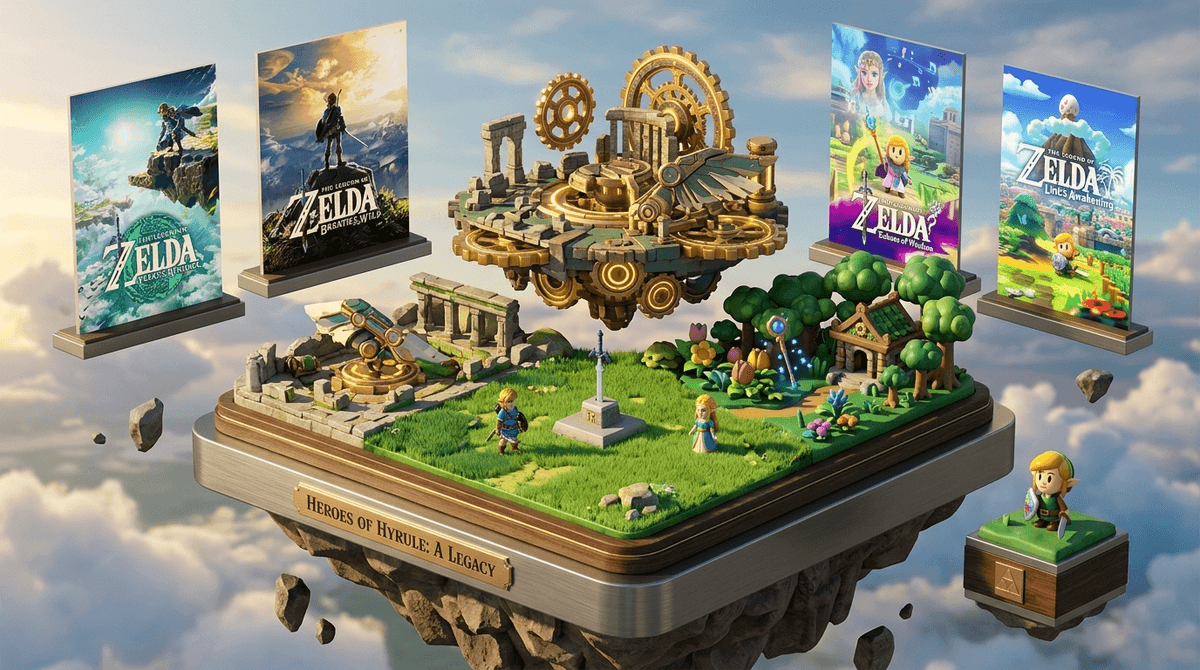
TL;DR: If you’re worried about "brain rot" or your kid spending eight hours a day doing nothing but "skibidi" dances in Roblox, Zelda is your new best friend. It is the literal opposite of mindless clicking. It’s a masterclass in physics, engineering, and "try-fail-repeat" resilience. It’s single-player (no toxic chat!), beautiful, and genuinely respects your child's intelligence.
Quick Picks:
- The Creative Engineering Choice: The Legend of Zelda: Tears of the Kingdom
- The Pure Exploration Choice: The Legend of Zelda: Breath of the Wild
- The "Zelda is the Hero" Choice: The Legend of Zelda: Echoes of Wisdom
- The Retro/Cozy Choice: The Legend of Zelda: Link’s Awakening
The Legend of Zelda is a 40-year-old franchise from Nintendo that has somehow managed to stay the coolest kid in the room. Unlike Minecraft, which is a sandbox with no real "end," or Fortnite, which is a competitive adrenaline spike, Zelda games are "action-adventure" titles.
You usually play as Link (a silent protagonist in a green or blue tunic) as he explores the kingdom of Hyrule to save Princess Zelda and defeat an ancient evil named Ganon. But that’s just the plot. The gameplay is about being dropped into a massive world and being told: "The world is broken. Figure out how to fix it."
We talk a lot about "digital wellness," which often just sounds like "taking the iPad away." But wellness is also about the quality of the digital diet.
Most modern apps—think TikTok or YouTube Shorts—are designed for passive consumption. They feed you content. Zelda, specifically the modern entries, demands active production.
In most games, if there’s a locked door, you find a key. In The Legend of Zelda: Tears of the Kingdom, if there’s a river you can’t cross, the game doesn't give you a bridge. It gives you three logs, a battery, and a fan, and says, "Build a hovercraft. Or a bridge. Or a catapult. We don't care, just get across."
This is computational thinking and creative engineering in a way that feels like play. When your kid tells you about a "cool thing they did in Zelda," they aren't talking about a meme; they’re usually talking about a complex logical sequence they engineered themselves.
Kids are constantly told what to do. At school, at home, at practice. Zelda is one of the few places where they have total agency.
- True Freedom: In the newer games, you can see a mountain in the distance and just... go there. There are no "invisible walls."
- The "Eureka" Moment: The puzzles are hard. When a kid finally figures out how to reflect light off a shield to open a stone door, the hit of dopamine is earned, not just handed out by an algorithm.
- Cultural Currency: Even though it’s single-player, kids talk about Zelda at lunch. They compare "builds" or show off how they beat a certain boss. It’s "Ohio" (weird/cringe) to not know what a Korok is these days.
Best for: Ages 9+ This is the game that changed everything in 2017. It’s a massive, open-world survival game. You have to manage your stamina, cook food to stay warm in the mountains, and observe the environment to solve puzzles. It’s quiet, contemplative, and stunningly beautiful. It teaches resource management and patience.
Best for: Ages 10+ The sequel to Breath of the Wild and arguably the greatest "engineering" game ever made. The "Ultrahand" ability allows kids to glue objects together to create vehicles, robots, and machines. It’s essentially a physics playground. If your kid likes LEGO or Roblox building, this is the "Gold Standard."
Best for: Ages 7+ Released in late 2024, this is the first time Princess Zelda is the main playable hero. The gameplay is unique: Zelda doesn't usually fight with a sword. Instead, she creates "echoes" (copies) of items she finds—like a table, a bed, or a monster—to solve puzzles. It’s a bit more approachable than the big 3D games and great for younger kids who are still developing their 3D spatial awareness.
Best for: Ages 7+ A remake of a 1993 classic. It looks like a living toy box. It’s "top-down" (like a bird’s eye view), which makes it much easier for kids who struggle with controlling a camera in 3D games. It’s charming, a bit surreal, and very structured.
Check out our guide on the best Nintendo Switch games for kids
While Zelda is generally "family-friendly," there are a few things to keep in mind:
- Reading is a Must: There is no voice acting for the main dialogue. If your child can't read yet, you will be sitting next to them reading text boxes for hours.
- Difficulty Spikes: These games do not "rubber band." If a kid wanders into an area they aren't ready for, they will get "one-shotted" by a high-level monster. This can lead to frustration. It’s a great opportunity to talk about resilience and knowing when to walk away and come back later.
- Fantasy Violence: It’s all "sword and sorcery." Monsters disappear in a puff of purple smoke when defeated. No gore, no blood, no realism.
Safety Considerations: The "Single-Player" Perk
The biggest selling point for many Screenwise parents? Zelda is 100% single-player. There is no "Global Chat." There are no "Skins" to buy with a credit card. There is no risk of your 10-year-old being called something horrific by a 19-year-old in a headset. It is a safe, contained, artistic experience.
See the differences between Zelda and Genshin Impact
Zelda games are massive. We are talking 60 to 150 hours of gameplay to "finish" them. This isn't a game they’ll beat in a weekend.
The Screen Time Trap: Because the game is so immersive, "just five more minutes" easily turns into two hours. The puzzles are designed to keep your brain "on," making it hard to find a natural stopping point.
- Pro-tip: Use the "Save and Quit" feature. Zelda lets you save almost anywhere. There is no excuse for "I can't save right now, Mom!" (Unlike in Fortnite or League of Legends).
If you want to actually connect with your kid over Zelda, don't ask "Are you winning?" (There is no "winning" in Zelda, only progressing).
Instead, try these:
- "What’s the coolest machine you’ve built today?"
- "I saw you fighting that giant rock monster—how did you figure out its weakness?"
- "Which region of Hyrule is your favorite to explore?"
- "Show me how you solved that shrine puzzle."
When they explain their logic, they are practicing metacognition—thinking about their own thinking. That’s the "Gold Standard" we’re talking about.
If you are going to allow gaming in your house, Zelda is the "vegetables that taste like candy" of the digital world. It respects your child's autonomy, challenges their brain, and provides a beautiful, safe environment for them to fail and succeed on their own terms.
It’s not just "better than Skibidi Toilet"—it’s a genuine piece of digital art that they will likely remember for the rest of their lives.
- Check the Hardware: Do you have a Nintendo Switch? Zelda is an exclusive.
- Start with Breath of the Wild if they love exploration, or Tears of the Kingdom if they are a "builder."
- Set a Timer: Because these games are "sticky," set clear boundaries before they pick up the controller.
Learn how to set up parental controls on the Nintendo Switch
Find single-player games for Nintendo Switch