

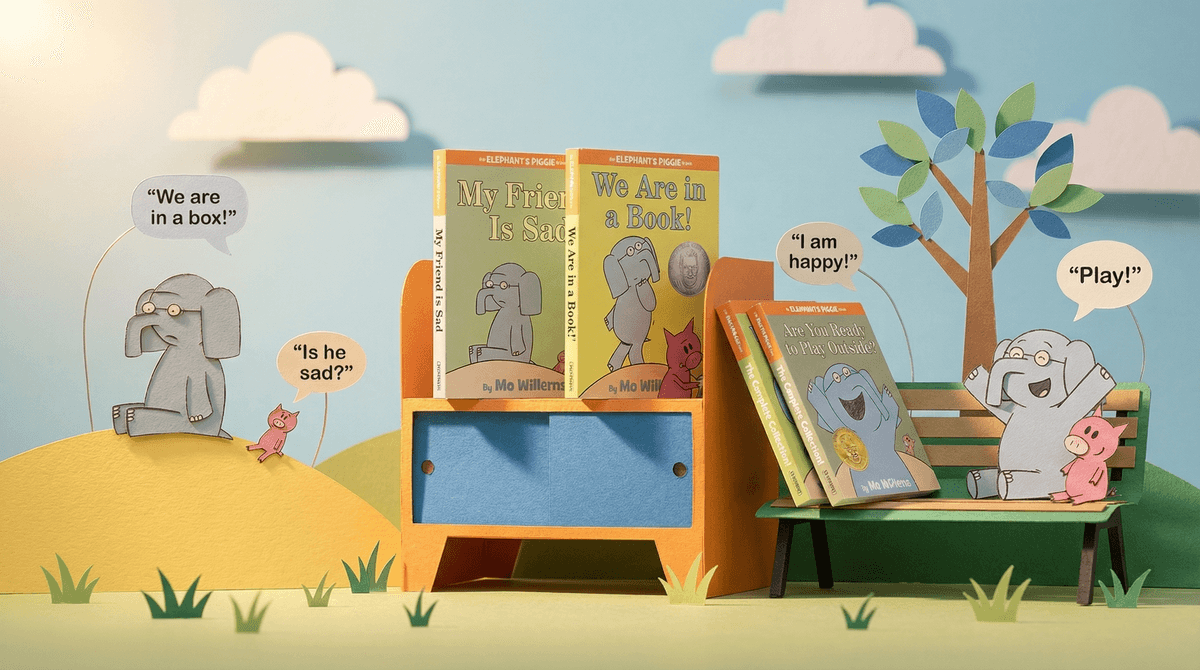
Elephant & Piggie is a series of 25 books by Mo Willems that follows the friendship between Gerald (a cautious, anxious elephant) and Piggie (an optimistic, enthusiastic pig). Published between 2007 and 2016, these books have become the gold standard for early readers—and honestly, they've earned that reputation.
Each book is short (usually 57 pages), uses simple vocabulary, and tells the entire story through dialogue in speech bubbles. Think of them as graphic novels for the kindergarten set, but without any of the visual overwhelm that can make actual graphic novels tricky for beginners.
Here's the thing about most early reader books: they're boring. Like, painfully boring. The vocabulary is appropriately simple, sure, but the stories are often just... nothing. "The cat sat. The cat ran. The cat is fat." Cool, great, my kid can decode those words but they'd rather stare at the ceiling.
Elephant & Piggie books are genuinely funny. Not "cute" or "sweet"—actually funny. The humor works on multiple levels, so kids laugh at the slapstick and silly situations while adults appreciate the more subtle friendship dynamics and emotional intelligence woven throughout.
The books also nail the emotional experience of being a little kid. Gerald worries about everything. Piggie gets overexcited. They misunderstand each other. They work through conflicts. They celebrate small victories. Kids see themselves in these characters in a way that feels real, not didactic.
And let's be honest: when your kid is struggling through early reading, the last thing you want is a book that makes them feel like reading is a chore. These books make reading feel like play.
Beyond being entertaining (which is honestly enough), Elephant & Piggie books are pedagogically brilliant:
The vocabulary is controlled but not dumbed down. Willems uses simple words, but he also introduces emotional vocabulary naturally—words like "worried," "surprised," "excited," and "sorry" appear in context where kids can understand them through the illustrations and story.
The speech bubble format is genius for beginning readers. Kids can see exactly who's talking, there's no confusing "he said/she said" to navigate, and the short bursts of text feel manageable rather than overwhelming. It's like training wheels that don't feel like training wheels.
The repetition is strategic. Many books in the series use repeated phrases or sentence structures, which helps kids build fluency and confidence. We Are in a Book! has Gerald and Piggie repeatedly saying "We are in a book!" as they discover someone is reading them. Kids love the meta-humor AND they get to practice reading the same phrase multiple times without it feeling like drill work.
The illustrations do heavy lifting. Mo Willems' simple but expressive drawings give kids tons of context clues. Even if they can't decode every word, they can follow the story through the pictures and use that understanding to help figure out the text.
Ages 4-5 (Pre-readers/Early emergent readers): Perfect for read-alouds. The dialogue format makes it easy to do character voices, and kids can start recognizing repeated words and phrases.
Ages 5-7 (Beginning readers): This is the sweet spot. Kids who are just starting to decode words independently can actually read these books themselves. Start with simpler titles like Are You Ready to Play Outside? or My Friend Is Sad.
Ages 7-8 (Developing readers): Even kids who've moved past "early reader" level often still love these books. They can read them independently with fluency, which builds confidence, and they appreciate the humor more deeply.
These books are SHORT. Like, you can read one in 5-10 minutes. This is a feature, not a bug. For kids who are intimidated by reading, finishing a whole book feels like a huge accomplishment. You can read one before school, one before bed, or knock out three in a sitting without anyone melting down.
The series explores real friendship dynamics. I Am Invited to a Party! deals with overthinking social situations. I Will Surprise My Friend! explores how good intentions can go wrong. Can I Play Too? tackles inclusion and problem-solving when a friend can't participate in an activity. These aren't after-school special moments—they're woven naturally into funny stories.
They're genuinely re-readable. Unlike some early readers that kids (and parents) can barely stand to get through once, Elephant & Piggie books hold up to multiple readings. Kids notice new details in the illustrations, appreciate jokes they missed the first time, and genuinely want to revisit them.
The whole series is worth getting. If your kid likes one, they'll probably like them all. Libraries always have them, but honestly, building a home collection is worth it. They're slim, they stack nicely, and they become comfort reads that kids return to over and over.
In a landscape where so much of kids' entertainment is screen-based (and look, Screenwise exists because we're not pretending screens don't exist), Elephant & Piggie books offer something genuinely valuable: books that kids actually want to read.
They're not competing with Roblox or YouTube for entertainment value, but they do offer a different kind of engagement—one that builds literacy skills, emotional intelligence, and a genuine love of reading.
If you're trying to establish reading habits early, these books are about as close to a sure thing as you can get. They work for reluctant readers, enthusiastic readers, kids who struggle with decoding, and kids who just want a good story.
Start with There Is a Bird on Your Head! or I Love My New Toy! and see what happens. Worst case scenario, you've read a funny book together. Best case scenario, you've found the series that turns your kid into a reader.