

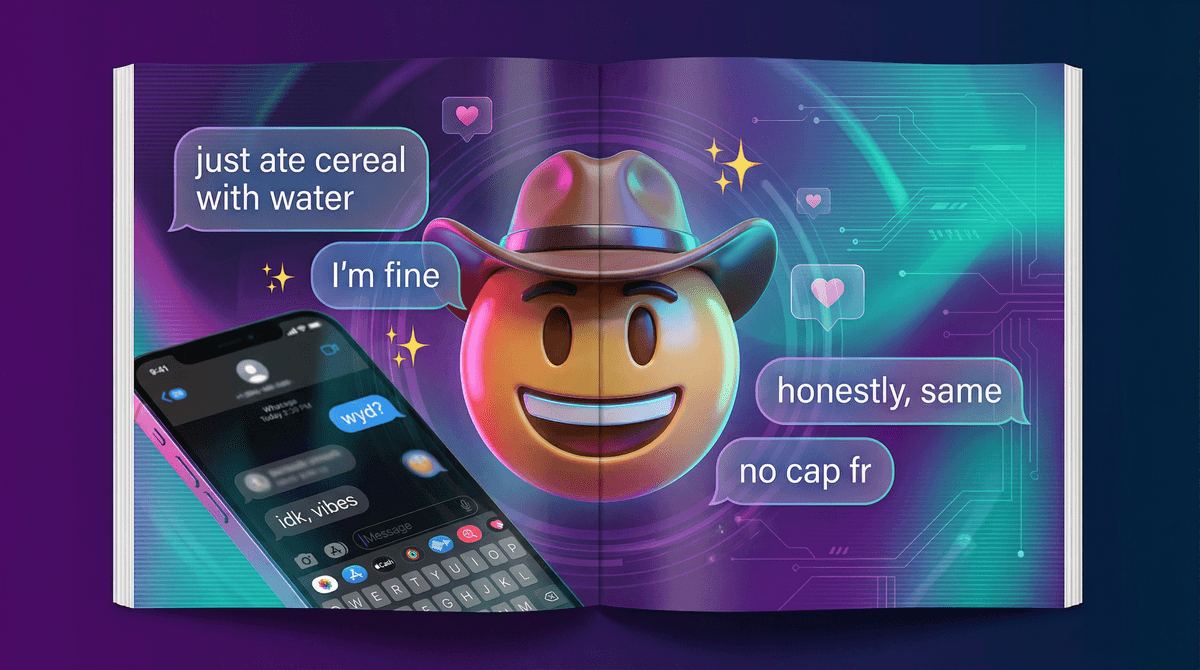
The cowboy emoji 🤠 has become one of Gen Z's most versatile communication tools, and if you're seeing it pop up in your teen's texts, it's probably not about horses or the Wild West. In the hands of Gen Z, this little emoji has evolved into something way more nuanced than its original ranching vibes would suggest.
The 🤠 has become the Swiss Army knife of passive communication—it can mean "this is awkward," "I'm being chaotic," "this is so cringe it's funny," or "I'm saying something unhinged and I know it." It's the digital equivalent of that nervous laugh you do when something is simultaneously funny and uncomfortable.
The cowboy emoji works because it's perfectly imperfect. It's goofy-looking enough to signal self-awareness, but not so obvious that it kills the joke. Gen Z has basically turned it into a tone indicator—a way to say "I'm being ironic" or "this is deliberately weird" without having to spell it out.
Here's where you'll typically see it:
After saying something chaotic or unhinged: "just ate cereal with water 🤠" (acknowledging the chaos)
To soften awkwardness: "accidentally called my teacher 'mom' today 🤠" (self-deprecating humor)
As passive-aggressive punctuation: "sure, I'd love to help you with homework you forgot about until 11pm 🤠" (the emoji does the eye-rolling for them)
With intentionally bad takes: "pineapple on pizza is good actually 🤠" (the emoji says "I know this is controversial")
To indicate 'yeehaw energy': When something is going off the rails but you're just along for the ride
The beauty of the 🤠 is its ambiguity. It's not quite positive, not quite negative—it exists in that gray area where most teenage communication lives.
Here's what makes this emoji particularly Gen Z: it's ironic by default. Your teen isn't identifying with cowboy culture or Western aesthetics. They're using it because it's random and slightly absurd. The disconnect between a cowboy and whatever they're actually talking about is the whole point.
This is part of a broader pattern in Gen Z communication where absurdist humor and randomness signal authenticity. Being too earnest can feel cringe, so they layer everything in irony. The cowboy emoji is a perfect vehicle for this—it lets them say something while simultaneously commenting on the act of saying it.
If your kid is using 🤠 in texts to you, they're probably:
- Trying to soften a request or admission
- Acknowledging something awkward
- Being playfully chaotic
- Testing whether you're fluent in their digital language
The good news: This is actually pretty harmless as far as teen communication goes. Unlike some emoji usage that can mask more concerning behavior, the cowboy emoji is mostly just... silly. It's a way for teens to add personality and tone to text communication, which is genuinely useful.
The context matters: Pay attention to what surrounds the emoji more than the emoji itself. "Can I go to Jake's house? 🤠" probably just means they're trying to be cute about asking. "I'm fine 🤠" after a rough day might actually mean they're not fine but don't want to talk about it yet.
You have a few options when your teen deploys the 🤠:
Play along: Using it back (correctly) can be a fun way to connect. "Sure, you can have friends over... as long as you clean your room first 🤠" works.
Acknowledge it directly: "I see that cowboy emoji—are you being serious or is this a joke?" Sometimes just naming it helps.
Ignore it: Often the emoji is just decoration. Respond to the actual content of their message.
Don't overthink it: This is not secret code for something sinister. It's just how they talk.
The cowboy emoji is part of a larger evolution in how young people use digital communication. Emojis aren't just adding emotion to text anymore—they're creating entirely new layers of meaning. Gen Z (and increasingly Gen Alpha) are building a visual language that's more sophisticated than "😊 = happy."
This matters because text-based communication is where your kids are living. Understanding these nuances—even the silly ones like 🤠—helps you stay connected to how they're actually expressing themselves. You don't need to use every emoji correctly, but knowing that the cowboy isn't just a cowboy helps you read between the lines.
The cowboy emoji is Gen Z's way of adding tone, irony, and personality to digital communication. It's chaotic, it's awkward, it's self-aware—and it's mostly harmless. Think of it as their generation's version of the winky face, but with more layers.
Should you worry about it? No. Should you maybe learn to use it correctly so you can occasionally surprise your teen with your cultural fluency? Absolutely 🤠.
The key takeaway: Digital communication is evolving faster than ever, and your kids are fluent in a visual language that can feel foreign. But underneath the emojis and the irony, they're still just trying to express themselves—and sometimes that expression involves a tiny cartoon cowboy.