

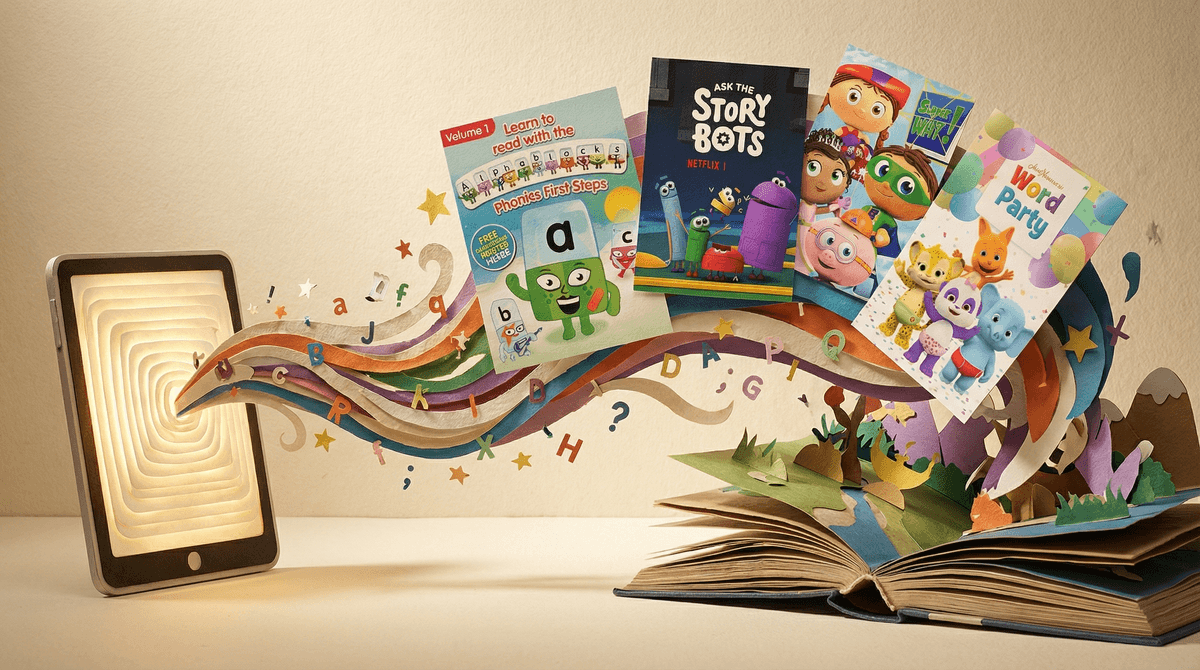
Look, we all know the guilt spiral: your kid's been watching TV for 45 minutes and you're wondering if their brain is turning into mush. But here's the thing—not all screen time is created equal. Some shows are genuinely designed to build reading skills, expand vocabulary, and make kids excited about stories and language.
Literacy-building TV goes beyond just "educational content." We're talking about shows that actively teach phonics, model reading behaviors, introduce rich vocabulary in context, play with language patterns, and make the connection between spoken and written words. The best ones make kids want to pick up books when the episode ends.
And yes, these shows exist for every age—from toddlers learning letter sounds to tweens discovering storytelling techniques they'll use in their own writing.
The research here is solid. Shows like Super Why! and Word Party aren't just slapping letters on screen and calling it educational. They're using explicit phonics instruction, repeated exposure to sight words, and interactive prompts that mirror what reading specialists do in classrooms.
A 2019 study found that kids who watched literacy-focused programming showed measurable improvements in letter recognition, phonological awareness, and early reading skills—especially when parents watched with them and talked about what they saw. That last part matters. The magic isn't just in the show; it's in the conversation afterward.
But let's be real: even the best literacy show isn't going to replace actual reading practice. Think of these as supplements, not substitutes. They're the vegetable puree you sneak into the mac and cheese—helpful, but not the whole meal.
Ages 2-5: Building Blocks
Bluey might not seem like a literacy show at first, but the dialogue is rich. The vocabulary is sophisticated without being condescending, and the storytelling structure is genuinely good. Kids absorb narrative patterns—beginning, middle, end, conflict, resolution—that become the foundation for reading comprehension later.
Super Why! is the OG literacy show. It explicitly teaches letter sounds, blending, and sight words. Yes, it's a bit... enthusiastic. But it works. Kids literally fly into books and change the story by changing letters and words. It's phonics instruction disguised as a superhero adventure.
Sesame Street remains undefeated. The segments with Elmo and Abby playing word games, the letter and number of the day, the celebrity cameos reading stories—it's all designed by actual literacy experts. Plus, it's been doing this for 50+ years, so the research behind it is deep.
Alphablocks (BBC) is pure phonics magic. Each character is a letter, and when they hold hands, they make words. It sounds weird, but kids get obsessed with sounding out words after watching this.
Ages 5-8: Early Readers
StoryBots makes learning fun without dumbing anything down. The vocabulary is surprisingly advanced, and the show models curiosity and asking questions—critical pre-reading skills. The songs are annoyingly catchy (you've been warned).
The Magic School Bus Rides Again combines science with rich vocabulary and complex sentence structures. Kids hear words like "metamorphosis" and "precipitation" used in context repeatedly, which is exactly how vocabulary sticks.
Wild Kratts is similar—tons of domain-specific vocabulary (habitat, predator, adaptation) woven into storytelling. Kids who watch this show can suddenly explain ecosystem dynamics at dinner, which is both impressive and slightly insufferable.
Ages 8-12: Confident Readers
At this age, you're looking for shows that model storytelling, introduce literary concepts, and inspire kids to read more.
Avatar: The Last Airbender is a masterclass in narrative structure, character development, and thematic depth. Kids who watch this often want to read fantasy novels to get that same epic storytelling fix. It's a gateway drug to reading.
Hilda is based on a graphic novel series, and the show is so good that kids inevitably want to read the books. The storytelling is layered, the world-building is rich, and the vocabulary is sophisticated without being pretentious.
The Who Was? Show brings the popular biography book series to life. It's goofy and irreverent, but it makes kids curious about historical figures and often sends them to the library to read more.
Co-viewing is the secret sauce. Watching together and talking about what you see multiplies the learning. Ask questions: "What do you think will happen next?" "Why did that character do that?" "What does that word mean?" You're modeling the internal dialogue good readers have.
Captions are your friend. Turn them on. Kids see the words while hearing them, which reinforces the connection between spoken and written language. This is especially powerful for early readers.
Follow their interests. If your kid is obsessed with dinosaurs, shows like Dino Dana will introduce vocabulary they'll actually care about learning. Motivation matters more than we think.
Don't stress about perfection. Your kid watching Bluey for the third time today isn't ruining their literacy development. Repetition is actually how young kids learn language patterns.
Screen time doesn't have to be a literacy enemy. The right shows can build vocabulary, model storytelling, teach phonics, and make kids excited about language and reading. But—and this is important—they work best as part of a literacy-rich environment that includes actual books, conversations, and reading together.
Think of literacy-building TV as a tool in your parenting toolkit. Not the only tool, but a legitimate one. And honestly? If your kid learns to love stories through Bluey and then asks you to read them a book at bedtime, that's a win.
The goal isn't to eliminate screen time—it's to make it intentional. And shows that help your kid become a reader? That's about as intentional as it gets.
Want to explore more? Check out our guide to educational shows by age or learn how to balance screen time with reading time .
.