

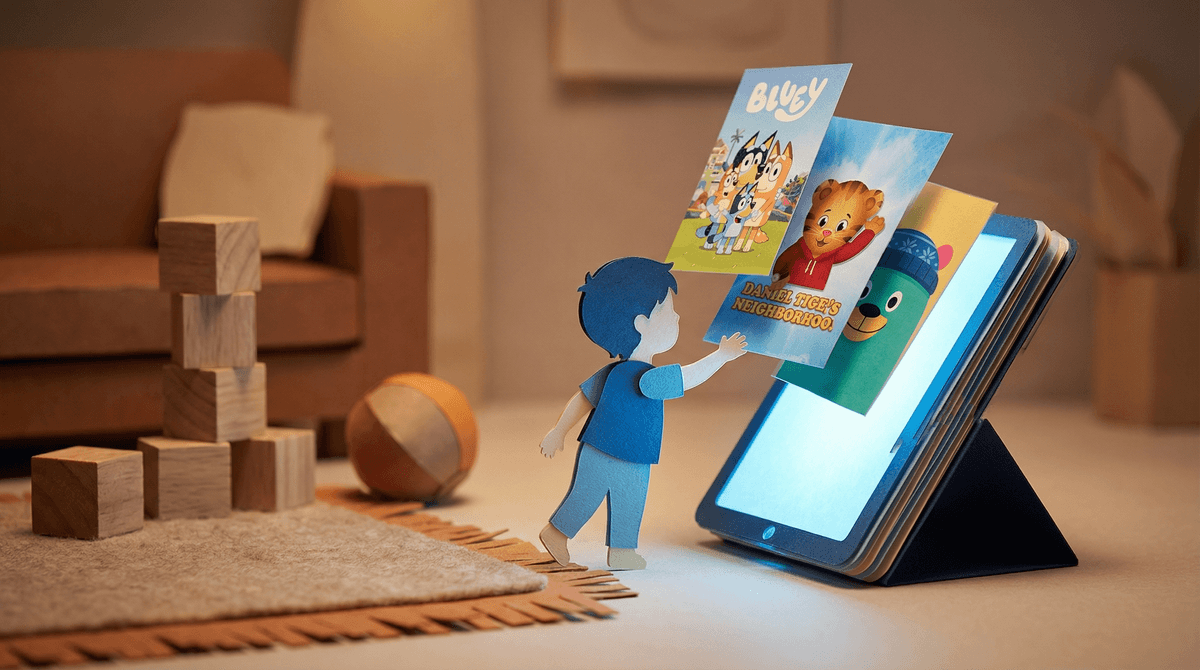
You know the scene: your two-year-old has been peacefully watching Bluey on the iPad for 20 minutes. You give the five-minute warning. Then the two-minute warning. Then you gently take the tablet away and... nuclear meltdown. We're talking full-body-on-the-floor, inconsolable screaming that makes you wonder if the neighbors are going to call someone.
Here's the thing: this isn't about your parenting, and it's not because your kid is "addicted" to screens (though that word gets thrown around way too casually). Toddler tablet tantrums are a specific phenomenon that happens because of how young brains interact with digital content, and understanding the "why" actually makes the "what do I do about it" a lot clearer.
Let's talk brain development for a second. Toddlers (roughly ages 1-4) are still developing their prefrontal cortex—the part of the brain that handles impulse control, emotional regulation, and transitions. It's basically under construction until they're in their mid-twenties, but it's especially rough in the toddler years.
Now add screens into the mix. Digital content is designed to be highly engaging. Bright colors, fast cuts, immediate feedback, constant novelty. For a toddler's developing brain, this creates an intense dopamine response. They're getting a little hit of "feel good" chemicals with every swipe, every new video, every game response.
When you take the screen away, you're not just ending an activity—you're abruptly cutting off that dopamine flow. Their brain is essentially saying "Wait, we were having the BEST TIME, why are you doing this to me?!" But they don't have the language or emotional tools to express that, so it comes out as a Category 5 tantrum.
This is different from, say, ending playtime at the park. Physical play doesn't create the same kind of rapid-fire dopamine hits. There's a natural rhythm to it. Screens don't have that rhythm—they're designed to keep you engaged indefinitely.
Here's where I'm not going to pull punches: the research on screen time for kids under 2 is pretty clear, and it's not great news for those of us who occasionally need 15 minutes to make dinner. The American Academy of Pediatrics recommends avoiding digital media for children under 18-24 months (except video chatting with grandma, which is different).
For ages 2-5, they recommend no more than one hour per day of high-quality programming, co-viewed with a parent when possible.
Now, do most families hit these targets? No. According to recent data, the average toddler gets closer to 2-3 hours of screen time per day. I'm not saying this to make anyone feel guilty—modern parenting is hard, and sometimes Bluey is the only thing standing between you and complete chaos. But it's worth knowing that the intensity of tablet tantrums often correlates with the amount and type of screen exposure.
You might notice that turning off the TV doesn't always create the same level of meltdown as taking away the tablet. There's a reason for that.
Tablets are interactive. Your toddler is swiping, tapping, controlling what happens. This creates a sense of agency and power that passive TV watching doesn't. When you take the tablet away, you're not just ending entertainment—you're taking away their control.
Tablets are personal. They're holding it. It's in their space. Taking it away feels more invasive than just turning off the TV across the room.
Tablets offer infinite choice. TV has commercial breaks, episode endings, natural stopping points. Tablets? There's always one more video, one more game, one more thing to explore. There's no natural endpoint.
Okay, so what do you actually do about this? Here are approaches that work with toddler brain development, not against it:
1. Build in Transition Time
Don't just give warnings—give transition activities. "In five minutes, we're going to put the tablet down and read your favorite book together." "After this episode, we're going to have a snack." Give them something to look forward to, not just an ending.
2. Use Visual Timers
Toddlers don't understand "five more minutes." Get a visual timer (there are apps for this, ironically) or use an egg timer they can see. When the timer goes off, screen time is over. This makes it the timer's "fault," not yours.
3. Create Screen Time Rituals
Screen time should have a beginning, middle, and end. Maybe it's always after lunch, always in the same spot, always with the same wind-down routine. Predictability helps toddlers manage transitions.
4. Co-View When Possible
I know this isn't always realistic, but when you can, watch with them. Talk about what's happening. Make it interactive in a different way. This also makes the transition away from screens easier because you're already engaged with them.
5. Avoid Screens as a Pacifier
This is the hard one. When screens become the go-to solution for every difficult moment—waiting at restaurants, car rides, grocery stores—kids never learn to tolerate boredom or discomfort. Try to save screens for specific times, not as an emergency eject button for your sanity (though sometimes you need that button, and that's okay too).
6. Offer a Replacement Activity Immediately
Don't just take the screen away and leave them to figure out what's next. Have the next thing ready: "Let's go outside!" "Want to help me bake cookies?" "Should we build a tower with your blocks?" The faster you redirect, the less intense the tantrum.
Look, the app store is full of things marketed as "educational" for toddlers. ABC Mouse, Khan Academy Kids, endless alphabet apps. Some of them are genuinely well-designed.
But here's the truth: for toddlers, almost nothing beats real-world interaction. They learn better from playing with actual blocks than virtual ones. They learn letters better from reading physical books with you than from an app. The "educational" label makes us feel better about screen time, but it doesn't change the dopamine hit or the tantrum that comes when it ends.
That said, if you're going to do screen time anyway, quality matters. Daniel Tiger's Neighborhood is genuinely teaching emotional regulation. Bluey models creative play and family dynamics. These are better choices than algorithmically-generated YouTube content designed purely to capture attention.
Speaking of YouTube: YouTube Kids seems like a safe option, but it's actually one of the worst culprits for tablet tantrums. The autoplay feature means there's never a natural endpoint. One video leads to another leads to another, and your toddler's brain is just riding that dopamine wave indefinitely.
If you're using YouTube Kids, turn off autoplay. Choose specific videos or channels ahead of time. Treat it like TV episodes with clear endings, not an infinite scroll. Read more about YouTube Kids safety settings if you need help locking this down.
Toddler tablet tantrums aren't a sign that you're failing as a parent or that your kid has a "screen addiction." They're a predictable response to how young brains interact with highly engaging digital content. The tantrums are real, the struggle is real, and you're not alone in this.
The goal isn't perfection or zero screens (unless that works for your family). The goal is being intentional about when, how, and what your toddler is watching, and having strategies in place for the inevitable meltdowns.
Some families find that going cold turkey on tablets for a week helps reset expectations. Others find that strict time limits and routines work better. There's no one-size-fits-all solution, but understanding the brain science behind the behavior gives you better tools to work with.
-
Audit your current screen time habits. When is your toddler using screens? For how long? What are they watching? Track your family's screen time patterns
 to see what's actually happening vs. what you think is happening.
 -
Choose 2-3 strategies from this guide and try them consistently for a week. Change takes time, especially with toddlers.
-
Find screen-free alternatives that are actually engaging. Check out these toddler activities that compete with screen time
. -
Talk to your co-parent or caregiver about getting on the same page. Consistency across caregivers makes a huge difference.
And remember: you're doing a hard thing in an unprecedented time. No generation of parents has had to navigate this before. Give yourself some grace, stay informed, and keep adjusting as you learn what works for your kid.