

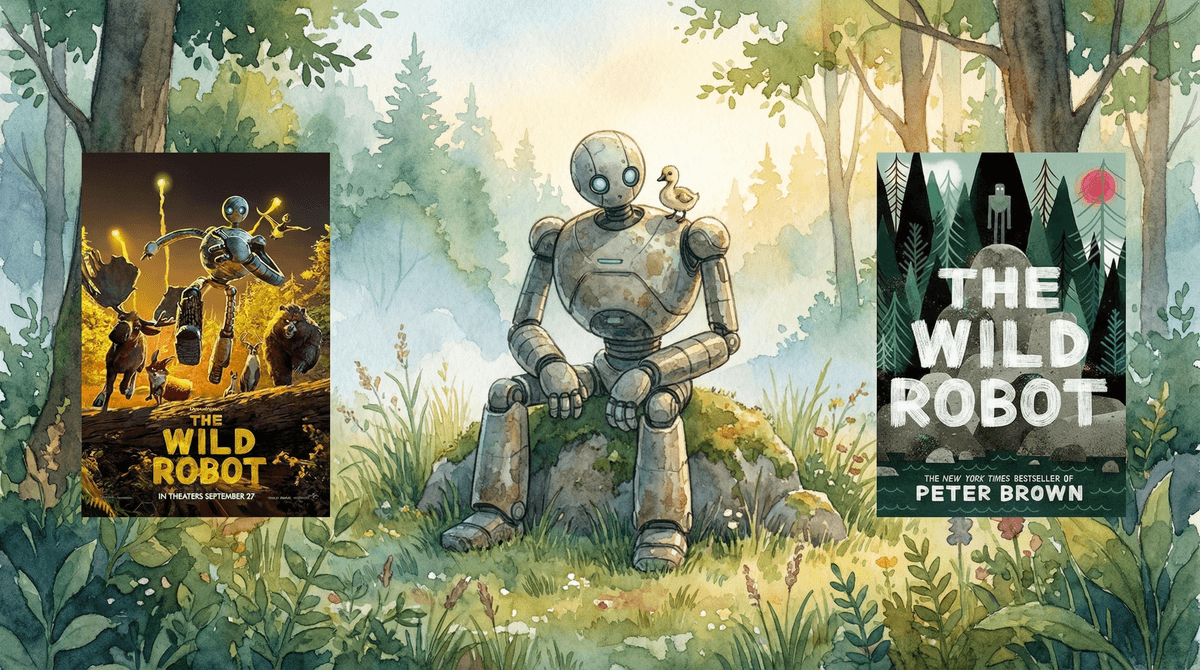
The Wild Robot Age Guide: Is It Right for Your Child?
The Wild Robot is rated PG and is genuinely one of the best family films in years. Most kids 7+ will love it, though sensitive 6-year-olds might need a heads-up about some intense predator-prey scenes. There's no language, no innuendo, and the emotional beats are earned rather than manipulative. If your kid handled the sad parts of Inside Out 2 or the scary moments in How to Train Your Dragon, they'll be fine here.
Quick age breakdown:
- Ages 5-6: Possible, but preview it first or watch together
- Ages 7-9: Sweet spot—emotional but not overwhelming
- Ages 10+: Will appreciate the deeper themes about belonging and identity
- Teens: Surprisingly resonant (don't let them tell you they're "too old")
Based on Peter Brown's beloved 2016 novel The Wild Robot, this DreamWorks film tells the story of Roz, a robot who washes up on a remote island and must learn to survive in the wilderness. After accidentally crushing a goose nest, she becomes the unlikely adoptive mother to a runt gosling named Brightbill. The film explores themes of motherhood, belonging, adaptation, and what it means to be "programmed" versus choosing your own path.
The animation is stunning—like a Miyazaki film met a Studio Ghibli watercolor. Director Chris Sanders (who also made Lilo & Stitch and How to Train Your Dragon) brings the same emotional intelligence and visual beauty to this story.
This isn't a "kids' movie that adults tolerate." It's a legitimately great film that works on multiple levels:
For younger kids (7-9): The relationship between Roz and Brightbill is sweet and funny. There's physical comedy, adorable animal characters, and a clear narrative arc about a little gosling learning to fly and fit in.
For tweens (10-12): The themes of feeling different, not fitting in with your "assigned" group, and finding your chosen family hit hard at this age. Brightbill's struggle with being raised by someone who doesn't look like him or understand his instincts mirrors a lot of what middle schoolers feel.
For teens and adults: The questions about nature versus nurture, predetermined programming versus choice, and what makes a "real" parent are genuinely thought-provoking. Plus, Lupita Nyong'o's voice performance as Roz is phenomenal—she makes a robot feel deeply human without being cloying.
The Intense Stuff
Let's be real about what might be hard for sensitive kids:
Predator-prey dynamics are front and center. This is a story about wilderness survival, which means foxes hunt rabbits, bears are scary, and the natural order involves animals eating other animals. It's not graphic—no blood or gore—but it's matter-of-fact about the food chain. One early scene shows a fox stalking prey that genuinely spooked some younger viewers in my theater.
The opening is sad. Roz accidentally steps on a goose nest, killing the mother and all the eggs except one. It's not drawn out or traumatic, but it happens quickly and sets up the whole story. If your kid is still processing Bambi's mom, give them a heads-up.
There's a climactic battle sequence in the third act that gets intense. Robots fight animals, there's destruction, and genuine stakes. Think The Iron Giant level intensity—not nightmare fuel, but definitely edge-of-your-seat.
The emotional beats are REAL. Multiple parents reported crying (myself included at the screening). The themes of letting your kid go, accepting that you can't protect them forever, and watching them leave the nest—it's all very on the nose for parents. Your kids might cry too, but it's the good kind of cathartic crying, not traumatic crying.
The Good Stuff
Zero bathroom humor. Shocking for a kids' movie in 2024, but true.
No pop culture references or dated jokes. This movie will age beautifully because it's not trying to be "relevant" or "hip."
The female characters are complex and central. Roz is the protagonist, and she's not defined by being nurturing or soft—she's analytical, awkward, and learns maternal instincts rather than having them pre-installed. Fink the fox (voiced by Pedro Pascal) is her sidekick, not the other way around.
The message is nuanced. This isn't a "be yourself" or "follow your dreams" platitude. It's about adaptation, community, sacrifice, and the messy reality of parenting. Roz literally has to override her programming to become a mother, which is a pretty sophisticated metaphor.
Beautiful without being scary. The island setting is lush and gorgeous, and even the "scary" animals are rendered in a stylized way that's intense but not realistic-nightmare-inducing.
Ages 5-6: Proceed with Caution
If you have a sensitive 5 or 6-year-old, I'd recommend previewing this yourself first or reading the book together before seeing the movie. The predator-prey stuff and the separation anxiety themes might be too much for kids who:
- Are still working through separation from parents
- Get very upset by animal-in-peril scenarios
- Are frightened by loud action sequences
That said, if your kindergartener handled Moana or Encanto, they'll probably be fine with a little prep.
Prep talk for younger kids: "This is a movie about a robot who learns to be a mom to a baby goose. Some parts are sad because the baby's real mom died, and some parts are intense because wild animals can be scary. But it has a happy ending and it's about how families come in all different shapes."
Ages 7-9: The Sweet Spot
This is the ideal age range. Kids this age:
- Understand the circle of life well enough to handle predator-prey dynamics
- Are starting to think about identity and belonging
- Can handle emotional complexity without being overwhelmed
- Will love the adventure and humor
Most second through fourth graders will walk out of this movie wanting to talk about it, which is the gold standard for family films.
Ages 10+: Deeper Themes
Older kids and tweens will pick up on the more sophisticated themes:
- What does it mean to be programmed vs. having free will?
- Is motherhood instinct or learned behavior?
- How do you balance protecting someone with letting them take risks?
- What makes a "real" family?
This is also a great age to read the book alongside the movie and compare how the story translates. (Spoiler: The book has a sequel, The Wild Robot Escapes, which is even better and would make a great read-aloud.)
Teens: Don't Skip This
Your 13-year-old might roll their eyes at a "kids' movie," but this one is worth pushing for. The themes about predetermined paths versus chosen identity, the cost of fitting in versus being authentic, and the bittersweet reality of growing up and leaving—these all resonate deeply during adolescence.
Plus, it's a genuinely beautiful film that doesn't talk down to its audience. If they liked Spider-Man: Into the Spider-Verse or The Mitchells vs. The Machines, they'll appreciate the craft here.
If your kids want to talk (and they probably will), here are some good entry points:
- "What did you think about Roz learning to be a mom? Do you think parents know how to do everything, or do they learn as they go?"
- "Brightbill felt different from the other geese. Have you ever felt like you didn't quite fit in? What helped?"
- "Roz had to choose between her programming and what she learned on the island. Do you think we're born a certain way, or do we become who we are based on our experiences?"
- "What do you think makes a 'real' family?"
For older kids, you might also discuss:
- The ethics of AI and robots—what responsibilities do we have to the technology we create?
- Environmental themes—the island is pristine until humans arrive at the end
- The cost of survival versus the value of community
If your kid has read the book, they'll notice some changes:
What's the same:
- The core relationship between Roz and Brightbill
- The wilderness survival challenge
- The themes of adaptation and belonging
- The climactic migration
What's different:
- The movie adds more action and a clearer villain (trying to avoid spoilers)
- Some animal characters are expanded or combined
- The emotional beats are amplified for cinematic effect
- The ending is slightly different but equally satisfying
Both are excellent. If your kid loves the movie, the book offers more quiet, contemplative moments. If they've read the book, the movie adds visual spectacle and emotional punch.
Language: None. Literally zero swearing or crude language.
Scary/Intense Scenes:
- Predator-prey hunting (not graphic)
- Robot vs. animal battle in the climax
- Storms and natural disasters
- Separation anxiety themes
Sad Moments:
- Death of Brightbill's biological mother (brief, not dwelt upon)
- Roz and Brightbill's arguments about belonging
- The migration/letting go sequence (bring tissues)
Positive Messages:
- Family is who you choose
- Adaptation and resilience matter more than perfection
- Community support helps everyone survive
- It's okay to be different
Role Models:
- Roz: Problem-solver, learns from mistakes, sacrifices for her child
- Brightbill: Overcomes self-doubt, finds his place
- Fink: Loyal friend, comic relief with depth
The Wild Robot is that rare family film that doesn't pander, doesn't rely on fart jokes, and trusts its audience to handle complex emotions. It's beautiful, funny, sad, and thought-provoking in equal measure.
Yes for most kids 7+. Sensitive 6-year-olds might need prep or a wait-and-see approach. Tweens and teens will get more out of it than they expect.
Watch it together if you can. This is one where the post-movie conversation is half the value. And honestly? You'll probably get as much out of it as your kids do.
If your family loves it, definitely check out the book series and consider other thoughtful animated films like Wolfwalkers, The Iron Giant, or My Neighbor Totoro.
- Preview it yourself if you have a particularly sensitive kid under 7
- Read the book first if your kid does better with preparation for emotional content
- Plan for a post-movie conversation—this one deserves it
- Have tissues ready—for you, not just the kids
Want to explore more films with similar themes? Check out our guides on movies about found families or animated films that don't talk down to kids.