

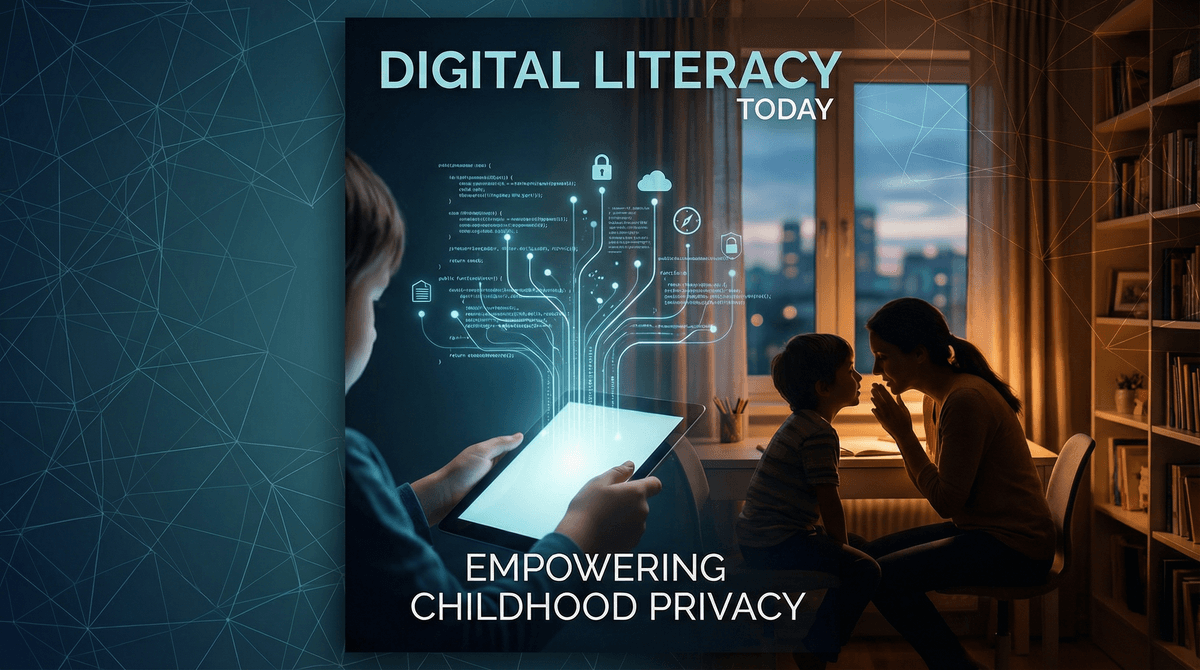
The Age of Disclosure: When to Tell Your Kids How Their Data Is Being Used
TL;DR: Your 5-year-old doesn't need to understand targeted advertising, but your 13-year-old absolutely should. Here's a progressive privacy curriculum that grows with your child—from "apps remember things about you" in kindergarten to "here's how TikTok's algorithm works" in high school.
We teach kids to look both ways before crossing the street. We explain stranger danger. We have "the talk" about bodies and consent. But when do we have the talk about how Instagram is literally designed to keep them scrolling, or how that "free" game is actually a sophisticated psychological operation to extract money from their developing brains?
The answer isn't one conversation. It's a curriculum that evolves as your kid does.
Here's what changed: kids are online younger, and the systems extracting value from them are exponentially more sophisticated than they were five years ago.
A typical 10-year-old today has interacted with dozens of algorithms, been served thousands of targeted ads, and generated enough behavioral data to fill a small library. Most have no idea this is happening. They think YouTube just "knows" they like Minecraft videos, that Roblox is "free," and that Snapchat is just where friends talk.
The cognitive dissonance is wild: we're hyper-vigilant about physical safety (car seats until they're basically in high school), but we hand over devices that are actively profiling our children's personalities, preferences, and vulnerabilities.
Ages 4-7: The Foundation
What they can understand: Apps and websites remember things about you. Some things are okay to share, some aren't.
Key concepts to introduce:
- Digital permanence lite: "Once you send a picture, you can't get it back"
- Basic privacy: "We don't tell strangers our address or phone number—online OR in person"
- The difference between real and ads: Point out when something is trying to sell them something
How to talk about it: When they're watching Bluey on Disney+ and an ad comes on, say: "See how they're trying to get you to want that toy? That's their job. Your job is to decide if you actually want it."
When they play PBS Kids Games, mention: "PBS Kids doesn't show you ads because they're not trying to sell you stuff. That's pretty cool."
What NOT to do: Don't make them paranoid. The goal isn't fear; it's awareness.
Ages 8-11: Pattern Recognition
What they can understand: Companies collect information to predict what you'll like and buy. Algorithms decide what you see. "Free" usually means you're the product.
Key concepts to introduce:
- How algorithms work: "YouTube shows you videos based on what you've watched before. Sometimes that's helpful, sometimes it keeps you in a bubble"
- The attention economy: "Apps are designed to keep you using them as long as possible. That's how they make money"
- Data collection basics: "When you play Fortnite, it tracks what skins you look at, how long you play, who you play with—all to figure out what you might buy"
How to talk about it:
When they're begging for Robux: "Let's talk about how Roblox makes money. The game is free, but they've designed it so you feel like you NEED Robux to have fun. That's intentional. Learn more about how Robux works ."
."
When they're watching MrBeast: "Notice how every video has a crazy thumbnail and title? That's because YouTube rewards videos that get lots of clicks. So creators have to make everything EXTREME to compete."
Activities that help:
- Play Kind Words together and talk about how anonymous online interactions work
- Watch The Social Dilemma (age 10+) and discuss
- Look at their YouTube recommended feed together and reverse-engineer why each video is there
Ages 12-14: The Deep Dive
What they can understand: Surveillance capitalism. Algorithmic manipulation. The difference between correlation and causation. How their data creates a permanent digital profile.
Key concepts to introduce:
- Targeted advertising: "That ad for anxiety medication showed up because the algorithm thinks you're anxious based on your search history"
- Filter bubbles: "TikTok shows you content that confirms what you already believe. This is how radicalization happens"
- Data brokers: "Companies you've never heard of buy and sell information about you. They know your location history, purchase patterns, even your menstrual cycle if you use a period tracking app"
- Behavioral prediction: "The algorithm doesn't just respond to what you like—it tries to shape what you'll like next"
How to talk about it: When they get TikTok (if you allow it): "Let's set this up together and talk about how the For You Page works. It's genuinely impressive AI, but it's designed to be addictive. Notice how you feel after 20 minutes of scrolling."
When they want BeReal: "This app claims to be more 'authentic' than Instagram, but it's still collecting your data and location. Let's look at their privacy policy together." Read more about BeReal's privacy concerns.
When they're applying to colleges: "Everything you post can be found. Colleges look. Employers look. Your digital footprint is part of your permanent record now."
The hard conversations:
- Mental health tracking: "If you're searching for eating disorder content, the algorithm will show you MORE eating disorder content. This isn't a conspiracy—it's just how it works. But it can be really dangerous."
- Predatory design: "Snapchat streaks are designed to create FOMO and keep you checking constantly. That's not friendship—that's manipulation."
- The real cost of free: "You're not buying these apps, so you're not the customer. You're the product being sold to advertisers."
Ages 15-18: Digital Citizenship and Self-Advocacy
What they can understand: Everything. The full picture of surveillance, manipulation, and the trade-offs we make for convenience.
Key concepts to introduce:
- Privacy as a right: "You're entitled to privacy, but you have to actively protect it. Default settings are never in your favor"
- Digital literacy as power: "Understanding how these systems work gives you control. You can use them without being used by them"
- The political dimension: "Data privacy isn't just personal—it's about power, democracy, and who controls information"
How to talk about it: Honestly, by this age, they might be teaching YOU. But here's what you can still do:
- Help them set up a password manager and use two-factor authentication
- Review privacy settings together on all their apps annually
- Discuss news about data breaches, AI regulation, and platform controversies as they happen
- Model good digital citizenship yourself (this is crucial—they're watching)
The college/job conversation: "Your digital presence is now part of your professional identity. Google yourself. Set up alerts. Clean up old accounts. This isn't paranoia—it's basic career hygiene."
Some shows and books that can support these conversations:
- Ages 8+: The Wild Robot by Peter Brown (explores AI and consciousness in an accessible way)
- Ages 10+: Ready Player One (virtual worlds and corporate control)
- Ages 12+: Black Mirror (select episodes—"Nosedive" is perfect for teens)
- Ages 14+: Permanent Record by Edward Snowden (if they're ready for the deep end)
You don't need to be a tech expert to have these conversations. You just need to be curious alongside your kid.
Some phrases that work:
- "I don't fully understand how this works. Let's figure it out together."
- "What do you think this app gets out of being free?"
- "How do you feel after using this for a while?"
- "What would you do if you were designing this app? How would you make money?"
The goal isn't to make them paranoid or to ban everything. The goal is to develop their critical thinking so they can navigate digital spaces with agency.
"But everyone has TikTok!" "I know. And everyone's data is being collected. We can talk about whether that's a trade-off you want to make, but let's be clear about what the trade-off IS."
"You're so paranoid!" "Maybe. But companies spend billions of dollars studying how to influence your behavior. I'm just trying to make sure you know that's happening."
"This is just how things work now!" "Sure. And people used to smoke on airplanes. Just because something is normal doesn't mean we can't think critically about it."
Privacy education isn't a one-time talk—it's an ongoing conversation that evolves as your child develops the cognitive capacity to understand increasingly complex systems.
Start early with simple concepts. Build gradually. By the time they're teenagers, they should understand not just THAT their data is being collected, but HOW, WHY, and WHAT THEY CAN DO ABOUT IT.
The kids who understand these systems will have a massive advantage over the kids who don't. They'll be less vulnerable to manipulation, more thoughtful about their digital presence, and better equipped to navigate an increasingly algorithmic world.
-
This week: Have one conversation about how a specific app your kid uses makes money. Just one. Start with Roblox
or YouTube if you need a starting point. -
This month: Do a privacy settings audit together. Pick one app and actually read the privacy policy (yes, really). Discuss what you find.
-
This year: Make privacy education part of your regular family conversations, like you do with other safety topics. It's not a special occasion—it's just part of growing up in 2026.
Your kids are going to live in a world where their data is currency, algorithms shape their reality, and privacy is something you have to actively fight for. The earlier you start these conversations, the better equipped they'll be.
And hey, you might learn something too. Ask your kid to explain how the TikTok algorithm works. They probably already know.