

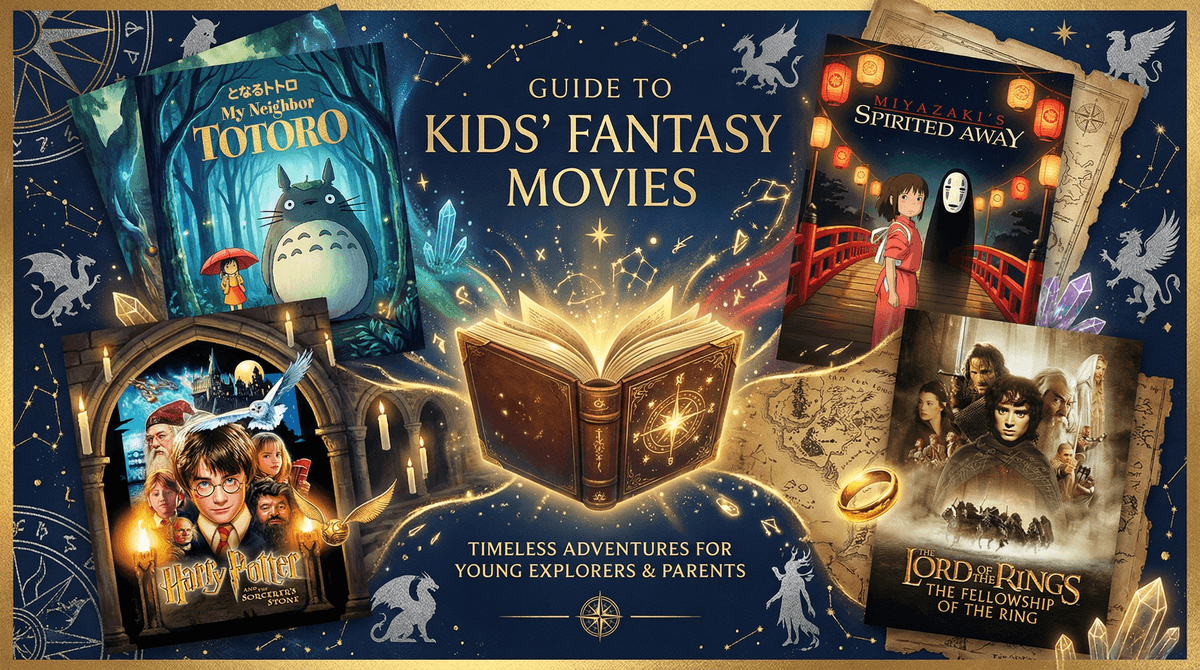
The Ultimate Guide to Magical Kids' Fantasy Movies
TL;DR: Fantasy movies can transport kids to incredible worlds while teaching real lessons about courage, friendship, and standing up for what's right. Here are the best magical adventures organized by age, from gentle fairy tales to epic quests—plus what to watch out for and how to make these movies more than just screen time.
Quick Picks by Age:
- Ages 4-7: The Secret of Kells, My Neighbor Totoro, Ponyo
- Ages 8-10: Harry Potter and the Sorcerer's Stone, The NeverEnding Story, Stardust
- Ages 11+: The Lord of the Rings trilogy, Pan's Labyrinth (older teens), Spirited Away
Fantasy isn't just escapism—it's one of the most powerful ways kids process complex emotions and ideas. When a child watches Matilda use her powers to stand up to injustice, they're learning about agency. When they see Frodo carry the ring despite being terrified, they're learning about courage not being the absence of fear.
The best fantasy movies create a safe distance from real-world problems while still engaging with them. Death, loss, injustice, fear—these are heavy topics, but wrapped in magic and adventure, kids can explore them without feeling overwhelmed.
That said, not all fantasy is created equal. Some movies use magic as window dressing for lazy storytelling. Others go too dark too fast. And plenty are just... boring? Let's break down what actually works.
This is the gold standard for introducing young kids to fantasy. Two sisters move to the countryside and encounter forest spirits, including the iconic Totoro. There's no villain, no peril, just wonder and gentle magic. The movie also deals with their mother's illness in a way that's honest but not traumatic.
What makes it work: The magic feels earned and natural. Kids get that Totoro represents something bigger—comfort, nature, the feeling of being protected—without needing it spelled out.
Watch out for: Some kids find the Catbus genuinely unsettling (it's a bus... but also a cat... with many legs). Preview it if your kid is sensitive to weird-looking creatures.
Stunning Irish animation about a boy in a medieval monastery who helps create the Book of Kells. The art style alone is worth the watch—it looks like an illuminated manuscript come to life.
What makes it work: It's genuinely educational without being preachy. Kids learn about medieval Ireland, the importance of art and storytelling, and get a fantasy adventure with a fairy companion and a scary forest god.
Watch out for: The Vikings are portrayed as genuinely frightening raiders. There's no graphic violence, but the threat is real and might be too intense for very sensitive kids.
A fish-girl wants to become human after befriending a five-year-old boy. It's basically The Little Mermaid if it were wholesome, weird, and featured way more ramen.
What makes it work: The relationship between Ponyo and Sosuke is pure and sweet. The magic is chaotic and beautiful. And unlike most fantasy, the parents are actually present and helpful.
Watch out for: The tsunami sequence can be scary for younger viewers, even though it's portrayed as magical rather than destructive.
You knew this would be here. The first Harry Potter movie is still the best entry point to the series—it's magical, fun, and relatively light before things get darker.
What makes it work: The wish fulfillment is off the charts. You're special, there's a whole magical world, you have best friends, you're good at something. It's catnip for kids who feel overlooked.
Watch out for: The series gets progressively darker. If your kid is sensitive, maybe stop after Chamber of Secrets. By Prisoner of Azkaban, we're dealing with soul-sucking demons and betrayal. Still great, just know what you're getting into.
Also, yes, J.K. Rowling's views on trans issues are problematic. You can acknowledge that while still recognizing the cultural impact of these stories. Here's how to talk about separating art from artist with kids .
.
An '80s classic about a boy reading a book about a boy trying to save a fantasy world from The Nothing. It's meta before meta was cool.
What makes it work: It's genuinely about the power of imagination and stories. The message that fantasy matters, that stories save us—it's beautiful and kids get it.
Watch out for: The horse scene. You know the one. Artax in the Swamp of Sadness. It's devastating. It's supposed to be devastating. But be prepared for tears and questions about depression (which is essentially what The Nothing represents).
A boy crosses a wall into a magical realm to retrieve a fallen star for the girl he loves, only to discover the star is actually a woman. Adventure, pirates, witches, and Robert De Niro as a sky pirate ensue.
What makes it work: It's a fairy tale that gently subverts fairy tale tropes. The girl he thinks he loves turns out to be shallow. The "prize" he's seeking becomes the person he actually falls for. It's surprisingly sophisticated.
Watch out for: Some scary imagery with the witches, and a few innuendos that will go over kids' heads but might make you squirm.
The fantasy epic against which all others are measured. Hobbits, wizards, elves, dwarves, a ring of power, and the fate of Middle-earth.
What makes it work: These movies take their world seriously. The stakes are real. The characters are complex. The themes—corruption, the burden of power, friendship, sacrifice—are timeless. And the filmmaking is simply stunning.
Watch out for: These are LONG (extended editions are even longer—save those for true fans). The battle sequences are intense. Shelob the spider is nightmare fuel. And there's a lot of death, though rarely graphic. This is solidly 11+ territory, maybe 13+ for sensitive kids.
Pro tip: Watch The Fellowship of the Ring first and gauge from there. If the Moria sequence is too much, hold off on the sequels.
A girl's parents are turned into pigs at an abandoned theme park that's actually a bathhouse for spirits. She must work there to save them and find her way home.
What makes it work: It's weird in the best way. The imagery is unforgettable—the radish spirit, No-Face, the stink spirit. And underneath the strangeness is a coming-of-age story about a girl finding her courage and identity.
Watch out for: It's genuinely strange and can be unsettling. The scene where her parents transform is disturbing. No-Face's consumption spiral is creepy. But it's the kind of creepy that fascinates rather than traumatizes most kids.
"Inconceivable!" that this isn't higher on the list, but hear me out—while it's rated PG and often shown to younger kids, the humor really lands best with tweens and teens who can appreciate the wit and meta-storytelling.
What makes it work: It's a perfect fairy tale that knows it's a fairy tale. The frame story of a grandfather reading to his sick grandson gives permission to enjoy something earnest and romantic without feeling cheesy.
Watch out for: The Fire Swamp's Rodents of Unusual Size (R.O.U.S.) can startle younger viewers, and the torture machine sequence, while not graphic, is intense.
Set in 1944 Spain, a young girl escapes into a fantasy world while living with her cruel stepfather, a fascist officer. The fantasy and reality blur in devastating ways.
What makes it work: This is fantasy as coping mechanism. The magical world Ofelia creates is both beautiful and terrifying, mirroring the real-world horrors she's experiencing. It's a masterpiece.
Watch out for: This is HARD R territory. Graphic violence, disturbing imagery, intense themes. This is for mature teens only, and even then, watch it with them and be ready to process it together.
Jim Henson's puppet fantasy about a Gelfling trying to heal a broken crystal and restore balance to his world.
What makes it work: The world-building is incredible. No humans, just fully realized alien creatures and cultures. It trusts kids to follow a complex story without dumbing anything down.
Watch out for: The Skeksis are TERRIFYING. Like, genuinely nightmare-inducing for younger kids. The scene where they drain the Podling's essence is dark. This is often marketed for younger kids because it's puppets, but it's really best for 11+.
A field mouse must move her family before the farmer's plow arrives, leading her to discover her late husband's connection to mysterious, intelligent rats.
What makes it work: It's genuinely sophisticated. The animation is gorgeous. The story doesn't condescend. And it deals with themes of scientific ethics, courage, and single parenthood.
Watch out for: Some genuinely scary moments—the owl, the cat, the sinking house. Ages 8+ who can handle some tension.
From the creators of The Secret of Kells, this is about a mute girl who might be a selkie (a seal-person from Irish mythology) and her brother's journey to help her find her voice.
What makes it work: It's about grief, sibling relationships, and accepting change. The animation is breathtaking. And it introduces kids to Celtic mythology in an accessible way.
Watch out for: Deals with maternal loss in a way that's beautiful but sad. Have tissues ready.
A boy with magical storytelling powers must find his father's armor to defeat his vengeful grandfather and aunts.
What makes it work: The stop-motion animation is jaw-dropping. The story is about memory, family, and the power of stories. And it's one of the few fantasy films that portrays disability (Kubo has one eye) matter-of-factly.
Watch out for: Some scary imagery with the Sisters and the Moon King. Best for 9+.
Ages 4-7: Look for gentle magic, minimal peril, and clear good vs. not-scary-bad dynamics. Studio Ghibli's lighter fare (Kiki's Delivery Service, My Neighbor Totoro) is perfect. Avoid anything with sustained tension or scary creatures.
Ages 8-10: Can handle more complex plots, mild peril, and some scary imagery if balanced with humor and hope. The first few Harry Potter films, The Chronicles of Narnia, and Percy Jackson work well here.
Ages 11-13: Ready for epic stakes, character death (if not graphic), and more complex themes. Lord of the Rings, later Harry Potter films, and The Spiderwick Chronicles fit here.
Ages 14+: Can engage with darker themes, moral ambiguity, and more intense imagery. Pan's Labyrinth (for mature 16+), The Shape of Water, and darker anime like Princess Mononoke.
Scary imagery: Fantasy movies often feature creatures and situations designed to be frightening. The question isn't "is it scary?" but "can my kid handle this kind of scary?" Some kids love the thrill, others will have nightmares.
Death and loss: Many fantasy stories involve character death. The Lion King traumatized a generation with Mufasa's death. Be prepared for questions about mortality.
Intense themes: The best fantasy tackles real issues—abuse, war, prejudice, environmental destruction. Make sure your kid is ready to engage with these metaphorically.
Religious concerns: Some families avoid fantasy due to religious beliefs about magic. That's your call. Just know that most fantasy uses magic as metaphor rather than actual occult practice. Here's more on navigating fantasy and faith.
Read the books first (or after): Many of these movies are based on books. Reading together creates anticipation and gives you built-in conversation starters about what was different.
Talk about the themes: "Why do you think Frodo was chosen to carry the ring instead of someone more powerful?" "What would you do if you found out you were magical?" These movies are packed with discussion fodder.
Create together: Fantasy movies inspire creativity. Draw the creatures, write your own stories, build the worlds in Minecraft or with LEGOs.
Explore the mythology: Use these movies as gateways to actual mythology and folklore. Percy Jackson leads to Greek myths. Song of the Sea opens the door to Celtic folklore.
Watch the making-of content: Especially for movies like Lord of the Rings or Kubo, the behind-the-scenes footage showing how it was made can be as magical as the film itself.
Fantasy movies can be some of the most meaningful screen time your kids experience. They're not just entertainment—they're how we've told important stories since humans first sat around fires. The magic is just the delivery system for lessons about courage, kindness, sacrifice, and hope.
Don't get hung up on finding the "perfect" movie. Pay attention to your specific kid—what excites them, what scares them, what they're ready for. And remember that a movie that's too intense becomes a teaching moment about knowing your limits, while a movie that's too babyish becomes a conversation about how taste changes.
The goal isn't to shield kids from everything scary or sad. It's to give them frameworks for processing big emotions and ideas in safe, magical contexts. And honestly? Some of these movies might hit you harder than they hit your kids. That's okay too.
Start a fantasy movie list with your kids: Let them have input on what to watch next. Check out our guide to family movie nights for tips on making it an event.
Balance fantasy with other genres: Fantasy is great, but mix in documentaries, comedies, and movies that reflect diverse experiences.
Use Screenwise to check ratings and reviews: Before committing to a 3-hour Lord of the Rings marathon, see what other parents say about age-appropriateness.
Trust your instincts: If something feels off for your kid, it probably is. You can always come back to it in a year or two. The magic will still be there.