

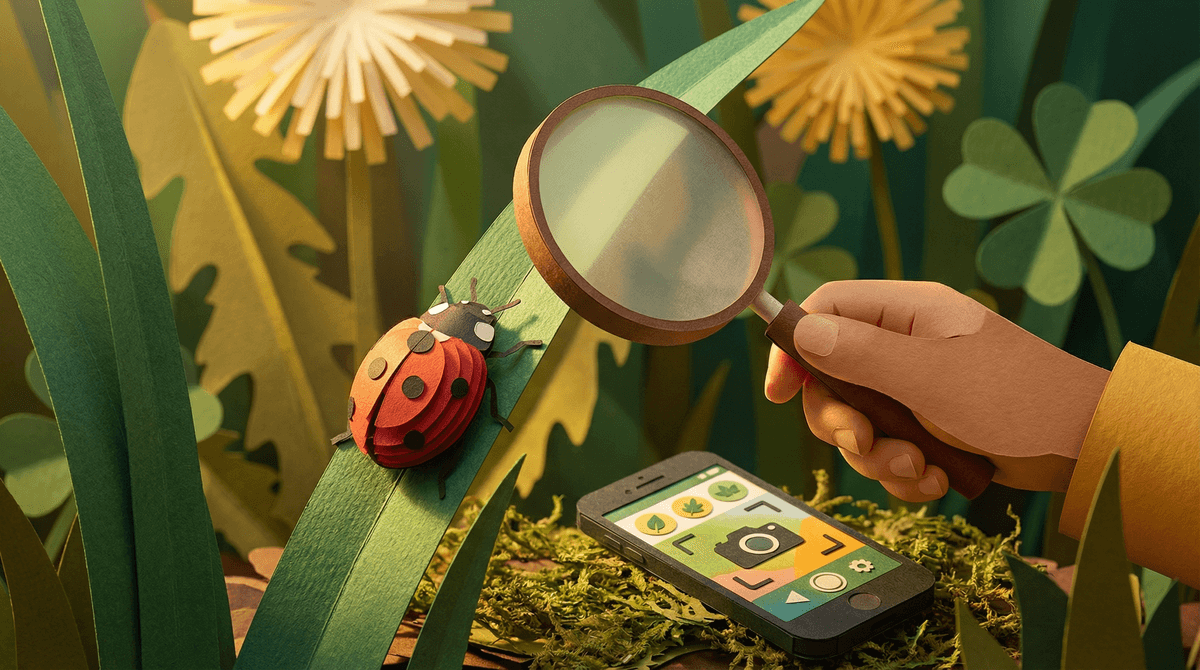
Look, I get it. When you hear "get your kids outside," you might be picturing another exhausting trip to the playground where they complain they're bored after five minutes. But here's something different: micro-exploration — the art of getting down on your knees (literally) and examining the ridiculously tiny world that exists in your backyard, on your sidewalk, or in that neglected corner of the park.
We're talking microscopes, magnifying glasses, bug-catching kits, and the simple act of looking really closely at stuff. And honestly? It might be one of the best antidotes to screen addiction we've got.
This isn't about turning your kid into the next David Attenborough (though wouldn't that be cool). It's about giving them something that modern digital life rarely provides: the experience of sustained attention on something real, unpredictable, and genuinely fascinating.
Here's what happens when kids spend time examining tiny things up close:
They develop patience. You can't rush an ant. You can't skip ahead to see what the caterpillar does next. Unlike YouTube or Roblox where everything is instant and algorithmic, nature operates on its own timeline. Kids learn to wait, observe, and pay attention — skills that are genuinely eroding in the dopamine-hit culture of modern apps.
They practice scientific thinking without realizing it. When a kid notices that pill bugs curl up when touched, they're forming hypotheses. When they wonder why some leaves have fuzzy undersides and others don't, they're asking research questions. This is the foundation of critical thinking, and it happens organically when you're just... looking at stuff.
They experience genuine wonder. Not the manufactured "wow" of a video game achievement or a TikTok trend, but actual holy crap that's amazing wonder. The first time a kid sees a water bear (tardigrade) under a microscope, or watches a spider spin a web in real-time, or discovers that butterfly wings are actually made of tiny scales — that hits different than any screen content ever will.
It's a gateway to longer attention spans. Kids who can spend 20 minutes watching ants carry food back to their colony are building the neural pathways for sustained focus. This translates to everything else: reading, homework, conversations, creative projects.
The beauty of micro-exploration is that it doesn't require a ton of expensive gear or a PhD in biology:
For ages 3-6: Start with a simple magnifying glass (the big-handled kind that won't break immediately). That's it. You can find pill bugs under rocks, examine flower petals, look at tree bark up close. At this age, it's about building the habit of looking closely, not about scientific accuracy.
For ages 7-10: Add a basic bug-catching kit (the kind with the magnifying container) and maybe a beginner microscope. The AmScope 120X-1200X is solid for around $30-40 and actually works, unlike those toy microscopes that just frustrate everyone. You can examine pond water, leaves, your own hair, fabric, basically anything.
For ages 11+: If they're genuinely interested, consider a better microscope (the $100-150 range gets you something decent) and prepared slide sets. At this age, they can start understanding cellular structures, identifying species, and doing more methodical observation.
But honestly? A $5 magnifying glass and a jar with holes punched in the lid will get you 80% of the way there.
Here's the thing: you can't just hand a kid a magnifying glass and say "go explore." Well, you can, but it probably won't stick. Here's what actually works:
Start with a specific mission. Not "go look at nature" but "let's see how many different types of bugs we can find in the next 20 minutes" or "let's examine every leaf on this tree and see if they're all the same."
Go small and close to home. Your backyard or the sidewalk outside your building has more life than you think. You don't need to drive to a nature preserve. Some of the coolest stuff is growing in the cracks of your driveway.
Make it social. Invite another family to do a "bug hunt" together. Kids are way more interested when there's someone to share discoveries with. Plus, it gives you another adult to talk to while the kids are occupied (win-win).
Document it. Let them take photos with your phone (yes, screens can be tools, not just entertainment). Create a nature journal. Make a collection of interesting finds. The act of documenting makes the experience feel more significant and gives them something to revisit.
Connect it to their existing interests. Into Pokémon? Talk about how real bugs have different types and abilities too. Love Minecraft? Discuss how bees actually pollinate flowers in real life. Into art? Examine the patterns and colors in nature up close.
Here's why this matters in the context of digital wellness: micro-exploration provides what screens promise but rarely deliver — genuine engagement and discovery.
Apps and games are designed to feel like exploration and discovery, but they're actually highly controlled experiences. The algorithm knows where you're going before you do . The game has predetermined outcomes. The video has a script.
Nature? Nature doesn't give a damn about your engagement metrics. That spider might weave an incredible web, or it might just sit there. The caterpillar might transform into a butterfly, or a bird might eat it first. This unpredictability is a feature, not a bug (pun intended).
When kids experience genuine unpredictability and have to exercise patience and observation to see results, they're building resilience against the instant-gratification patterns that make screen addiction so powerful.
Ages 3-5: Keep it simple and sensory. "What does this feel like? What color is it? Is it moving?" Don't worry about scientific names or accuracy. Just build curiosity and the habit of looking closely.
Ages 6-8: Start introducing basic concepts like life cycles, habitats, and the idea that different creatures have different jobs in nature. They can handle simple microscopes and more structured observation activities.
Ages 9-12: This is the sweet spot for deeper scientific thinking. They can understand ecosystems, food chains, cellular structures, and can conduct more systematic observations. Let them lead investigations based on their questions.
Ages 13+: If they're still interested (and many are, especially if you've built this habit early), support more advanced work. They can use apps like iNaturalist to identify species, understand taxonomy, and contribute to citizen science projects. Yes, this involves screens, but it's screens as tools for real-world engagement, not passive consumption.
You don't need to know everything. In fact, it's better if you don't. "I don't know, let's find out together" is a powerful phrase. Model curiosity, not expertise.
Some kids will love this immediately, others won't. And that's okay. Try different approaches — some kids are more into plants than bugs, some love pond water microscopy but hate catching insects. Find their entry point.
It's okay to use screens as a supplement. Look up what you found together. Watch a YouTube video about the bug you discovered. Use apps to identify plants. The key is that screens support the real-world experience, not replace it.
Weather and seasons matter. Spring and summer are obviously easier, but winter has its own micro-world — ice crystals, animal tracks, evergreen needles, bark patterns. Don't let cold weather be an excuse.
Safety basics: Teach kids not to touch their faces after handling bugs or plants (until they wash hands), be aware of poison ivy/oak, don't disturb bee or wasp nests, and always return creatures to where you found them after observation.
In a world where kids are increasingly living in algorithmically-curated bubbles, getting down on the ground with a magnifying glass is almost radical. It's slow, it's unpredictable, it requires patience, and it offers genuine discovery.
You're not trying to turn your kid into a scientist (though you might). You're giving them practice at sustained attention, wonder, and engagement with something real. Those are skills that will serve them whether they grow up to study biology or become a graphic designer or run a coffee shop.
Plus, honestly? It's pretty cool to see a kid genuinely excited about finding a beetle instead of begging for more iPad time.
This week: Get a magnifying glass (or use the magnifying feature on your phone camera in a pinch) and spend 15 minutes examining something small in your yard or local park. That's it. Just one small thing, up close, together.
This month: If the interest is there, invest in a basic microscope or bug-catching kit. Set aside one afternoon a week for "micro-exploration time."
This year: Build it into your family rhythm. Not as another scheduled activity, but as a default option when someone says "I'm bored." Because the tiny world is always there, always changing, and always worth looking at.
And if you're looking for more ways to balance screen time with real-world engagement, explore our guides on outdoor activities and hands-on learning.