

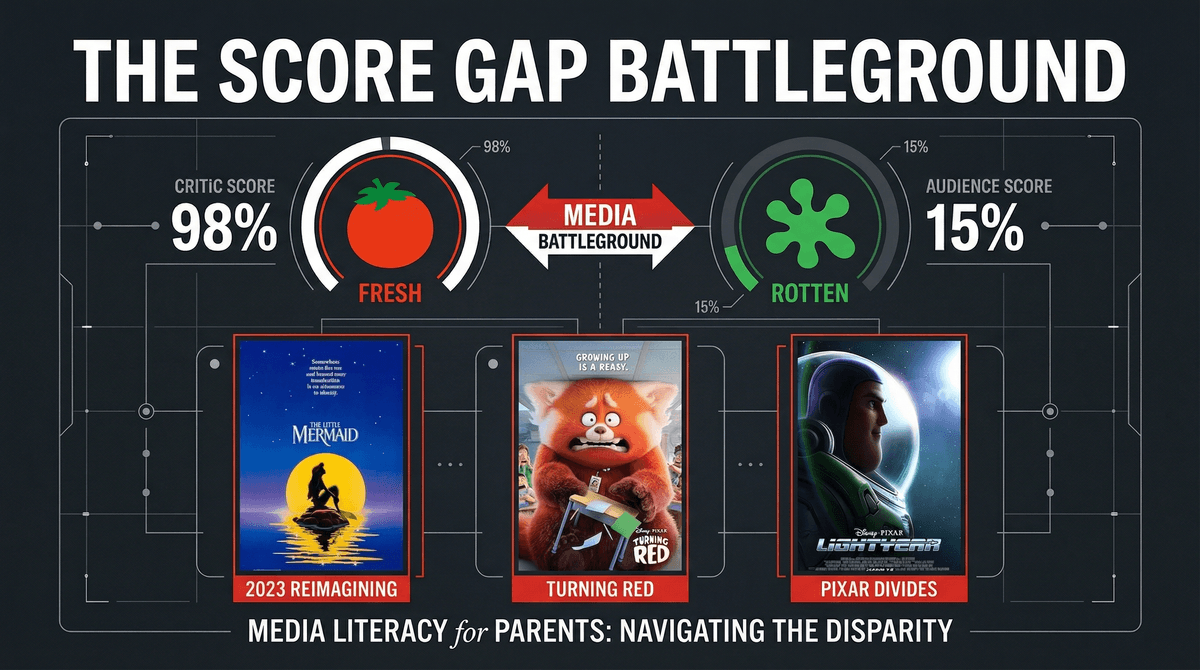
When Movie Scores Become Battlegrounds: The Viral Rotten Tomatoes Controversies Parents Should Know About
Rotten Tomatoes scores have become less about "is this movie good?" and more about culture war proxy battles. When you see a massive gap between critic and audience scores, or coordinated review-bombing, that's your signal to ignore the number and actually investigate what's in the film. Here's what you need to know about the most viral score controversies—and how to figure out if a movie is actually right for your family.
Recent viral controversies worth understanding:
- The Little Mermaid (2023) - bombed before anyone saw it
- Velma - became the most review-bombed show ever
- The Last of Us - critics loved it, certain audiences hated episode 3
- Lightyear - tanked over a 2-second same-sex kiss
- Turning Red - called "inappropriate" for mentioning periods
Rotten Tomatoes used to be pretty straightforward: critics watch movie, critics rate movie, you get a percentage. But somewhere around 2016, the scores became weaponized. Now, before a movie even releases, organized groups will flood the audience score section with 1-star reviews based on a trailer, a casting choice, or a single scene someone posted on Twitter.
The pattern is predictable: A movie or show features a diverse cast, LGBTQ+ characters, or challenges traditional narratives → outrage merchants on YouTube make 47 videos about "woke Hollywood" → their audiences coordinate review-bombing → the score plummets → mainstream media writes articles about the "controversy" → more people pile on → the actual quality of the content becomes completely irrelevant.
The result? Parents trying to make informed decisions end up staring at a 23% audience score and a 95% critic score, wondering what the hell is going on.
Before the movie even premiered, it had thousands of negative audience reviews. The "controversy"? Halle Bailey, a Black actress, was cast as Ariel. That's it. That's the whole thing.
The actual movie: A pretty faithful Disney remake with gorgeous visuals and Bailey's genuinely stunning voice. Is it groundbreaking cinema? No. Is it a perfectly fine family movie that kids enjoy? Absolutely. The low audience score tells you nothing about the film's quality and everything about coordinated racism.
For parents: If your kid likes Disney princess movies, this delivers exactly what you'd expect. The score drama is completely disconnected from whether your 7-year-old will have a good time.
This one's complicated because the show actually is bad—but not for the reasons it got review-bombed. Velma reimagined the Scooby-Doo character as a South Asian teenager in an adult animated series. Before it dropped, it was already getting destroyed for "race-swapping" and making Velma explicitly gay.
The actual show: Genuinely unfunny, weirdly mean-spirited, and poorly written. But the coordinated 1-star reviews came from people who never watched it and just hated the concept of diverse casting.
For parents: This is rated TV-14 for a reason—it's got sexual content and language that make it completely inappropriate for kids anyway. The controversy is a distraction from the real issue: it's just not good television, period.
The Last of Us - Episode 3
The HBO series was universally praised until episode 3, which focused on a love story between two men. Suddenly, the audience scores for that specific episode tanked, with thousands of reviews calling it "unnecessary" and "forced."
The actual episode: One of the most beautiful, heartbreaking hours of television in years. It won awards. Professional critics called it a masterpiece. But because it centered gay characters, it got targeted.
For parents: The Last of Us is rated TV-MA for intense violence, gore, and mature themes. It's absolutely not for kids. But if you're deciding whether you want to watch it, that episode 3 score tells you nothing except that some viewers are uncomfortable with LGBTQ+ representation.
Pixar's Buzz Lightyear origin story included a brief scene where a female character kisses her wife. The scene lasts about 2 seconds. It sparked international bans, review-bombing, and countless think pieces.
The actual movie: A solid but not spectacular Pixar film that most kids found confusing because it's not actually about the Toy Story character—it's about the "real" astronaut that inspired the toy. The kiss scene is so brief most kids don't even register it.
For parents: The score controversy has nothing to do with whether your kid will enjoy this movie (though honestly, Toy Story itself is still better). If you're worried about the same-sex kiss, ask yourself: would you have the same concern if it were a heterosexual couple? If not, that's worth examining.
Pixar's film about a 13-year-old Chinese-Canadian girl who turns into a red panda when she gets emotional got absolutely destroyed by certain parent groups. The "controversy"? The movie references menstruation and a teenage girl having a crush on boys.
The actual movie: A genuinely delightful coming-of-age story about generational trauma, immigrant family dynamics, and puberty. It's funny, heartfelt, and incredibly well-made. The period reference is barely there—the girl's mom assumes she got her period, and the girl is embarrassed. That's it.
For parents: If you have a tween daughter, this movie is basically required viewing. It handles the awkwardness of early adolescence with humor and heart. The low audience scores came from adults who apparently think kids shouldn't know that periods exist.
When you see a score controversy brewing, here's your action plan:
1. Check the critic vs. audience score gap
- Small gap (within 20 points): Probably reflects genuine quality differences
- Massive gap (50+ points): Almost certainly review-bombing or coordinated campaigns
- Critics high, audience low: Often indicates diversity/representation backlash
- Critics low, audience high: Sometimes indicates fun-but-dumb entertainment that critics dismiss
2. Read the actual negative reviews Look for patterns. If the 1-star reviews all mention "woke," "agenda," "forced diversity," or "ruined my childhood," you're looking at coordinated backlash, not legitimate criticism. If they mention pacing issues, weak plot, or bad dialogue, that's actual feedback.
3. Check Common Sense Media They provide age-appropriate breakdowns of content—violence, language, sexual content, positive messages. This is infinitely more useful than a Rotten Tomatoes score for making family viewing decisions.
4. Watch the trailer yourself You can usually tell in 2 minutes if something matches your family's values and your kid's interests. A score can't tell you if your particular 8-year-old will love or hate something.
5. Ask other parents you trust Not random internet parents—actual parents you know whose judgment you respect and whose kids are similar to yours. Check out parent reviews on Screenwise for perspectives from intentional parents navigating the same decisions.
6. Consider the source of the controversy Is the backlash about actual content issues (violence, scary themes, inappropriate language) or about representation (diverse casting, LGBTQ+ characters, feminist themes)? One is about age-appropriateness, the other is about values—and only you can decide what matters for your family.
The Rotten Tomatoes score controversies reveal something bigger than just movie ratings: we're in an era where every piece of media becomes a referendum on culture war issues. And kids are watching us navigate this.
When you dismiss a movie solely because of a low audience score driven by review-bombing, you're potentially:
- Missing out on quality content your family would enjoy
- Inadvertently teaching kids that diverse representation is "controversial"
- Letting internet outrage merchants make decisions for your family
On the flip side:
- Sometimes the controversy points to genuinely age-inappropriate content that got marketed to the wrong audience
- Not every diverse or progressive film is automatically good—some are poorly made regardless of representation
- Your family's values matter, and you get to make choices based on what you want your kids exposed to
The key is making informed choices rather than reactive ones based on weaponized scores.
For kids under 10: They don't need to know about review-bombing or culture wars. Just preview content yourself and make decisions based on what you know about your kid.
For tweens (10-13): If they're asking why a movie has bad reviews, you can explain: "Sometimes people give bad reviews because they're upset about who's in the movie, not because the movie is actually bad. We're going to watch it ourselves and decide what we think."
For teens (13+): This is actually a great media literacy teaching moment. Show them the score gaps, read some reviews together, talk about coordinated campaigns and how online outrage works. Ask questions like:
- "What do you notice about these negative reviews?"
- "Do they mention the actual movie or just who's in it?"
- "How do you think we should decide if something is worth watching?"
This teaches critical thinking about online information—a skill they desperately need.
Rotten Tomatoes scores used to be a helpful shortcut. Now they're often a minefield of culture war proxy battles that have nothing to do with whether a movie is good or appropriate for your family.
Your new approach:
- Treat massive critic/audience score gaps as a red flag to investigate, not as truth
- Read actual reviews for content specifics, not just numbers
- Use resources like Common Sense Media and Screenwise for age-appropriate guidance
- Watch trailers and trust your own judgment about your own kids
- Teach older kids to think critically about online review campaigns
The goal isn't to ignore all criticism or blindly consume everything. It's to make intentional choices based on actual information about content, not on coordinated internet outrage.
And sometimes? The movies with the most controversial scores end up being exactly what your family needs to watch together—not despite the representation that sparked backlash, but because of it.
Want to dig deeper?

The internet will keep trying to make every movie a battleground. You don't have to fight those battles—you just have to make informed choices for your actual family, not the hypothetical one the algorithm thinks you should be.