

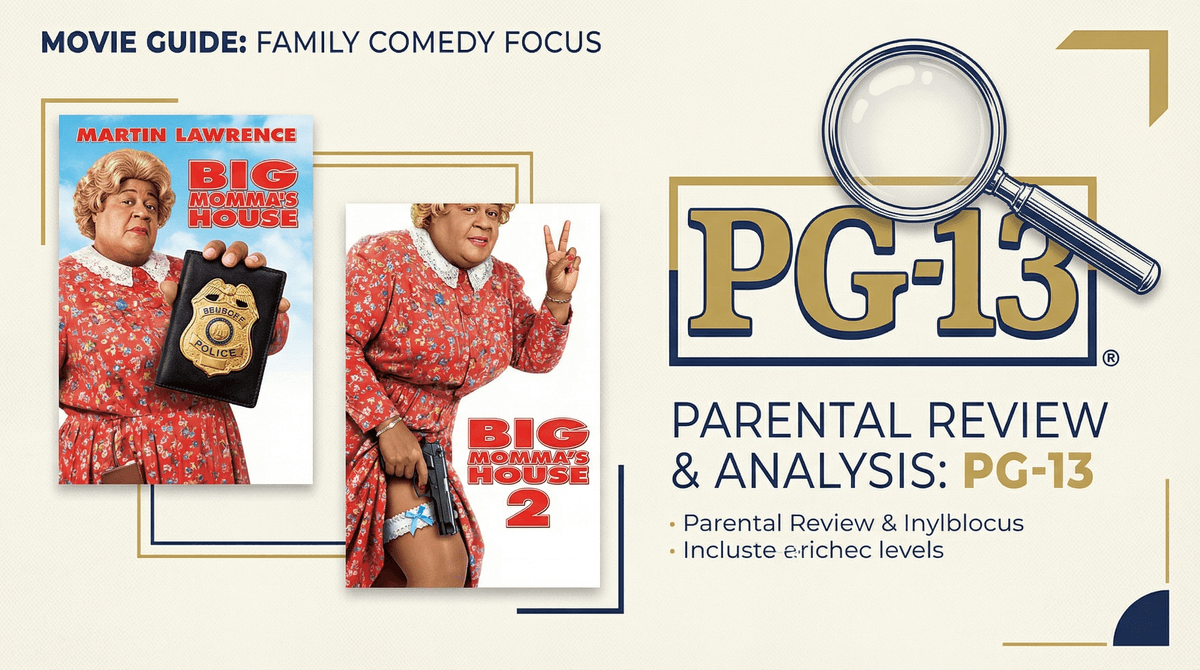
Big Momma's House: What That PG-13 Rating Really Means for Your Family
Big Momma's House is a 2000 comedy where Martin Lawrence goes undercover as an elderly Southern woman. The PG-13 rating is doing some heavy lifting here—this movie has sexual innuendo throughout, crude humor about bodies and bodily functions, gun violence, and some genuinely uncomfortable moments involving deception and voyeurism. Appropriate for ages 13+, maybe 11-12 if you're watching together and ready to have conversations about consent and respect.
If you're looking for family comedies that actually work for younger kids, you'll want to skip this one.
The PG-13 rating for Big Momma's House is technically accurate, but it's riding that line hard. Here's what you're actually dealing with:
Sexual Content & Innuendo: This is the big one. The entire premise involves Malcolm (Martin Lawrence) disguising himself as Big Momma to protect a woman and her son, which leads to countless scenes of:
- Extended bathroom humor and jokes about Big Momma's body
- Malcolm seeing Sherry (the woman he's protecting) in various states of undress
- Sexual situations played for laughs, including a scene where Malcolm-as-Big-Momma has to share a bed with an older man who's attracted to Big Momma
- Lots of double entendres and suggestive dialogue
- A childbirth scene that's played for gross-out comedy
Violence: Malcolm is an FBI agent, so there's:
- Gun violence and shoot-outs (not graphic, but present)
- Physical comedy that involves people getting hurt
- Threatening situations that could be scary for younger viewers
Language: Surprisingly mild for a PG-13—some "hell," "damn," and "ass," but no F-bombs. Still, the crude humor more than makes up for the restrained profanity.
Problematic Elements: Beyond the rating system, there are some things worth considering:
- The entire movie involves extensive deception and lying
- Voyeuristic elements where Malcolm sees Sherry without her knowledge
- Fat suit humor and jokes about elderly people's bodies
- Gender stereotypes and some dated attitudes about masculinity
Big Momma's House was a massive hit in 2000, spawning two sequels. Martin Lawrence's physical comedy is legitimately impressive—the man commits fully to the bit. For kids who discover it now, it's usually because:
- It's on streaming and the thumbnail looks funny
- Martin Lawrence is recognizable from other content
- The premise sounds hilarious to middle schoolers (and honestly, it kind of is)
- Their friends have seen it and quote the lines
The movie has moments of genuine heart, particularly around the relationship between Big Momma and Sherry's son Trent. When it's not being crude, it actually has something to say about family, protection, and doing the right thing.
Ages 8 and under: Hard no. The sexual content and innuendo will either go over their heads (in which case, why bother?) or make you deeply uncomfortable explaining things you're not ready to explain.
Ages 9-12: Still probably not, unless you're watching together and ready for a lot of conversations. The humor is designed to make this age group giggle at inappropriate things, which might be exactly what you're trying to avoid. That said, if you have a mature 11-12 year old and you're doing a family movie night where you can pause and discuss, it's not going to traumatize anyone. Just know what you're getting into.
Ages 13+: This is the target zone for PG-13, and it makes sense here. Teenagers can understand the comedy without necessarily adopting the problematic elements. They're also old enough to discuss why some of the voyeuristic stuff is actually not okay, even in a comedy.
What about the sequels? Big Momma's House 2 (2006) and Big Momma's House: Like Father, Like Son (2011) follow similar patterns—PG-13 ratings with heavy sexual innuendo, crude humor, and physical comedy. They're not significantly better or worse from a content perspective, just diminishing returns on the same joke.
Here's the thing that's worth discussing with your teen if they do watch this: comedy evolves, and what was acceptable (or at least mainstream) in 2000 doesn't always hold up.
The fat suit humor, the jokes about bodies, the way the movie treats the idea of a man dressing as a woman—these elements feel dated now because our understanding of respect, consent, and identity has (thankfully) evolved. That doesn't mean the movie is evil or that Martin Lawrence is a bad person. It means we can enjoy physical comedy and silly premises while also recognizing that some jokes don't need to be made anymore.
If your 13-year-old wants to watch this, it's actually a decent opportunity to talk about:
- Consent: Malcolm sees Sherry in private moments without her knowledge. Even though he's protecting her, that's still a violation. How would that feel?
- Deception in relationships: The movie plays lying for laughs, but what would happen in real life?
- Body humor: Why do we laugh at certain bodies? Is that fair? Is it kind?
You don't need to turn movie night into a lecture series, but a few well-placed questions during or after can help your kid develop critical thinking about media.
If the Big Momma's House premise appeals to you (physical comedy, disguises, silly situations) but you want something more appropriate for younger viewers:
- Mrs. Doubtfire (PG-13): Similar premise, Robin Williams in a fat suit, but significantly less crude. Still has some dated elements, but much more family-friendly overall.
- The Parent Trap (1998 version, PG): Deception and disguises without the sexual content
- Night at the Museum (PG): Physical comedy and silly situations, genuinely fun for the whole family
- Spy Kids (PG): Action comedy with gadgets and disguises, actually appropriate for kids
For more options, check out family-friendly comedies that actually make everyone laugh.
Big Momma's House is a PG-13 movie that earns its rating through sexual innuendo, crude humor, and some violence. It's not appropriate for elementary schoolers, questionable for middle schoolers, and fine for high schoolers who can handle (and ideally discuss) the problematic elements.
Martin Lawrence is funny. The physical comedy works. But the movie is also a product of its time, with humor that feels increasingly uncomfortable as we develop better understanding of consent, body image, and respect.
If your teen wants to watch it: Go ahead, but watch it with them if possible, or at least be available to talk afterward. Use it as a springboard for conversations about how comedy changes and why some jokes don't land the same way they used to.
If your younger kid wants to watch it: Redirect to something else. There are so many genuinely funny family movies that don't require you to explain why it's not okay to watch someone undress without their knowledge, even if you're protecting them from danger.
The good news? You're asking these questions, which means you're already thinking critically about what your family watches. That's literally the entire point—not perfection, just intention.
Want to explore more about how to talk to kids about media choices? Or need help setting up age-appropriate streaming profiles? We've got you covered.