

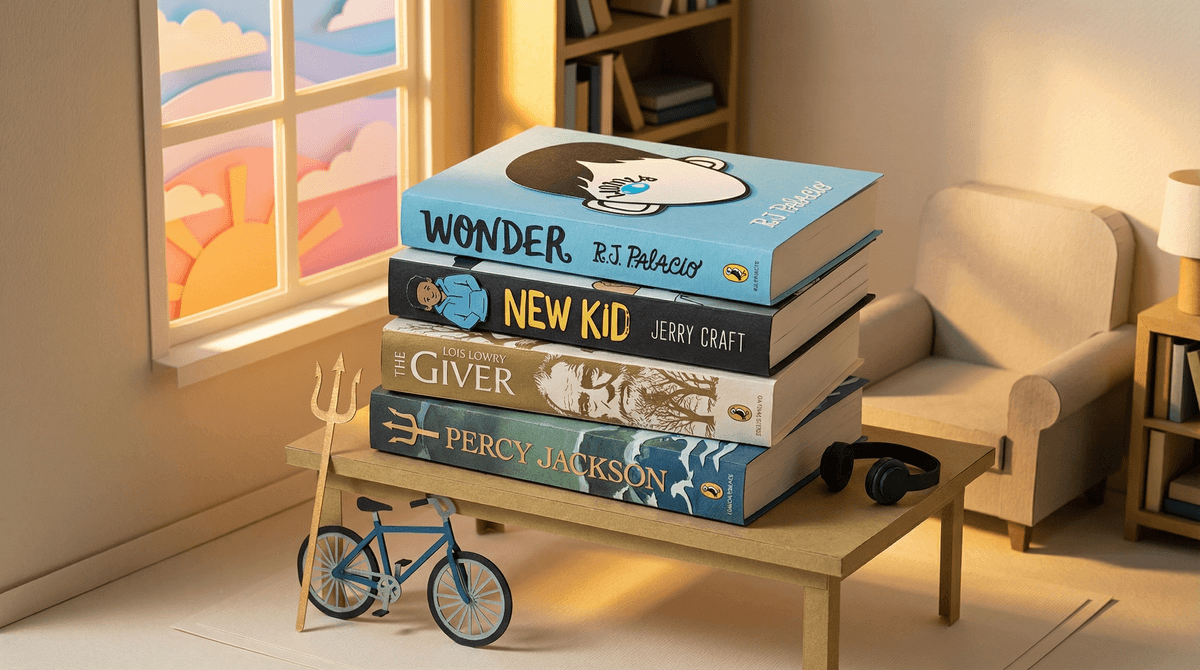
The Must-Read Books for Every 6th Grader in 2026
Sixth grade is when kids start choosing their own identity as readers—or deciding they hate books entirely. Here's a curated list that actually works: books that tackle identity, friendship, and belonging without feeling like homework. Whether your kid devours 400 pages in a weekend or needs graphic novels to stay engaged, there's something here that'll stick.
Quick picks:
- For the fantasy lover: Percy Jackson and the Olympians
- For real-world stories: Wonder by R.J. Palacio
- For the reluctant reader: New Kid by Jerry Craft
- For the deep thinker: The Giver by Lois Lowry
- For the kid who "doesn't like reading": Diary of a Wimpy Kid
Sixth grade is the inflection point. Kids are old enough to handle complex themes—racism, death, injustice, first crushes—but young enough that you still have some influence over what lands on their nightstand. This is also when reading diverges hard: some kids are crushing 300-page novels while others are still struggling through chapter books, and both are completely normal.
The goal isn't to force-feed classics. It's to find books that make them want to keep reading. Books that reflect their world, expand their empathy, and maybe—just maybe—spark a conversation at dinner about something deeper than Fortnite skins.
The pitch: Auggie Pullman has a facial difference and is starting 5th grade at a mainstream school for the first time. The story is told from multiple perspectives—Auggie, his sister, his friends—which makes it perfect for teaching empathy and point-of-view.
Why it works: This book is the gold standard for discussing kindness, bullying, and what it means to be different. It's assigned in tons of schools, but even kids who read it for class tend to actually like it. The multiple narrators keep it engaging, and the themes are meaty enough for real conversations.
Parent note: Auggie's condition (Treacher Collins syndrome) is described but not graphic. The bullying scenes are realistic but not traumatic. Great for families who want to talk about inclusion and standing up for others.
The pitch: Jordan is one of the few Black kids at a prestigious private school, navigating microaggressions, code-switching, and the pressure to fit in. It's a graphic novel, which means it's accessible even for kids who claim to hate reading.
Why it works: This won the Newbery Medal for a reason. It's funny, honest, and tackles race and class without being preachy. The graphic novel format makes it a quick read, but the themes stick with you. Perfect for discussing what it means to be yourself in spaces where you don't quite fit.
Parent note: Some parents worry graphic novels "don't count" as real reading. They're wrong. Graphic novels are legit literature, and for reluctant readers, they're often the gateway drug to longer books.
The pitch: Percy is a 12-year-old with ADHD and dyslexia who discovers he's the son of Poseidon. Greek mythology meets modern-day quests, with humor, action, and a protagonist who doesn't fit the typical hero mold.
Why it works: This series is crack for middle schoolers. It's fast-paced, funny, and makes kids feel smart because they're learning mythology without realizing it. Percy's learning differences are treated as strengths, which is huge for kids who struggle in traditional school settings.
Parent note: The whole series is great, but start with The Lightning Thief. If your kid loves it, there are approximately 47 other books in the extended Riordanverse to keep them busy. Also, the Disney+ show is solid and worth watching together.
The pitch: Jonas lives in a seemingly perfect society with no pain, no conflict, and no color. When he's chosen to be the Receiver of Memory, he learns the dark truth about his world.
Why it works: This is dystopian fiction that makes kids think. It's short (under 200 pages), so it doesn't feel like a slog, but it raises big questions about conformity, freedom, and what we're willing to sacrifice for safety. Great for kids who like The Hunger Games but aren't quite ready for the violence.
Parent note: The ending is ambiguous, which some kids (and parents) find frustrating. But that ambiguity is the point—it's a great opportunity to talk about interpretation and what you think happened.
The pitch: Castle "Ghost" Cranshaw has a natural talent for running, but he's also got a lot of anger and a traumatic past. When he joins an elite track team, he has to learn discipline, trust, and what it means to be part of something bigger than himself.
Why it works: Jason Reynolds writes books that feel like they're written for kids, not at them. Ghost is funny, flawed, and real. The book tackles poverty, trauma, and family dysfunction without being heavy-handed. It's also the first in a series, so if your kid loves it, there's more.
Parent note: There's some mild language and references to domestic violence (Ghost's dad shot at him and his mom when he was younger). It's handled sensitively, but worth knowing going in.
The pitch: Three kids, three time periods, three refugee stories—Josef fleeing Nazi Germany in 1939, Isabel escaping Cuba in 1994, and Mahmoud leaving Syria in 2015. Their stories are told in parallel and eventually intersect in a surprising way.
Why it works: This book builds empathy for refugees in a way that feels urgent and real. It's historical fiction, but the themes are painfully current. The parallel structure keeps it engaging, and the ending will wreck you (in a good way).
Parent note: There's violence—people die, kids are in danger, the stakes are real. It's not gratuitous, but it's also not sanitized. Good for families who want to talk about immigration, war, and what it means to be a refugee.
The pitch: Jacqueline Woodson's memoir in verse about growing up Black in the 1960s and 70s, split between South Carolina and New York. It's about identity, family, and finding your voice as a writer.
Why it works: Poetry intimidates some kids, but Woodson's verse is accessible and lyrical. The short chapters make it feel quick, and the themes—belonging, racism, family—are timeless. It won the Newbery Honor and the National Book Award for a reason.
Parent note: Some kids resist poetry, but the narrative structure makes this feel more like a story than a poetry collection. Great for kids who love memoirs or who are interested in the Civil Rights era.
The pitch: Thirteen-year-old Brian is the sole survivor of a plane crash in the Canadian wilderness. Armed with only a hatchet, he has to figure out how to survive—find food, build shelter, and deal with his own fear and loneliness.
Why it works: This is a survival story that keeps kids on the edge of their seats. It's about resilience, problem-solving, and learning to trust yourself. The pacing is tight, and the stakes are real. Great for kids who love adventure and don't want a lot of emotional drama.
Parent note: There's some intense survival stuff—Brian gets sick, deals with animal attacks, and has to process his parents' divorce. But it's not graphic, and the focus is on resourcefulness and growth.
Let's be real: not every 6th grader is going to voluntarily pick up a 300-page novel. And that's okay. Here are books that work for kids who need a gentler on-ramp.
Why it works: These books are like training wheels for reluctant readers. They're funny, heavily illustrated, and written in a diary format that feels approachable. Greg Heffley is kind of a jerk, which makes him weirdly relatable to middle schoolers who are figuring out their own moral compass.
Parent note: Some parents complain that Greg is a bad role model. He is! But that's also the point—kids can see his mistakes and (hopefully) learn from them. These books won't win literary awards, but they'll keep your kid reading, which is the real goal.
Why it works: Another graphic novel, this one about Raina's real-life dental drama (she loses her front teeth in 6th grade) and the social nightmare that follows. It's funny, relatable, and deals with friendship, self-image, and middle school awkwardness.
Parent note: Telgemeier has a whole catalog of graphic novels (Sisters, Drama, Guts) that are all solid. If your kid likes one, they'll probably like them all.
The pitch: Starr witnesses her childhood friend Khalil being shot by a police officer. The book follows her struggle to find her voice and speak up, even when it's dangerous.
Why it works: This book is raw, honest, and necessary. It tackles police violence, systemic racism, and code-switching in a way that's accessible to teens. It's also a great story—Starr is a fully realized character, not just a mouthpiece for social issues.
Parent note: This is technically YA, so it's better for mature 6th graders or advanced readers. There's some strong language and heavy themes. But if your kid is ready for it, this is the book that'll make them think.
The pitch: Hà is a 10-year-old girl who flees Vietnam with her family in 1975 and struggles to adapt to life in Alabama. It's written in verse, based on the author's own experience as a refugee.
Why it works: This book builds empathy for the immigrant experience in a way that feels personal and specific. The verse format makes it accessible, and the story is both heartbreaking and hopeful.
Parent note: Great for families who want to talk about immigration, cultural identity, and what it means to start over in a new country.
Most of these books are solidly in the 10-13 range, but every kid is different. Here's a rough guide:
- Ages 10-11: Start with Wonder, Percy Jackson, New Kid, Hatchet
- Ages 11-12: Add The Giver, Ghost, Refugee
- Ages 12-13 or mature readers: The Hate U Give, Brown Girl Dreaming
If your kid is a reluctant reader, start with graphic novels or shorter books like Diary of a Wimpy Kid or Smile. The goal is to build momentum, not check boxes.
Reading levels are a spectrum: Your kid might be reading at a 4th-grade level or crushing high school books. Both are fine. Meet them where they are, not where you think they "should" be.
Representation matters: Kids need to see themselves in books, but they also need to see experiences different from their own. A diverse bookshelf isn't just nice to have—it's essential for building empathy and understanding.
Let them choose: Yes, you can nudge and suggest, but forcing a book rarely works. If your kid hates The Giver, let them put it down and try something else. The goal is to create lifelong readers, not resentment.
Audiobooks count: If your kid prefers listening to reading, that's totally valid. Audiobooks build literacy and comprehension just like physical books.
Sixth grade is when reading either clicks or becomes a chore. Your job isn't to force classics down their throat—it's to find books that make them want to keep turning pages. Whether that's Percy Jackson, New Kid, or Diary of a Wimpy Kid, the best book is the one they'll actually read.
Stock your shelves with diverse stories, let them explore, and trust that even if they're not reading "the classics," they're still building skills, empathy, and a love of stories. And honestly? That's what matters most.
Want more book recs? Check out books for reluctant readers, graphic novels for middle schoolers, or books about identity and belonging.