

The Hunger Games Age Rating: What Parents Need to Know Before Watching
The Hunger Games movies are rated PG-13, but that rating does some heavy lifting. We're talking about teenagers brutally killing each other on live TV in a dystopian dictatorship. The official rating says 13+, but honestly? Most kids aren't ready until 14-16, depending on their maturity level and sensitivity to violence.
Quick breakdown:
- Official rating: PG-13 (all four films)
- Realistic age range: 14-16+
- Violence level: High (but not gratuitously gory)
- Mature themes: Government oppression, class warfare, PTSD, propaganda, child death
- What makes it tough: The premise itself—kids forced to murder each other for entertainment
If you somehow missed this cultural phenomenon, The Hunger Games started as a YA book trilogy by Suzanne Collins that became a four-movie franchise (because Hollywood splits final books into two parts, obviously).
The story follows Katniss Everdeen, a 16-year-old living in a dystopian future where North America has become "Panem"—a wealthy Capitol surrounded by 12 oppressed districts. As punishment for a past rebellion, the Capitol forces each district to send two teenagers (ages 12-18) to compete in the annual Hunger Games: a televised fight to the death where only one person survives.
It's essentially a critique of reality TV, government control, economic inequality, and desensitization to violence... wrapped in a survival story with a love triangle.
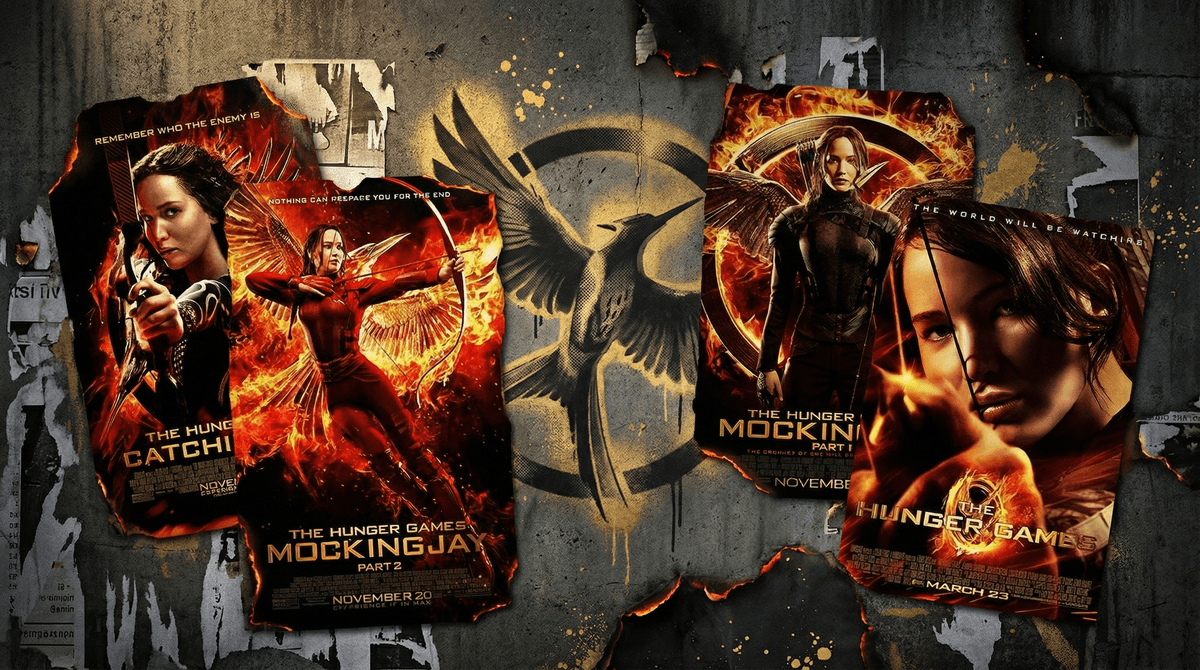
The four movies are:
- The Hunger Games (2012)
- Catching Fire (2013)
- Mockingjay Part 1 (2014)
- Mockingjay Part 2 (2015)
Plus there's a 2023 prequel, The Ballad of Songbirds and Snakes, which we'll get to.
The MPAA gave all four films a PG-13 rating for "intense violent thematic material and disturbing images." That's technically accurate but also wildly understates what you're dealing with here.
Here's what PG-13 means in practice for Hunger Games:
The Violence
The movies show teenagers killing each other. Full stop. Yes, director Gary Ross (and later Francis Lawrence) were strategic about it—the camera shakes, cuts away at key moments, and avoids lingering on gore. You won't see Saw-level brutality. But you absolutely see:
- Kids getting stabbed, speared, and beaten to death
- A 12-year-old girl dying in Katniss's arms
- Necks being snapped
- People being blown up by landmines
- Firebombs engulfing crowds
- A character's mouth being sewn shut
- Torture and execution
The violence isn't gratuitous, but it's constant and the emotional weight is heavy. This isn't Marvel where everyone quips after battle—characters are traumatized, broken, and changed by what they experience.
The Psychological Intensity
Beyond the physical violence, the psychological horror is significant:
- The premise itself: Children are selected by lottery to die for entertainment
- PTSD and trauma: Katniss has nightmares, panic attacks, and survivor's guilt throughout
- Propaganda and manipulation: The Capitol uses media to control the population
- Hopelessness: The first film especially feels claustrophobic and bleak
- Moral complexity: "Good guys" make terrible choices; war crimes happen on both sides
There's also a suicide attempt, threats of sexual exploitation, and the aftermath of war including civilian casualties.
Ages 10-12: Too Young
Even if your middle schooler has read the books (which are slightly less intense than the movies), the visual medium hits different. The books let kids control the pace and imagine violence in ways they can handle. The movies put it right in front of them.
Red flags at this age:
- Limited ability to process complex moral ambiguity
- Higher risk of nightmares and anxiety
- Difficulty separating fiction from reality with disturbing content
- Not developmentally ready for themes of government oppression and systemic injustice
Ages 13-14: Proceed with Caution
This is where the official rating kicks in, but it really depends on the individual kid. Some mature 14-year-olds can handle it; many can't.
Good candidates at this age:
- Already interested in dystopian fiction
- Can discuss complex themes (not just "good vs. evil")
- Doesn't have anxiety triggers around violence or death
- Has context for understanding allegory and social commentary
Watch together if you go this route. The post-movie conversation is crucial.
Ages 15-16+: Generally Ready
Most high schoolers can handle the content at this point, especially if they have any interest in the genre. They're developmentally able to:
- Process the political and social commentary
- Understand the critique of media and violence
- Separate entertainment from endorsement
- Discuss the moral complexity without black-and-white thinking
That said, if your teen struggles with anxiety, depression, or has trauma history, the themes might still be triggering regardless of age.
The Ballad of Songbirds and Snakes (2023) is also rated PG-13 and features similar violence—it's set during the 10th annual Hunger Games, so yes, more teens killing each other.
The twist: The protagonist is a young Coriolanus Snow (who becomes the villain of the original trilogy), so you're following someone who gradually becomes a monster. It's arguably more psychologically complex than the originals.
Age recommendation: Same as the original films (14-16+), but maybe lean older if your teen struggles with morally gray protagonists.
If your teen has read the books and wants to watch the movies, that's actually a decent pathway. The books prepare them for the content, and they can compare how the violence is portrayed.
Key differences:
- Books: First-person narration from Katniss means you're inside her head, processing trauma alongside her
- Movies: More visual violence but less internal monologue
- Pacing: Books allow readers to control their pace; movies are relentless
Some parents are more comfortable with books first because kids self-regulate better with reading. If a scene is too intense, they can skim or take a break. Movies don't offer that control.
The Good Stuff
Despite the heavy content, there's legitimate value here:
Strong female protagonist: Katniss is brave, flawed, and doesn't exist just for romance. She's a survivor who becomes a reluctant revolutionary.
Social commentary: The series tackles class inequality, media manipulation, the cost of war, and the dangers of authoritarianism. These are important conversations.
Consequences matter: Unlike many action franchises, Hunger Games shows that violence has lasting psychological impact. Characters don't just "bounce back."
No gratuitous gore: The filmmakers were thoughtful about showing violence without glorifying it.
The Concerns
Desensitization: Some worry that packaging "kids killing kids" as entertainment (even critically) normalizes violence. Fair point.
Triggering content: If your teen struggles with anxiety, depression, or trauma, the themes of hopelessness and PTSD might hit too close to home.
The love triangle: It's there, and it's kind of exhausting. Katniss is dealing with war crimes and your teen might just want to know if she picks Peeta or Gale.
Incomplete worldbuilding: The movies streamline a lot. If your kid asks "but why did the districts rebel in the first place?" the films don't fully explain.
If you decide your teen is ready, watch together and create space for conversation:
Before watching:
- Set expectations: "This is going to be intense. If you need to pause or stop, just say so."
- Provide context: "This is a dystopian story—a warning about what could happen, not a prediction."
During:
- Check in at natural breaks
- Pause if they seem overwhelmed
- Don't force them to "tough it out"
After:
Ask open-ended questions:
- "What did you think about how the Capitol controlled the districts?"
- "Why do you think people watched the Games?"
- "How do you think Katniss will deal with what happened?"
- "What would you do in her situation?"
Connect it to real-world parallels:
- Reality TV and exploitation
- Wealth inequality
- How governments use propaganda
- The cost of war on soldiers and civilians
If your teen wants dystopian content but isn't ready for Hunger Games, try:
Books:
- The Giver by Lois Lowry—gentler dystopia, ages 10+
- Among the Hidden by Margaret Peterson Haddix—dystopia without violence, ages 9-12
Movies:
- The Maze Runner—teens in danger but less psychological weight (ages 13+)
- Divergent—dystopian but more action-adventure than bleak (ages 13+)
- WALL-E—dystopian themes, zero violence (all ages)
For more options, check out dystopian books for teens or sci-fi movies for kids.
The Hunger Games is rated PG-13, but it earns every bit of that rating. The violence is strategic rather than gratuitous, but it's still teenagers killing teenagers. The themes are heavy: government oppression, trauma, war, propaganda, and the cost of survival.
Most kids aren't ready until 14-16, and even then, it depends on the individual. Sensitive kids, anxious kids, or those with trauma histories might need to wait longer—or skip it entirely.
If you do watch, watch together. The post-movie conversations are where the real value lives. This isn't just entertainment; it's social commentary wrapped in a survival story. Help your teen process what they're seeing and connect it to real-world issues.
And if your teen isn't ready yet? That's completely fine. The movies aren't going anywhere, and there's no rush to expose kids to content before they can meaningfully engage with it.
Trust your gut. You know your kid better than any rating system.
- Check out The Hunger Games on Screenwise for parent reviews and WISE scores
- Read more about age-appropriate dystopian content
- Explore how to talk to teens about violence in media

- Compare with other PG-13 movies that push boundaries