

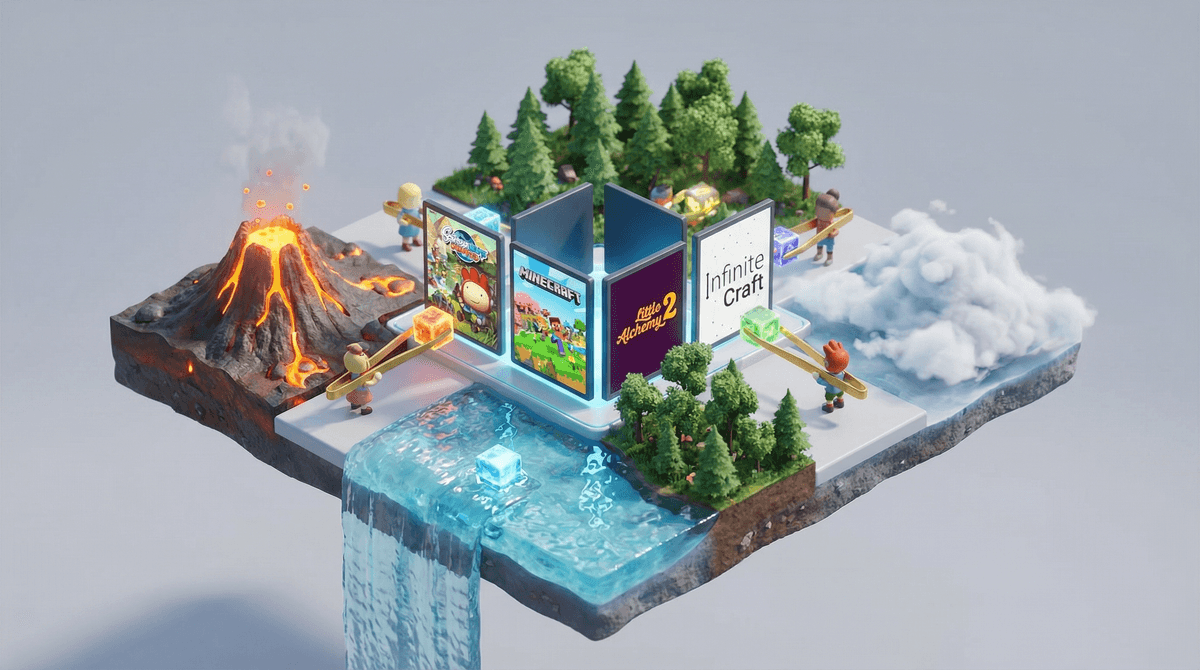
If your kid has been sitting at the computer seemingly doing nothing but dragging boxes around for hours, they've probably discovered Infinite Craft. It's this deceptively simple browser game where you start with four basic elements (water, fire, wind, and earth) and combine them to create... literally everything. And I mean everything. Players have created things like "Taylor Swift," "Bitcoin," "Existential Dread," and "Homework Excuse."
The genius of Infinite Craft is that it uses AI to generate new combinations on the fly. Combine Water + Fire to get Steam. Steam + Earth makes a Geyser. Keep going and you'll eventually create Spotify, Democracy, or a Velociraptor. There's no goal, no score, no levels—just pure discovery and experimentation. It's basically chemistry class meets Wikipedia meets a very weird fever dream.
Screenwise Parents
See allThe game went viral because it hits that sweet spot of being immediately accessible (it's free, browser-based, no download) while offering genuinely endless possibilities. Kids love the dopamine hit of discovering something new, especially when they're the first person in the world to create that specific combination.
Here's what makes games like Infinite Craft so compelling:
The discovery high - That moment when you combine two random things and get something completely unexpected? That's a legitimate brain reward. It's why kids will sit there for two hours just... combining stuff.
No failure state - You can't lose. You can't die. You can't mess up. For kids who deal with performance pressure in school or competitive games, this is refreshing.
Sharing discoveries - Kids love screenshotting their weirdest combinations and sharing them. "Look, I made Shrek + Depression = Therapy!" It becomes a social thing.
The illusion of infinite content - Even though the AI is doing the heavy lifting, kids feel like they're genuinely creating and exploring. It's creative play with training wheels.
Little Alchemy 2 (Ages 7+)
Little Alchemy 2 is the OG of this genre and honestly still holds up. You start with the same basic elements and combine them to discover 700+ items. Unlike Infinite Craft's AI chaos, Little Alchemy has a fixed set of combinations, which means there's actually an "end" you can reach.
Why it's good: The logic is more consistent, making it better for younger kids who might get frustrated by Infinite Craft's randomness. Plus there's a sense of completion when you discover all items. Available as a free app or browser game.
The catch: Once you've discovered everything, you're done. But that's also kind of nice? Not everything needs to be infinite.
Doodle God (Ages 10+)
Doodle God takes the combination formula and adds a creation mythology angle. You're literally playing god, combining elements to create the universe, life, and eventually modern civilization.
Why it's good: It has more structure and progression than Infinite Craft, with distinct "episodes" and achievements. The combinations follow actual logic (mostly), so kids learn some real science and history along the way.
The catch: The free version has ads, and the full version costs a few bucks. Also some religious themes if that matters to your family, though it's more Greek mythology vibes than anything specific.
Minecraft (Ages 8+)
Wait, hear me out. Minecraft is obviously not a combination game, but it scratches the same creative experimentation itch. The crafting system is all about discovering recipes—combine sticks and planks to make tools, mix potions, breed animals to get new variants.
Why it's good: It's the combination gameplay with actual stakes and goals. Plus you're building something physical (well, digital) rather than just collecting words in a list. And the social/multiplayer aspect is huge.
The catch: It's not free ($30-ish depending on platform), and it's a much bigger time commitment. Also, you'll need to think about multiplayer safety if your kid wants to play online.
Scribblenauts Unlimited (Ages 8+)
Scribblenauts flips the formula—instead of combining things to discover words, you type any word and it appears in the game world. Need to get past a guard? Summon a dragon. Or a sleeping potion. Or a giant hamburger to distract them.
Why it's good: It actively rewards creative thinking and vocabulary. Kids learn new words because they're trying to solve puzzles. The game has actual levels and challenges, so there's more structure than pure sandbox combination games.
The catch: It's a paid game (around $20), and the magic wears off once you realize you can solve most puzzles by just typing "jetpack" or "God."
The Powder Toy (Ages 12+)
[The Powder Toy](https://screenwiseapp.com/media/the-powder-toy-app is a free physics sandbox where you combine different materials and elements to create reactions. Pour water on fire, mix explosives, create nuclear reactions, build circuits. It's like a chemistry set meets a particle simulator.
Why it's good: It's actually educational. Kids learn real physics and chemistry concepts. The community shares incredible creations—working computers, art, complex machines. It's genuinely impressive.
The catch: The learning curve is steeper, and the interface looks like it's from 2003 (because it basically is). This is for kids who are ready to geek out on how things actually work, not just collect funny combinations.
Neal.fun's Other Games (Ages 10+)
The creator of Infinite Craft, Neal Agarwal, has made a bunch of other brilliant browser games. Check out The Password Game (create a password with increasingly absurd requirements), Space Elevator (scroll through space), and Absurd Trolley Problems (exactly what it sounds like).
Why they're good: They're free, weird, educational, and have that same "I can't believe this exists" quality. Great for kids who love Infinite Craft's vibe.
The catch: They're more like toys than games—you'll spend 20 minutes with each and move on. But that's kind of perfect for a brain break.
These games are genuinely low-risk. No chat, no multiplayer drama, no microtransactions (mostly), no violence. The main "danger" is that your kid will spend three hours discovering that Banana + Sadness = Monday.
But they're not all equal in value. Infinite Craft is fun but ultimately pretty shallow—it's AI-generated randomness, not real logic. Games like Little Alchemy 2 and The Powder Toy actually teach patterns and thinking. Minecraft and Scribblenauts add problem-solving and creativity with consequences.
Time limits still matter. Just because a game is "educational" doesn't mean six hours of it is better than two hours. The discovery dopamine loop is real, and kids can definitely zone out clicking combinations while their brain goes on autopilot.
Use these as transitions. These games are perfect for "you have 30 minutes before dinner" or "brain break between homework assignments." They're self-contained, easy to pause, and won't leave your kid in the middle of a raid or competitive match.
If your kid loves Infinite Craft, they're probably drawn to open-ended creative play without pressure or judgment. That's actually a great instinct! The question is whether you want them in pure sandbox mode (Little Alchemy, Doodle God) or if you want to nudge them toward games with more depth and learning (Minecraft, Scribblenauts, The Powder Toy).
None of these are going to rot their brain. But also, none of them are going to teach your kid to code or become the next Elon Musk, despite what some gaming blogs might suggest. They're just... fun. And sometimes that's enough.
Next step: Try Little Alchemy 2 first—it's free, it's clean, and if your kid bounces off it, you'll know they want something with more action. If they love it, then you can explore the deeper options.
And hey, at least they're not watching Skibidi Toilet compilations. Small wins.