

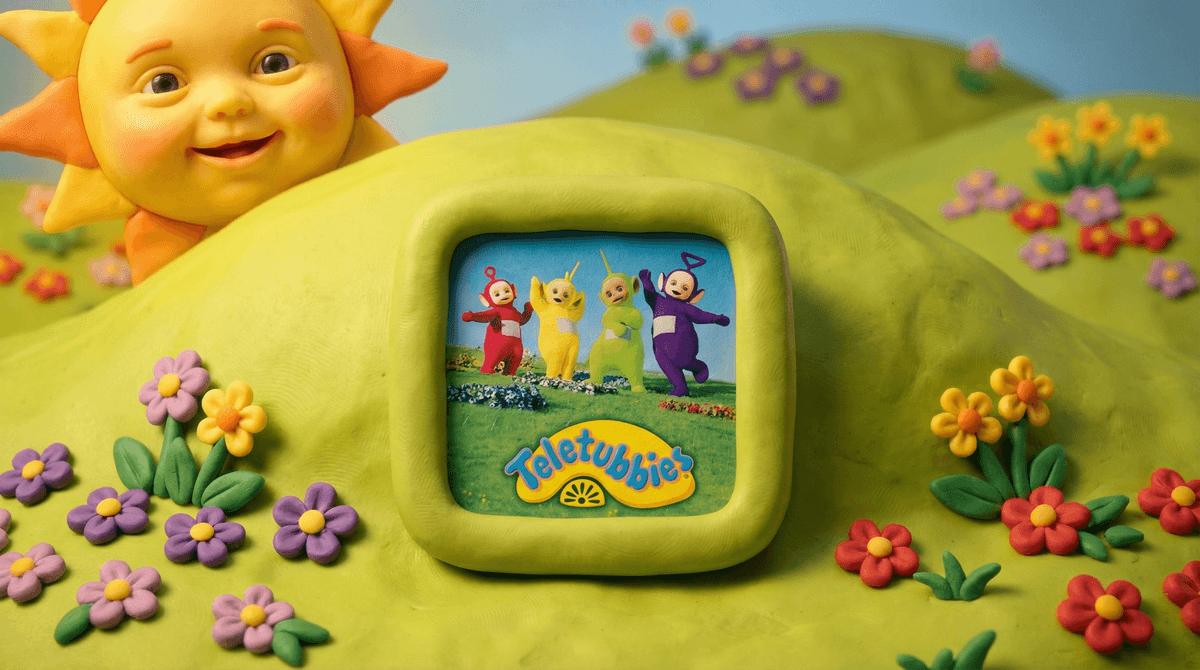
If you're a millennial parent, Teletubbies probably lives somewhere in your childhood memory bank – those four colorful creatures with TV screens in their tummies wandering around a surreal landscape.
But here's the thing: Teletubbies is having a major moment with a whole new generation.
The original show ran from 1997-2001 on PBS, then got a Netflix reboot in 2015 that's still going strong. We're talking about Tinky Winky (purple), Dipsy (green), Laa-Laa (yellow), and Po (red) – four baby-like characters who live in Teletubbyland, speak in simplified language, and have actual television screens embedded in their stomachs that show real footage of kids doing everyday activities.
Yeah, it's weird. Let's just acknowledge that upfront.
The show is specifically designed for toddlers and very young children (ages 1-4), with each episode running about 25 minutes in the original format or 11-15 minutes in the Netflix version. There's minimal plot, tons of repetition, and a speaking sun baby that giggles at everything. It's intentionally slow-paced, uses simple language patterns, and repeats segments multiple times per episode.
Created by Anne Wood and Andrew Davenport in the UK, it became a global phenomenon – we're talking 120+ countries. And despite parents finding it absolutely baffling (or mildly terrifying), kids have been mesmerized by it for over 25 years.
Let me tell you something that might make you feel better: your toddler's obsession with Teletubbies is actually developmentally appropriate.
The show was designed with input from child development experts specifically for how very young brains work. Here's what's actually going on:
The Repetition Is The Point
Toddlers learn through repetition. Like, serious repetition. The kind that makes adults want to poke their eyes out.
Teletubbies repeats segments two or three times per episode – the same clip of real kids playing, the same dance sequence, the same "again, again!" refrain. For your 2-year-old, this isn't boring. It's exactly what their brain needs to process and internalize new information.
The Language Matches Their Stage
The Teletubbies speak in simplified, toddler-like language. "Big hug!" "Eh-oh!" "Again, again!" This mirrors how young children actually communicate and makes them feel seen. They're not struggling to keep up with complex dialogue – they're watching characters who talk like they do.
The Pace Respects Their Processing Speed
Unlike most modern kids' content that's edited at breakneck speed, Teletubbies moves slowly. Really slowly. There are long pauses, gentle transitions, and time for kids to actually absorb what's happening. For developing brains that process visual information more slowly than adults, this is actually respectful programming.
Real Kids On The Tummy Screens
Those segments showing real children doing activities – feeding chickens, painting, playing with siblings – are fascinating to toddlers. They're seeing kids like themselves doing real-world activities, which helps them make sense of their own experiences.
Here's where we get practical about whether Teletubbies makes sense for your family.
Ages 1-2: Actually Designed For This Age
This is the sweet spot. Teletubbies was literally created for this developmental stage.
The American Academy of Pediatrics recommends minimal screen time under 18 months (except video chatting), and 1 hour max of high-quality programming for 2-5 year olds. If you're going to use some screen time with very young toddlers, Teletubbies is about as developmentally appropriate as it gets.
What works here:
- The slow pace matches their processing abilities
- Simple language supports early vocabulary development
- Repetition aids learning and memory
- Gentle content won't overstimulate
What to watch for:
- Don't use it as a babysitter for hours on end
- Co-view when possible to point out and discuss what's happening
- Balance with plenty of screen-free play and interaction
Ages 3-4: Still Appropriate But May Lose Interest
Many kids start aging out of Teletubbies around 3 or 4 as they're ready for more complex narratives. And that's totally normal and fine.
Some kids stay interested longer, especially if they have younger siblings or if the show provides comfort during transitions or stressful times. There's no need to force them to "graduate" to something else if they're still enjoying it.
Ages 5+: Probably Moved On
By kindergarten, most kids have naturally transitioned to shows with more plot and character development. If your 5+ year old is still watching, it's usually either nostalgic comfort viewing or they're watching with a younger sibling.
The only concern here would be if they're exclusively watching content designed for much younger ages and refusing age-appropriate material – that might be worth a conversation with your pediatrician about whether they're seeking regulation or comfort for a specific reason.
Let's talk about the stuff that actually matters for your decision-making.
The Screen Time Calculation
Here's my honest take: Teletubbies is probably one of the least concerning ways your toddler could spend screen time.
It's slow, it's gentle, there are no ads (on PBS or Netflix), no influencer culture, no merchandise tie-ins being pushed in every episode. The Netflix version is even shorter per episode, which makes it easier to stick to time limits.
That said, it still counts as screen time. The AAP guidelines exist for good reasons – young kids need physical play, human interaction, and real-world exploration for healthy development. Teletubbies can be part of a balanced media diet, but it shouldn't replace the floor time, outdoor play, and face-to-face interaction that toddler brains really need.
Co-Viewing Makes It Better
I know, I know – the whole point of putting on a show is sometimes to get 20 minutes to make dinner or answer emails. That's real life, and no judgment.
But when you can, watching together and talking about what's on screen significantly increases the learning value. Even simple comments like "Look, Po is jumping! Can you jump?" or "Those kids are feeding chickens. Remember when we saw chickens at the farm?" help your toddler make connections.
The "Again Again" Thing Is Actually Smart
One of the Teletubbies' catchphrases is demanding "Again! Again!" and then the show literally replays what just happened.
Parents find this maddening. Kids find it perfect.
It's actually teaching your toddler that they can make requests and be heard, and it's normalizing the idea that repetition is how we learn. Pretty clever, honestly.
Educational Value Is Real But Limited
Teletubbies does support some early learning:
- Basic vocabulary and language patterns
- Emotional recognition (the Teletubbies express simple emotions)
- Observation of real-world activities
- Simple cause and effect
What it doesn't do:
- Teach letters, numbers, or specific academic skills
- Provide complex problem-solving scenarios
- Build detailed narrative comprehension
If you're looking for more explicitly educational content, shows like Daniel Tiger's Neighborhood or Bluey offer more skill-building. But for very young toddlers, Teletubbies' simplicity is actually its strength, not a weakness.
The Weird Factor
Let's address the elephant in the room: Teletubbies is objectively strange. Baby-like creatures with TV tummies, a vacuum cleaner that's somehow alive, a sun with a baby's face, and a disembodied voice narrating everything.
Some parents find it unsettling. Some kids find it scary (the Lion and Bear sketch apparently traumatized a generation of British children).
If your kid loves it and isn't frightened, the weirdness doesn't matter. If it creeps them out or gives them nightmares, there are plenty of other options. Trust your kid's response and your own gut.
For toddlers watching Teletubbies, you're not having deep media literacy conversations. But you can still build healthy viewing habits:
Set Clear Boundaries
"We're going to watch two episodes, and then it's time to play outside."
Toddlers do better with concrete limits. Using a visual timer can help them understand when screen time is ending.
Make Connections to Real Life
"The kids on Laa-Laa's tummy are dancing! Want to dance too?"
Help your toddler connect what they see on screen to their actual experiences and activities.
Name the Emotions
"Tinky Winky is sad because he dropped his bag. When you're sad, what helps you feel better?"
Even simple shows offer chances to build emotional vocabulary.
Talk About the Real Kid Segments
Those tummy-screen clips of real children are perfect for conversation:
"Those kids are playing with water. We played with water at the park yesterday!"
This helps toddlers understand that TV shows and real life are connected but different.