

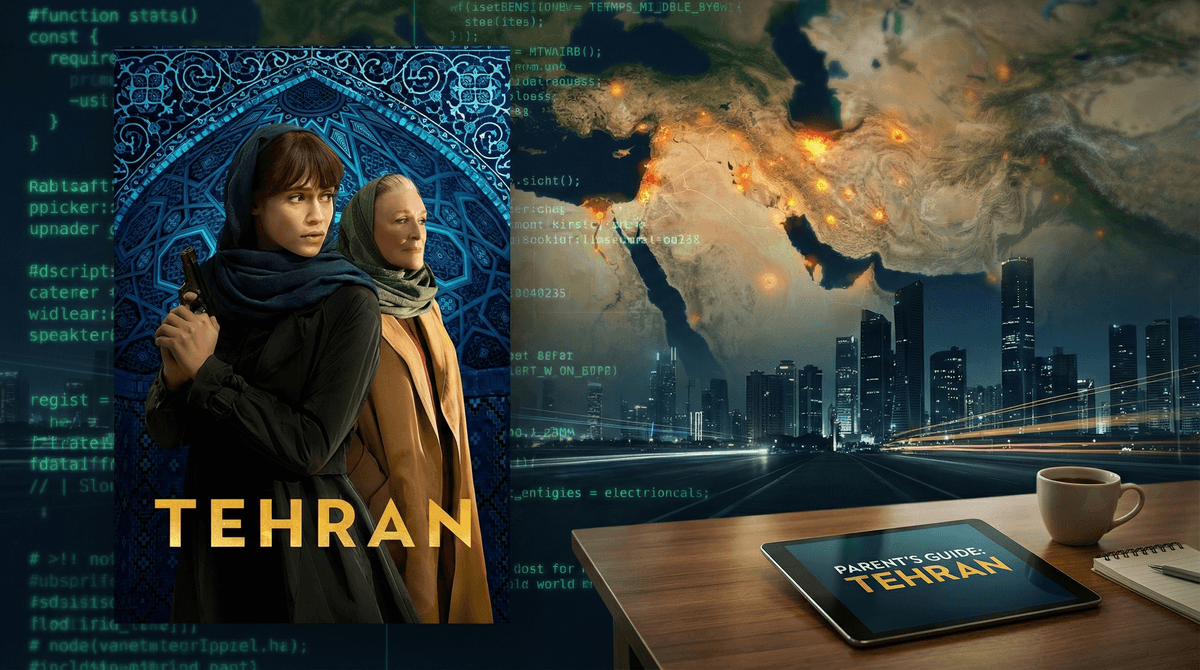
TL;DR: Tehran is a high-octane, TV-MA spy thriller on Apple TV+ that trades James Bond gadgets for realistic cyber-warfare and brutal geopolitical realities. It’s fantastic for older teens (16+) who are interested in coding, international relations, or complex moral dilemmas, but it is intense. Expect graphic violence, public executions, drug use, and a plot where "the good guys" do very bad things.
If you’re looking for a quick "yes/no" on whether to let your 14-year-old watch it, the answer is likely no unless you’re sitting right there to unpack the heavy Iranian-Israeli conflict. But for a 17-year-old heading off to college soon? It’s a masterclass in digital ethics and global perspective.
Quick Links for the Spy-Obsessed:
- Fauda – For even more intense Israeli intelligence drama.
- The Americans – The gold standard for "spy family" moral complexity.
- Mr. Robot – If the hacking in Tehran is what hooked them.
- Slow Horses – A slightly more cynical (and British) take on espionage.
Tehran follows Tamar Rabinyan, a young Mossad agent born in Iran but raised in Israel. She’s a world-class hacker sent deep undercover into the heart of Tehran. Her mission? Hack into the Iranian electric grid to disable air defenses so the Israeli Air Force can bomb a nuclear reactor.
Naturally, things go sideways immediately.
Unlike a lot of American spy shows that feel like a recruitment video, Tehran is messy. Tamar is skilled but terrified. The Iranian "antagonist," Faraz, isn't a cardboard cutout villain; he’s a dedicated investigator trying to protect his country and his wife. It’s a cat-and-mouse game where the stakes are literal world war, and the "hacking" isn't just typing fast—it’s about social engineering, physical risk, and digital footprints.
Older teens are currently obsessed with "authentic" content. They’re tired of the sanitized, CW-style drama. Tehran feels real.
- The Tech Factor: For the kids who grew up on Minecraft and moved into Roblox scripting or actual Python coding, the way Tamar uses technology is fascinating. It’s not "magic"; it’s a tool that can fail.
- Moral Ambiguity: Gen Z has a very high tolerance—and even a preference—for stories where nobody is purely "good." They like seeing the internal conflict of a protagonist who has to lie to innocent people to achieve a "greater good."
- The Aesthetic: The show is visually stunning. It captures the vibrant, underground youth culture in Iran—illegal raves, forbidden tech, and the tension between tradition and modernity. It’s a window into a world they rarely see on TikTok.
Learn more about why teens are drawn to gritty political thrillers
Apple TV+ gives Tehran a TV-MA rating, and they aren't kidding. If your teen is still sensitive to "jump scares" or physical brutality, this is a hard pass.
Violence and Gore
This is the biggest hurdle. The show depicts the reality of an authoritarian regime and the ruthlessness of espionage. You will see:
- Public hangings (shown from a distance, but the psychological impact is heavy).
- Point-blank shootings and bloody stabbings.
- Scenes of interrogation and physical torture.
- The aftermath of explosions.
Language and Substance Use
The dialogue is a mix of Hebrew, Persian (Farsi), and English. The profanity is frequent but usually feels "in character" for high-stress situations. There is also a significant subplot involving the underground drug scene in Tehran, including scenes of teens and young adults using MDMA and other substances at parties.
Sexual Content
There is some nudity and several sexual situations. It’s not "Euphoria" levels of constant, but it’s definitely present and intended for a mature audience.
If you decide to let your teen watch this, you need to be prepared for the "Why are they fighting?" conversation. Tehran doesn't provide a history lesson; it drops you right into the middle of a decades-long shadow war between Israel and Iran.
The show is an Israeli production, but it has been praised for humanizing Iranian characters. However, it still views the world through a specific lens. This is a great opportunity to talk about media literacy. Ask your teen: How would this show look if it were produced by an Iranian film studio? How does the music change when we’re in the Mossad headquarters versus the Iranian Revolutionary Guard offices?
Check out our guide on talking to teens about geopolitics in media
If Tehran feels a bit too heavy, or if you’ve finished it and want something in the same vein but with different "vibes," here are our top picks:
Ages 16+ If you want to talk about the cost of lying to your family, this is it. It follows two Soviet spies living as a married couple in 1980s DC. It’s arguably the best spy show ever made, but like Tehran, it’s very violent and has significant sexual content.
Ages 15+ If the "hacking" part of Tehran is what your teen keeps talking about, Mr. Robot is the gold standard for technical accuracy. It deals heavily with mental health, corporate greed, and digital privacy. It’s dark, weird, and brilliant.
Ages 15+ For a teen who likes the spy genre but needs a break from the "super-agent" trope. It’s about the MI5 rejects (the "Slow Horses") who end up stumbling into real conspiracies. It’s funny, cynical, and much less "intense" than Tehran.
Ages 12+ If you have a younger teen who wants the "spy" feel without the trauma, this reality show is great. Ordinary people go "on the run" and try to avoid being caught by professional "hunters" (former intelligence officers) using real-world surveillance tech. It’s a great way to talk about digital footprints.
Don't just let the credits roll and walk away. Tehran provides some of the best "teachable moments" for digital wellness and ethics we've seen in a while.
- On Digital Footprints: "Tamar almost gets caught because of one small digital mistake. How much of your life is 'trackable' if someone really wanted to find you?"
- On Ethics: "Do you think Tamar was right to put her Iranian friends in danger to complete her mission? Is there a point where the 'mission' isn't worth the human cost?"
- On Perspective: "What did you think of Faraz (the Iranian investigator)? Did you find yourself rooting for him at any point? Why?"
Ask our chatbot for more conversation starters about digital ethics
Tehran is not "brain rot." It’s a high-protein, complex, and often stressful piece of media. It’s the kind of show that can actually sharpen a teen’s understanding of the world—provided they have the maturity to handle the graphic nature of the storytelling.
If your teen is 16 or 17 and into current events, this is a "Watch Together" recommendation. You’ll both be at the edge of your seats, and you’ll have plenty to talk about when the screen goes black.
Next Steps:
- Check the Vibe: Watch the first 15 minutes of Season 1, Episode 1 alone. If the tension makes you uncomfortable, your teen might not be ready.
- Set Ground Rules: If you allow it, make it a "living room only" show. This isn't one for them to binge alone on an iPad at 2 AM.
- Contextualize: Spend five minutes on Wikipedia looking at a map of the Middle East before you start. It helps.