

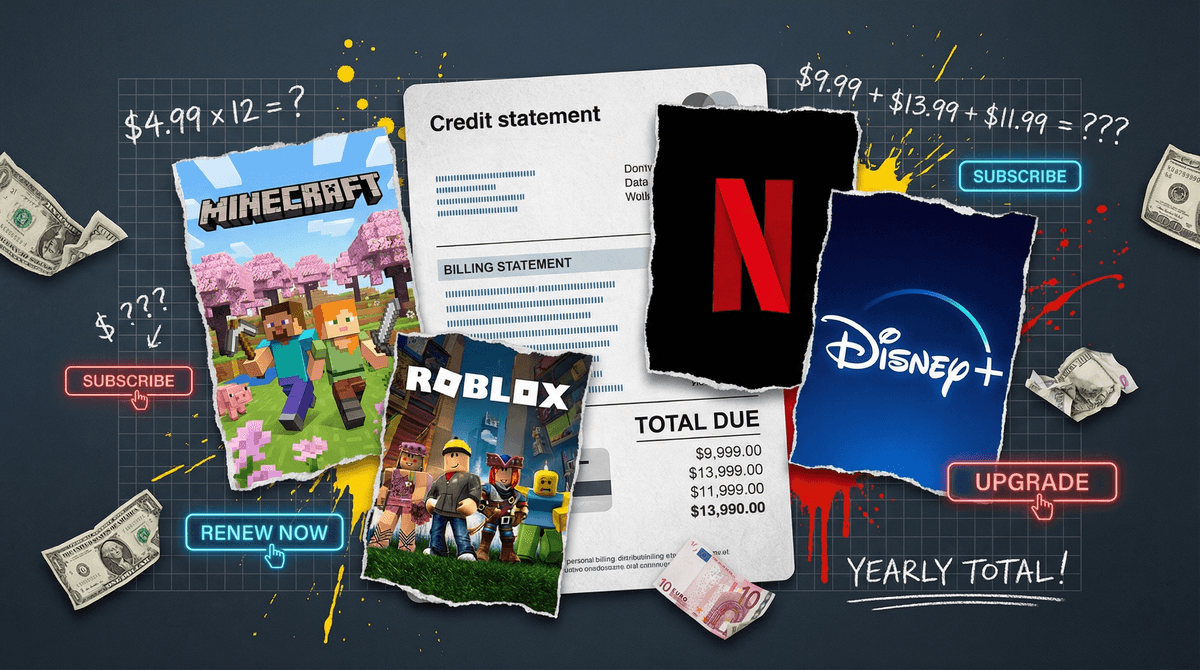
You know that moment when you're reviewing your credit card statement and realize you're paying for three streaming services you forgot existed, a meditation app you used twice, and some random game currency auto-renewal from four months ago? That's subscription creep—and kids are spectacularly bad at understanding it.
Here's the thing: kids see "$4.99/month" and think "that's less than a Happy Meal!" What they don't see is that it's $60/year, and when you stack it with Roblox Premium ($9.99), Minecraft Realms ($7.99), YouTube Premium ($11.99), and whatever else they've convinced you they "need," you're suddenly looking at $50-100+ every single month disappearing into the digital void.
According to our Screenwise community data, 60% of families have kids playing on Roblox servers (which typically requires Premium), 25% are paying for Minecraft Realms, and 55% of families report regular gaming—much of which involves subscription models. Meanwhile, 40% have Netflix on regular accounts (not just kids profiles) and 30% let kids watch Disney+ independently. Each of these represents a monthly charge that kids likely have zero concept of as "real money."
Kids are growing up in a world where money is increasingly abstract. They don't see you hand over cash. They don't watch you write checks. They see you tap your phone or click a button, and stuff appears. The connection between "monthly subscription" and "actual dollars leaving our bank account forever until we manually cancel" just doesn't compute.
The psychology is fascinating: A one-time $60 purchase feels expensive to kids. But $4.99/month? That's nothing! It's the same mental trick that gets adults to sign up for gym memberships they never use. Our brains are terrible at calculating cumulative costs over time.
Add to this that many subscription models are specifically designed to be frictionless. Auto-renewal. Stored payment info. No confirmation needed. Roblox literally lets kids rack up charges with a few clicks if you're not careful with parental controls.
Let's do some actual math that might make your kid's eyes glaze over (but do it anyway):
Scenario 1: The "Just One Thing" Kid
- Roblox Premium: $9.99/month = $119.88/year
- "But Mom, it's basically free compared to other games!"
- Reality check: That's 24 movie tickets. Or 12 actual physical toys. Or a Nintendo Switch game that they'd own forever.
Scenario 2: The Streaming Collector
- Netflix: $15.49/month (standard plan)
- Disney+: $13.99/month
- YouTube Premium (because ads are "literally unwatchable"): $11.99/month
- Total: $41.47/month = $497.64/year
- That's a family vacation. Or a really nice bike. Or half a summer camp.
Scenario 3: The Gaming Enthusiast
- Roblox Premium: $9.99/month
- Minecraft Realms: $7.99/month
- Fortnite Battle Pass: $9.99/month
- PlayStation Plus: $9.99/month
- Total: $37.96/month = $455.52/year
And here's the kicker: these often stack. Many families are paying for multiple streaming services AND gaming subscriptions. Learn more about how these costs add up across different platforms .
.
The "free trial" trap is real. Kids see "free for 30 days!" and think they're getting something for nothing. They don't understand that it auto-converts to paid unless you actively cancel. And guess what? These companies are counting on you forgetting.
In-game currencies obscure real costs. Robux, V-Bucks, Minecoins—these aren't Monopoly money. When kids see "800 Robux for $9.99," they're not doing the mental math that translates to real dollars per item. If you're wondering whether Robux is actually real money, spoiler alert: it absolutely is.
Peer pressure amplifies everything. When "everyone" has Roblox Premium or Minecraft Realms to play with friends, the subscription feels mandatory rather than optional. And kids are right that there's real social cost to being left out—but that doesn't mean you can't have boundaries.
The cancellation maze is intentional. Ever tried to cancel a subscription? It's never as easy as signing up. This isn't an accident. Kids need to understand that "just trying it for a month" often turns into "paying for six months before we notice."
Ages 8-10: At this age, kids can start understanding monthly vs. one-time costs, but they need it really concrete. Show them your bank statement (the relevant parts). Have them calculate: "If we pay $10 every month for a year, how much is that total?" Use physical money if it helps. Let them see you actually cancel something and explain why.
Ages 11-13: Middle schoolers can handle more nuance. This is a great age to introduce the concept of opportunity cost: "If we spend $50/month on subscriptions, what else could we do with that $600/year?" Let them make real choices with trade-offs. Maybe they get one subscription of their choice, but they have to give up something else.
Ages 14+: Teens should be doing the actual math themselves. Have them audit all family subscriptions and calculate annual costs. Better yet, give them a monthly "digital budget" they manage themselves—if they want three subscriptions, they need to figure out how to make it work within their allocation. This is legitimately useful life skills training.
Start with curiosity, not accusation: "Hey, I was looking at our subscriptions and got curious about something. Do you know how much your Roblox Premium costs per year?" (Spoiler: they don't.)
Make it visual: Pull up a spreadsheet or piece of paper and actually write out the monthly costs, multiply by 12, and show the total. Seeing "$455.52/year" hits different than "$37.96/month."
Connect to their values: "I know playing with your friends on Realms is important to you. Let's figure out what we can afford and what trade-offs make sense." This isn't about being punitive—it's about being realistic.
Teach the cancellation skill: Seriously, sit down together and actually cancel something (maybe an old subscription nobody uses). Show them where to find subscription settings, how to turn off auto-renewal, how to set calendar reminders before trials end. This is adulting 101.
Introduce the "one-in, one-out" rule: Want a new subscription? Great! Which existing one are we canceling? This forces actual decision-making rather than endless accumulation.
Subscription creep isn't just a kid problem—it's a modern money management problem that adults struggle with too. But kids are starting from scratch with zero context about how these costs accumulate, and the entire system is designed to make spending feel painless.
The goal isn't to ban all subscriptions or make kids feel guilty about wanting things. It's to build actual financial literacy around recurring costs, opportunity costs, and intentional spending. These are life skills they'll use forever.
And look, maybe your family has room in the budget for multiple subscriptions. That's fine! The point is making those choices deliberately rather than letting them happen by default because nobody's paying attention.
-
Do a family subscription audit this week. List everything with a monthly charge. Calculate the annual cost. Let kids see the real numbers.
-
Set up a "digital budget" conversation. What's realistic for your family? What are the priorities? What trade-offs make sense?
-
Check your parental controls. Make sure kids can't add subscriptions without approval. Here's how to set up Roblox parental controls if you haven't already.
-
Practice canceling something together. Even if it's something small you don't use anymore, the skill of navigating cancellation flows is valuable.
-
Revisit quarterly. Subscriptions drift. What made sense in January might not make sense in April. Build in regular check-ins.
The subscription economy isn't going anywhere. Teaching kids to navigate it thoughtfully? That's parenting in 2026.