

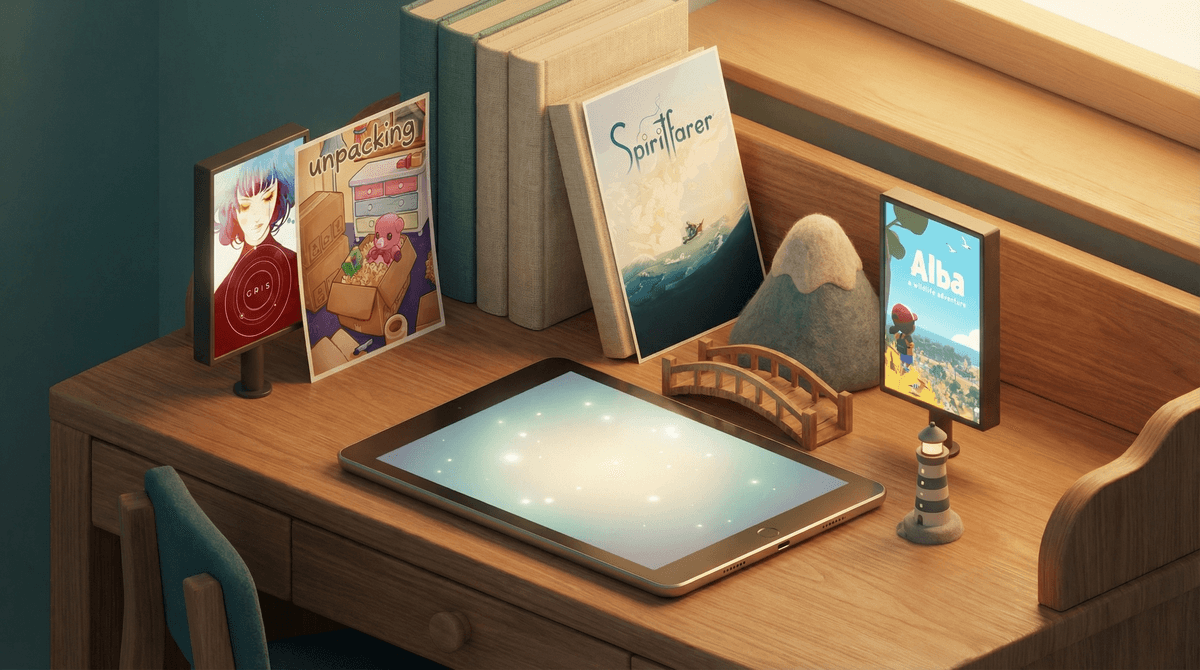
Story-driven game apps are exactly what they sound like: games where the narrative is the main event, not just window dressing between boss battles. Think of them as interactive books where your kid's choices actually matter—they're shaping the story, not just trying to get to the next level or rack up a high score.
These aren't your typical Roblox or Fortnite experiences. Instead of "eliminate 50 opponents" or "collect 1000 coins," the goal is to navigate relationships, solve mysteries, make moral choices, and see how the story unfolds based on decisions. Games like Gris, Alba: A Wildlife Adventure, and Kentucky Route Zero prioritize emotional journeys over twitch reflexes.
The interesting thing? While 55% of kids in our community data are gaming, many parents don't realize how different story-driven games are from the competitive, achievement-focused games dominating their kids' screen time. This is a completely different category worth understanding.
Here's the thing about story-driven games: they scratch a completely different itch than competitive gaming. Kids who love these games often:
Want to feel something. These games explore themes like loss, friendship, identity, and belonging. Spiritfarer, for example, is literally about helping souls pass on—and yes, kids will cry, and that's kind of the point.
Enjoy having agency. Unlike a movie or book where the story happens to characters, story games let kids BE the character making choices. Should they help this NPC or walk away? Lie to protect someone or tell the truth? These aren't arbitrary—they shape the narrative.
Appreciate slower pacing. Not every kid wants the dopamine hits of battle royale games. Some genuinely prefer exploring beautiful worlds, reading dialogue, and taking their time. A Short Hike is basically a cozy mountain climbing game about conversations and exploration.
Learn empathy through gameplay. When you play as a character facing real problems—grief, discrimination, environmental destruction—you're practicing perspective-taking in a way that's hard to replicate elsewhere.
For parents, these games often feel like a relief. They're the gaming equivalent of finding out your kid wants to watch Studio Ghibli films instead of random YouTube compilations.
Ages 6-9:
- Unpacking - Literally unpacking boxes through someone's life stages. Wordless, meditative, surprisingly emotional.
- Alba: A Wildlife Adventure - Environmental activism meets grandparent visits. Wholesome and empowering.
- A Short Hike - Climb a mountain, talk to animals, find feathers. That's it. It's perfect.
Ages 10-13:
- Gris - A wordless game about grief and recovery. Visually stunning, emotionally complex.
- Spiritfarer - Managing a boat, caring for spirits, dealing with death. Surprisingly gentle despite heavy themes.
- Life is Strange - Time travel, friendship, consequences. Some mature themes—worth researching before downloading
 .
.
Ages 14+:
- Oxenfree - Supernatural mystery with real teenage dialogue and relationship dynamics.
- What Remains of Edith Finch - Family history exploration through interconnected vignettes. Haunting and beautiful.
- Night in the Woods - College dropout returns home, deals with mental health, economic anxiety, and friendship. Real and raw.
These games take time. Unlike a Clash Royale match that's over in three minutes, story games might need 30-60 minute sessions to feel satisfying. That's actually a feature—it encourages deeper engagement rather than constant context-switching.
Reading matters. Most story-driven games involve significant text—dialogue, journals, environmental storytelling. If your kid struggles with reading, these might be frustrating rather than fun, though some like Gris are entirely wordless.
Themes can be mature. Death, loss, mental health, discrimination—these games don't shy away from real issues. That's part of their power, but it means you should actually watch them play or play alongside them, especially for younger kids. Here's how to approach these conversations.
They're usually single-player. Unlike the 50% of kids in our data who have unsupervised tablet access often spent on multiplayer games, story games are typically solo experiences. This can be wonderful for focused, reflective play—or isolating if it's their only gaming.
They're often premium purchases. Most quality story games cost $5-20 upfront rather than being "free" with in-app purchases. This is actually great—no surprise charges, no Robux-style pressure, just a complete experience.
Story-driven game apps occupy a unique space in the gaming landscape. They're not trying to maximize engagement metrics or sell you cosmetics—they're trying to tell a meaningful story that your kid participates in creating.
For the 22% of kids in our community with smartphones and the 50% with unsupervised tablet access, these games offer an alternative to the endless scroll or competitive grind. They have natural endpoints, encourage reflection, and often spark real conversations.
Are they "better" than other games? That's the wrong question. They're different—and for some kids, at some times, they might be exactly what they need.
Try one together. Download A Short Hike or Unpacking and play it side-by-side. See if this style resonates with your kid.
Ask about their choices. If they're playing a story game, ask "Why did you choose that?" rather than "Are you winning?" The conversation will be completely different.
Balance, not replacement. Story games don't need to replace all other gaming—they're just another option in the mix. Some kids will love them, others won't, and that's fine.
Use Screenwise to explore more. Check out other narrative-focused games that might fit your family's values and your kid's interests.
The goal isn't perfect digital wellness—it's intentional choices that fit your family. Story-driven games are just one more tool in the toolbox.