

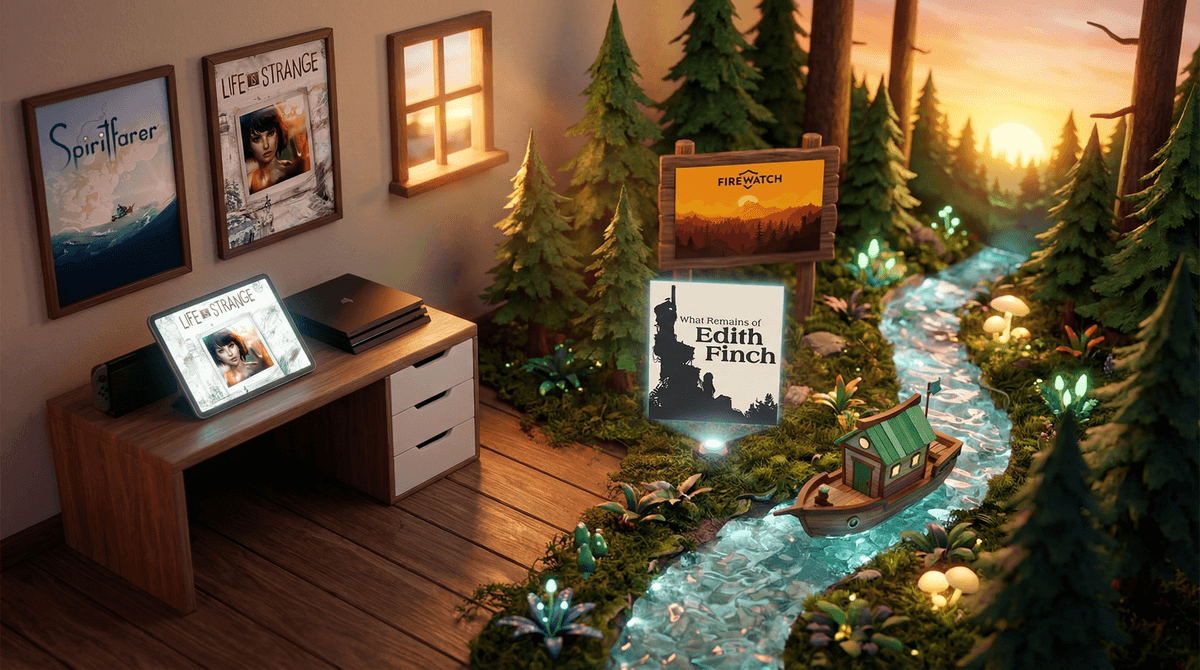
Story-based video games are exactly what they sound like—games where the narrative is the main event, not just window dressing between action sequences. Think of them as interactive novels or movies where your choices actually matter. We're talking about games like The Last of Us, Life is Strange, Firewatch, and What Remains of Edith Finch.
These aren't your typical shoot-em-up or sports games. The gameplay mechanics take a backseat to character development, plot twists, and emotional arcs. Some are point-and-click adventures, others are walking simulators, and some blend action with deep storytelling. What they all share is that the story is the reason you keep playing, not the high score.
Here's the interesting thing: about 55% of families in our community report that their kids are gaming, and while many default to Minecraft and Roblox, story-based games represent a completely different category that often flies under parents' radar. These games can be as rich as any book your kid might read for English class—sometimes richer.
Story-based games are basically the gateway drug to caring about narrative structure. They teach plot pacing, character motivation, consequence, and theme—all the stuff English teachers try to get kids excited about, except now your kid is choosing to engage with it at 9 PM on a school night.
The good ones build empathy in ways that passive media can't. When you control a character making impossible choices—do you save this person or that person? Do you tell the truth or lie to protect someone?—you're not just watching someone else's moral dilemma. You're living it. Research shows that narrative games can increase perspective-taking and emotional intelligence, especially when players inhabit characters different from themselves.
They also build critical thinking and literacy skills. Many story games involve reading dialogue, interpreting subtext, picking up environmental storytelling clues, and making decisions based on incomplete information. Kentucky Route Zero is basically playable magical realism. Disco Elysium has more text than most novels.
And honestly? Some of these games are just really, really good stories. Like, cry-in-your-room-thinking-about-it-for-days good. Spiritfarer deals with death and letting go more beautifully than most children's books. Celeste tackles anxiety and self-acceptance. These aren't frivolous time-wasters.
Not all story games are created equal, and age-appropriateness varies wildly.
Ages 8-12
Look for games with lighter themes and clear moral frameworks:
- A Short Hike – wholesome exploration with gentle storytelling
- Unpacking – wordless narrative told through organizing belongings
- Spiritfarer – deals with death but in a gentle, age-appropriate way
- Stardew Valley – has narrative elements woven into farming gameplay
Ages 13-15
Teens can handle more complex themes and moral ambiguity:
- Life is Strange – time travel, friendship, tough choices (note: some mature themes)
- Oxenfree – supernatural mystery with dialogue choices
- Firewatch – mystery in the Wyoming wilderness
- Celeste – platformer with story about mental health
Ages 16+
Older teens can engage with mature, complex narratives:
- The Last of Us – post-apocalyptic story about love and survival (violent but emotionally sophisticated)
- Disco Elysium – detective RPG with dense philosophical themes
- What Remains of Edith Finch – anthology of family stories (some dark themes)
Check the ESRB ratings, but also look beyond them. A game rated T for Teen might have themes that resonate more with a mature 15-year-old than an immature 17-year-old.
These games take time. Unlike a match of Fortnite that ends in 20 minutes, story games can take 8-30 hours to complete. That means you can't just say "one more game" as a stopping point. Instead, try "finish this chapter" or set a time limit with a 10-minute warning.
They're often single-player experiences, which means no online stranger danger, but also no social interaction. That's actually a feature for some families—it's a break from the constant connectivity of multiplayer games.
Some have replay value through different choices, but many are one-and-done experiences. That $30 game might give 15 hours of entertainment total. Compare that to a movie ticket and it's still a good deal, but it's different from games that kids play for hundreds of hours.
Watch for emotional intensity. These games can hit HARD. If your kid finishes To the Moon and seems quiet and contemplative, that's normal. These stories can be genuinely moving. It's actually a great opportunity for conversation—"What did you think about that ending?"
Consider playing together or watching. Many story games are actually fun to experience as a spectator. It's like watching a movie together, except your teen is driving the choices. This can be a great bonding activity and gives you insight into how they think through moral decisions.
Story-based video games occupy a unique space between books, movies, and games. They're not going to replace reading, but they're not brain rot either. The best ones are legitimate art that can teach empathy, critical thinking, and narrative literacy.
If your kid is already gaming (and 55% of families in our community are), story-based games might be a way to steer toward something with more depth than endless Roblox obbys. If your kid is a reluctant reader, these games might be the hook that gets them caring about character and plot.
The key is curation. Not every story game is appropriate for every age, and some are genuinely better than others. Do your homework, read reviews, and maybe even watch a spoiler-free playthrough on YouTube to see if it's right for your family.
Start a conversation: Ask your kid if they've heard of story-based games. Do they have friends who play them? What stories are they interested in?
Try one together: Pick an age-appropriate game and play it together, or watch them play. See how they respond to the narrative choices.
Use Screenwise: Find the best story games for your family about which story-based games might work for your specific family and kids' ages.
Set expectations: Talk about time commitment, emotional themes, and when it's appropriate to play. These aren't games you pause mid-scene.
Story-based games aren't for every kid or every family, but for the right player at the right age, they can be genuinely transformative. And honestly? That's pretty cool for something that starts with a controller and a screen.