

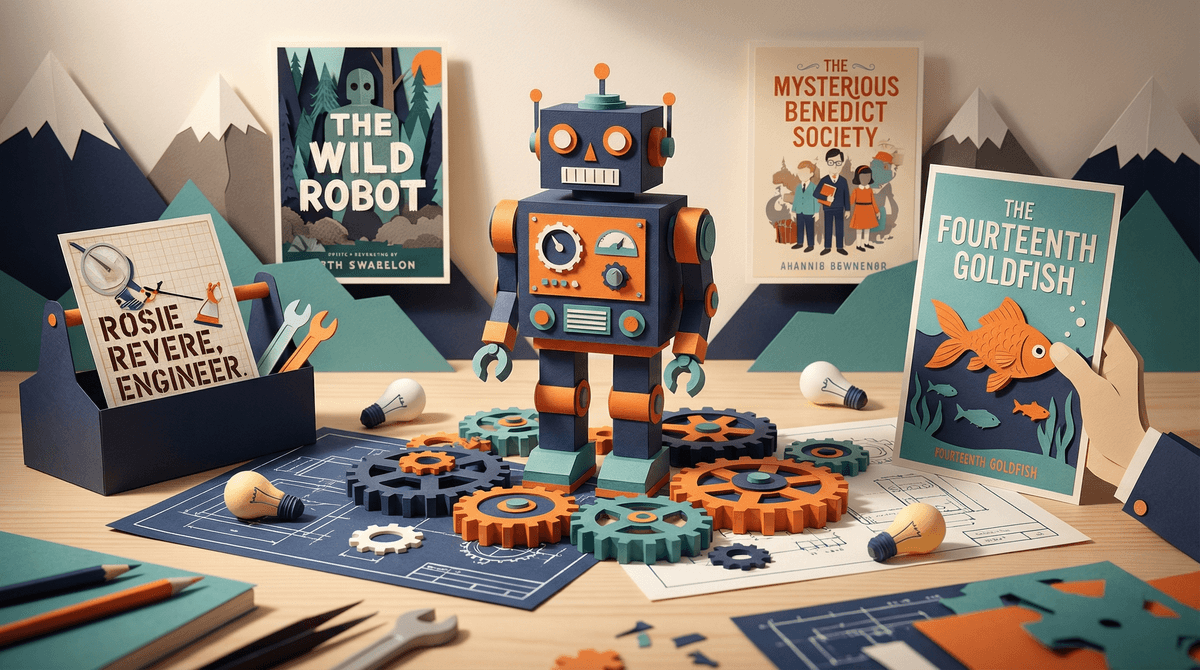
These are the books that make your kid actually want to learn about circuits, coding, and chemical reactions—because they're wrapped up in a good story with characters they care about. We're talking adventure novels where the protagonist solves mysteries using engineering principles, fantasy series where magic systems follow scientific rules, or realistic fiction where kids build robots to save the day.
The key difference from straight-up science books? The STEM concepts are baked into the plot, not tacked on as educational afterthoughts. Kids aren't reading about coding—they're following a character who codes their way out of trouble. It's the literary equivalent of sneaking vegetables into brownies, except kids actually know what's happening and still love it.
Here's the thing: by ages 8-10, a lot of kids have already decided whether they're "good at math" or "a science person." And if they've gotten the message (from school, from peers, from wherever) that STEM isn't their thing, it can stick. Fiction books create a side door into these subjects—one that doesn't feel like homework or pressure.
Plus, let's be real about the competition for your kid's attention. Roblox and YouTube are designed to be addictive. A good book can't auto-play the next chapter or send push notifications, but what it can do is create that same "just one more chapter" feeling while building reading stamina and exposing kids to new concepts.
And for kids who already love STEM? These books validate that interest and show them characters who think like they do. Representation matters in fiction—seeing yourself as the hero who loves building things or solving puzzles is powerful.
For the Future Engineers
The Wild Robot by Peter Brown is the perfect gateway. A robot named Roz wakes up on a remote island and has to learn to survive in nature. Kids don't realize they're learning about adaptation, problem-solving, and systems thinking while getting emotionally invested in a robot learning to be a parent. The sequels (The Wild Robot Escapes and The Wild Robot Protects) keep the momentum going.
The Questioneers series by Andrea Beaty—especially Rosie Revere, Engineer and Ada Twist, Scientist—started as picture books but now has chapter book versions that are perfect for this age range. The characters fail, iterate, and try again, which is honestly the most important STEM lesson there is.
For the Coders and Gamers
The Last Last-Day-of-Summer by Lamar Giles features two kids who discover time-loop technology and have to debug reality itself. If your kid plays Minecraft or talks about "glitches," they'll love this.
The Turing Test series tackles AI and coding concepts through mystery-solving. Fair warning: these can spark some deep conversations about what AI actually is .
.
For the Space and Science Obsessed
A Wrinkle in Time by Madeleine L'Engle is a classic for a reason. Tesseracts, time travel, and a female protagonist whose superpower is basically being good at math? Yes please. Some of the science is dated, but the core concepts hold up.
The Fourteenth Goldfish by Jennifer L. Holm explores biology and ethics when a girl's scientist grandfather discovers how to reverse aging. It's funny, it's weird, and it makes kids think about scientific ethics without feeling preachy.
For the Problem-Solvers
The Mysterious Benedict Society by Trenton Lee Stewart is puzzle-solving heaven. Four gifted kids use logic, observation, and teamwork to save the world. If your kid likes escape rooms or brain teasers, this is their jam.
Hoot by Carl Hiaasen weaves environmental science into a mystery about protecting endangered owls. It's accessible, funny, and teaches scientific observation without being textbook-y.
For 8-year-olds: Start with The Wild Robot, The Questioneers, or Hoot. These have simpler vocabulary and shorter chapters but don't talk down to kids.
For 9-10-year-olds: The Mysterious Benedict Society, A Wrinkle in Time, and The Last Last-Day-of-Summer offer more complex plots and themes while still being page-turners.
Reading level vs. interest level: Some of these books might technically be "below" your kid's reading level but are perfect for their interest level. That's totally fine. The goal is engagement, not struggle.
These books won't replace actual STEM learning. They're not going to teach your kid to code or build a robot. What they will do is make those subjects feel accessible, interesting, and cool. Think of them as the trailer that makes your kid want to see the full movie.
Diversity matters here. A lot of older STEM fiction defaulted to white male protagonists. The newer books on this list feature girls, kids of color, and different types of "smart." Ada Twist is Black. The Last Last-Day-of-Summer features Black protagonists in a predominantly Black community. Representation in STEM fiction helps all kids see themselves as potential scientists and engineers.
Some kids will want to go deeper. If your kid finishes The Fourteenth Goldfish and wants to know more about cellular biology, that's your cue to hit the library for age-appropriate nonfiction or find a good YouTube science channel. Follow their curiosity.
Reading together is still valuable at this age. Even if your kid can read independently, discussing these books together—talking about the science concepts, the ethical questions, the problem-solving strategies—deepens the experience. Plus, you might learn something too.
STEM-inspired fiction isn't going to magically turn your kid into the next Marie Curie, but it can keep doors open that might otherwise close. At an age when kids are forming identities around what they're "good at," these books show that science, math, and engineering can be creative, collaborative, and genuinely exciting.
The best part? Unlike Fortnite or TikTok, books don't have in-app purchases, algorithm-driven recommendations designed to maximize engagement, or comment sections full of strangers. They're just good stories that happen to make your kid's brain work in interesting ways.
Start with one book based on your kid's current interests. Loves animals? Try The Wild Robot. Into mysteries? Go with The Mysterious Benedict Society. Already plays Roblox constantly? The Last Last-Day-of-Summer bridges that gap.
Make it a trade. "For every hour of Minecraft, read for 20 minutes" is reasonable. Or create a "screen-free reading time" before bed that applies to everyone, including parents.
Visit your library. Librarians are literal experts at matching kids with books they'll love. Tell them your kid's interests and ask for STEM-inspired fiction recommendations. Most libraries also have digital borrowing through apps like Libby, which can feel more "tech-forward" to reluctant readers.
Want more personalized recommendations based on your kid's specific interests and reading level? Get STEM book recommendations for your child to get tailored suggestions for your family.