

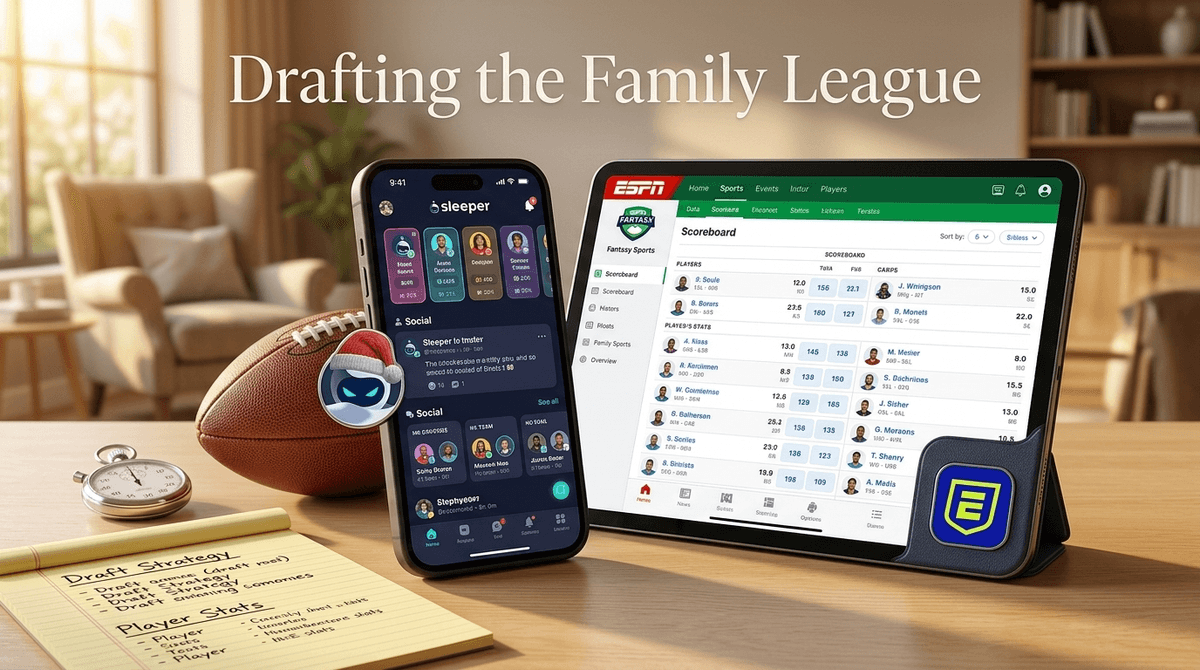
TL;DR: Fantasy sports can be a masterclass in data literacy and bonding, but the line between "fun stats" and "gambling-adjacent behavior" is thinner than ever. If your kid is asking for Sleeper, they’re joining a social network, not just a scoreboard. We recommend starting with a family-only league on ESPN Fantasy Sports or playing the low-stakes Retro Bowl to keep the focus on the game, not the "prop bets."
Check out our guide on the best sports apps for kids
Get advice about the risks of sports betting ads
It used to be that loving sports meant wearing a jersey and maybe catching the 10:00 AM kickoff. Today, for a huge percentage of kids—especially in the 10-14 age range—being a fan is an interactive, 24/7 data management job.
If you’ve noticed your kid obsessively checking "projections," "waiver wires," or "injury reports," they’ve likely entered the world of fantasy sports. At its best, fantasy football is Dungeons & Dragons for athletes; it’s a game of math, probability, and community. At its worst, it’s a gateway to the dopamine-heavy world of sports betting and "prop bets" that are currently saturating every corner of sports media.
Before we get into the "gambling gateway" concerns, let’s acknowledge the upside. Fantasy sports require a surprising amount of intellectual labor.
- Data Literacy: They are analyzing spreadsheets, comparing historical data, and understanding "value" versus "cost." It’s basically a math class they actually want to attend.
- Social Connection: It’s the "water cooler" for middle school. Having a league with friends gives them a consistent, structured way to communicate.
- Broadened Interests: Instead of just rooting for one team, they start learning about players across the entire league. It turns a niche interest into a deep knowledge base.
This is the app your kid is probably begging for. Unlike the legacy platforms, Sleeper was built as a "social-first" fantasy app. It looks and feels more like Discord or Slack than a sports site.
- The Good: The interface is modern, the "mascots" are cute, and the chat features are seamless.
- The No-BS Take: Sleeper is a social network. It has public channels where strangers talk trash, and it has heavily integrated "Sleeper Picks" (which is essentially daily fantasy/gambling). If your kid is on Sleeper, they aren't just checking scores; they are hanging out in a chat room.
The "Old Reliable." It’s a bit clunky and the UI feels like it’s from 2015, but it’s the standard.
- The Good: It’s relatively "safe" in terms of social interaction. If you set up a private family league, they aren't going to be bombarded by messages from strangers.
- The No-BS Take: The ads are relentless. You cannot escape the FanDuel or DraftKings integrations. Even if your kid isn't betting, they are being conditioned to believe that sports and betting are inseparable.
If your kid just wants scores and news without the "fantasy" management, this is often the go-to.
- The No-BS Take: theScore was literally bought by a gambling company (Penn Entertainment). The "Betting" tab is front and center. It’s a great app for stats, but it’s a billboard for the sportsbook.
If you want to redirect that football energy into something that isn't tied to real-world gambling markets, Retro Bowl is a masterpiece of a mobile game. It’s 8-bit, simple, and focuses on team management and gameplay rather than "prop bets."
Here is the part where we don't pull punches: The sports media landscape in 2026 is designed to turn fans into bettors.
When we were kids, the "spread" was something mentioned briefly by a guy in a suit on a pre-game show. Now, "Over/Under" and "Player Props" are scrolling across the bottom of the screen during every game.
For a 12-year-old, the jump from "I need Justin Jefferson to get 100 yards for my fantasy team" to "I should put $5 on Justin Jefferson getting 100 yards" is a very short leap. Apps like Sleeper make this even easier by offering "picks" that look like games but function like parlays.
Learn more about the psychology of "loot boxes" and gambling in games
Ages 8-10: The "Paper and Pencil" Phase
At this age, kids don't need an app. If they’re interested, help them track their favorite players in a notebook or a simple Google Sheets document. It keeps the focus on the math and the players, not the refreshing of a dopamine-inducing app.
Ages 11-13: The Family League
This is the sweet spot for a family-only league on ESPN Fantasy Sports or NFL Fantasy Football.
- Rule #1: No money. The prize should be something like "Winner chooses the Friday night movie" or a "Fantasy Trophy" that sits on their desk.
- Rule #2: Disable notifications. These apps use "Breaking News" alerts to pull kids back in every 20 minutes. They don't need to know about a 3rd-string tight end's hamstring at 9:00 PM on a Tuesday.
Ages 14+: The Peer League
This is when they’ll want to join leagues with their friends on Sleeper.
- The Conversation: Talk specifically about the "Picks" or "Daily Fantasy" sections of the app. Explain that these are designed to make the house money, not to make the game more fun.
- The Privacy Check: Ensure they are only in private leagues with people they actually know in real life. Public Sleeper channels can be toxic.
You don’t have to be the "fun police," but you should be the "reality check." Use these conversation starters:
- "Why do you think the app is showing you those 'Pick'em' odds?" (Help them understand the business model: the app wants them to spend money, not just have fun).
- "How does it feel when your 'projections' go down?" (Check in on the emotional volatility. If a bad game from a real-life player is ruining their entire Sunday, it’s time for a break).
- "What’s the difference between a 'skill' and 'luck' in this game?" (Fantasy is a mix of both. Betting companies want you to think it’s 100% skill so you feel confident enough to wager).
Fantasy sports can be a fantastic way for kids to develop a "growth mindset" regarding data and strategy. It can also be a 24/7 commercial for gambling.
The goal isn't to ban the apps—it's to de-couple the stats from the stakes. If your kid can tell you the yards-after-catch stats for every receiver in the AFC but doesn't know what a "parlay" is, you're winning.
If they are more interested in the "payout" than the touchdown, it’s time to bench the app and go play a round of Madden NFL 25 instead.
- Audit the Apps: Check your kid’s phone. Do they have Sleeper? If so, look at the "Picks" tab together.
- Start a Family League: Use a "boring" platform like Yahoo Fantasy Sports where you can control the environment.
- Set a "Screen-Free Sunday" Window: Pick one game a week where the phones go in the basket and you just watch the game as fans, not "general managers."
Check out our full guide to navigating Sleeper parental controls
Find more sports-related media recommendations