

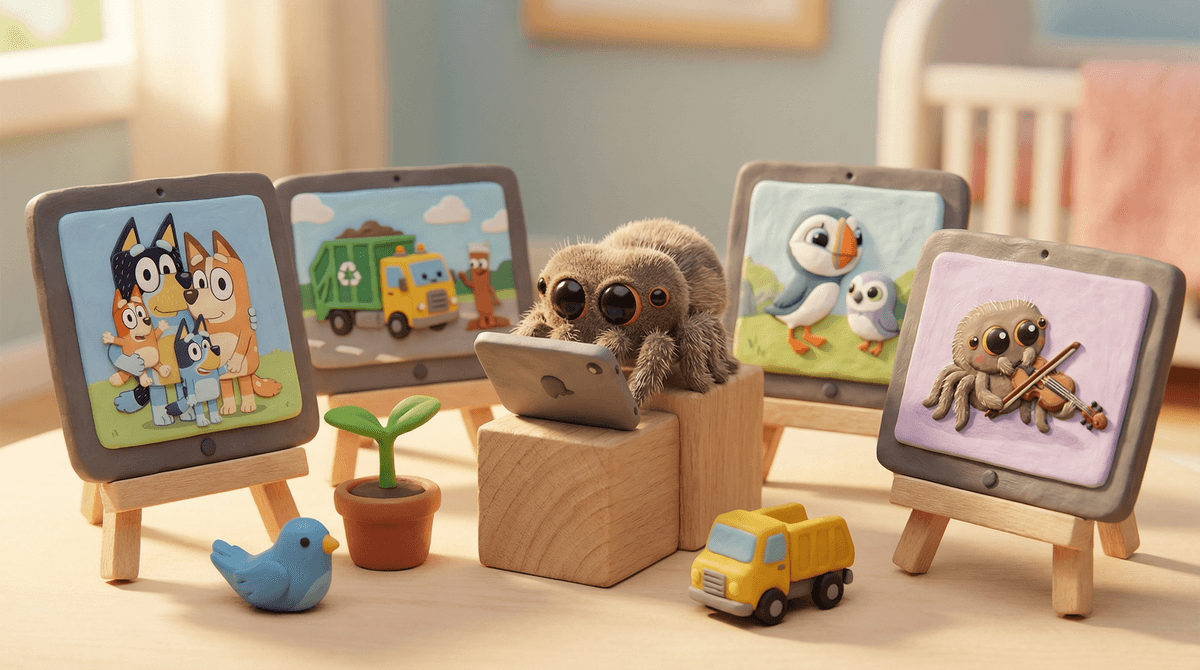
Lucas the Spider is an adorable animated series featuring a tiny jumping spider with enormous eyes and the voice of an actual child. It started as viral YouTube shorts created by animator Joshua Slice (voiced initially by his nephew) and has since evolved into a full series available on multiple platforms including YouTube, YouTube Kids, and Cartoon Network.
Each episode runs 1-7 minutes and follows Lucas as he explores his world with genuine curiosity and kindness. There's no villain, no conflict beyond "I want to make a friend" or "what does this thing do?" It's remarkably gentle content in a media landscape that often feels designed to overstimulate.
And here's the thing—it's actually working. Parents are discovering that their toddlers and preschoolers are genuinely captivated by these short, sweet stories. The question is: why, and what else is out there like it?
The pacing matches their actual attention span. We're not talking about the mythical "goldfish attention span" here—toddlers can focus for surprisingly long stretches on things that genuinely interest them. But 1-7 minutes is perfect for young kids who are still learning to follow a narrative arc.
It's actually calming. In our community data, families report an average of 4.2 hours of daily screen time, and let's be honest—a lot of that content is loud. Lucas the Spider uses soft music, a gentle voice, and slow movements. It's not trying to hijack the nervous system.
There's genuine emotional intelligence. Lucas experiences disappointment, fear, and joy in ways that feel real but not overwhelming. For 2-5 year olds learning to name their feelings, this is surprisingly valuable modeling.
Parents can tolerate it on repeat. And let's not pretend this doesn't matter. When your 3-year-old wants to watch the same thing seventeen times, you need content that won't make you want to throw the TV out the window.
Lucas the Spider is part of a broader trend of gentle, short-form animated content designed specifically for the youngest viewers. Here are similar shows worth knowing about:
StoryBots - Slightly longer episodes (around 20 minutes) but similar educational and gentle approach. The "Ask the StoryBots" series on Netflix answers kid questions with catchy songs and celebrity guests.
Bluey - The gold standard for many parents. 7-minute episodes about an Australian Blue Heeler family that somehow manages to be genuinely moving while teaching emotional regulation. Available on Disney+.
Trash Truck - Another Netflix gem with that same gentle pacing. A 6-year-old and his best friend (who happens to be a trash truck) navigate everyday adventures.
Puffin Rock - Narrated by Chris O'Dowd, this Irish series follows young puffin Oona. It's nature-focused and remarkably soothing.
Sarah & Duck - British series with wonderfully odd humor and a completely non-conflict-based structure. Sarah and her best friend Duck just... exist together in their quirky world.
YouTube is the wild west, even for "kids content." Our data shows that 42% of families allow solo YouTube usage, while 38% supervise, and 20% avoid it entirely. Even with YouTube Kids (used by only 20% of families in our community), the autoplay feature can lead kids down unexpected rabbit holes.
If you're letting your toddler watch Lucas the Spider on YouTube, turn off autoplay. The algorithm doesn't understand "gentle content only" as a category. Learn more about managing YouTube's autoplay feature .
.
Short-form isn't inherently bad, but context matters. There's a difference between watching three 5-minute episodes of Lucas the Spider and watching 15 minutes of random YouTube shorts. The former has narrative structure and emotional arcs. The latter is just stimulation.
These shows work best as transition tools. Many parents find that gentle short-form content is perfect for:
- Winding down before nap or bedtime
- Keeping a toddler occupied during a sibling's homework time
- Those desperate moments when you need 10 minutes to make dinner
They're less ideal as the primary entertainment for hours at a stretch, simply because the brevity that makes them perfect for transitions also makes them easy to binge without realizing it.
Ages 2-3: Lucas the Spider is genuinely appropriate here, though the AAP still recommends minimal screen time. If you're using it, co-viewing helps toddlers make connections between what they're watching and their real world.
Ages 4-5: This is the sweet spot. Kids can follow the simple plots independently, relate to Lucas's emotions, and even start asking questions about spiders in real life.
Ages 6+: Most kids will start aging out naturally, though there's nothing wrong with a 7-year-old who still finds Lucas comforting. Kids develop at different rates, and some need gentler content longer than others.
Lucas the Spider and similar shows represent something genuinely positive in the kids' content landscape—animation that respects young children's developmental needs without being condescending or overstimulating.
The key is being intentional about where your kids access this content. The shows themselves are great. The platforms they live on? That requires more active parenting.
If you're just discovering this genre: Start with one platform rather than letting kids browse. Netflix and Disney+ offer more controlled environments than YouTube.
If your toddler is already deep in the Lucas the Spider rabbit hole: Consider downloading episodes for offline viewing. This gives you complete control over what's next, without fighting the algorithm.
If you're trying to reduce screen time overall: These gentle shows can actually help with transitions away from screens. "One episode of Lucas, then we're going outside" is easier to enforce than "turn off YouTube now."
Want to understand how your family's viewing habits compare to others in your community? Screenwise can help you see where you fall on the spectrum and get personalized guidance based on your kids' ages and your family's values.
Because at the end of the day, it's not about finding perfect content—it's about making informed choices that work for your actual family, not some idealized version of parenting that doesn't exist.