

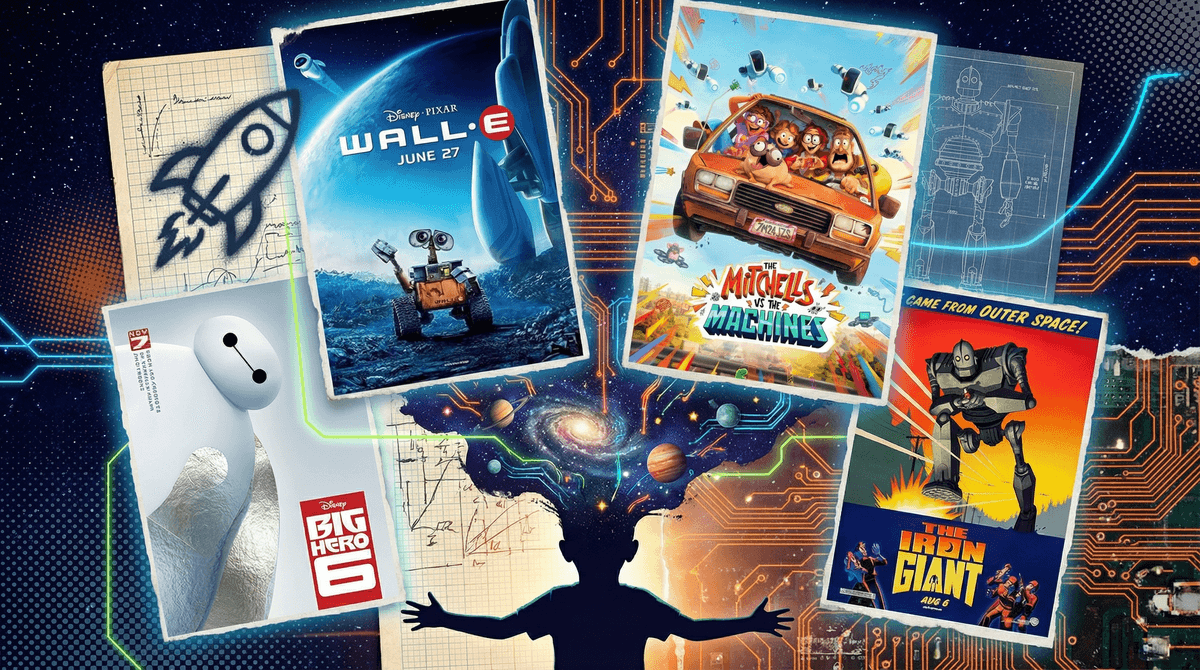
Look, we need to talk about sci-fi movies. Not the dystopian nightmare fuel that's everywhere right now, but the good stuff—the movies that make your kids ask "wait, could that actually happen?" at bedtime and then spiral into a 45-minute conversation about whether robots can have feelings.
Science fiction is basically a cheat code for parenting. It's one of the few genres where you can explore massive ethical questions—What makes us human? Should we trust technology? What do we owe each other?—without it feeling like a lecture. Your kid thinks they're just watching cool spaceships and time travel. You know they're actually processing some pretty heavy philosophy.
The problem? Most sci-fi skews either too young (talking animals in space, which, fine) or way too dark (looking at you, Black Mirror). Finding that sweet spot where the concepts are meaty but the execution isn't traumatizing takes some work.
Sci-fi hits different because it gives kids permission to ask "what if?" about literally everything. What if we could time travel? What if aliens are real? What if AI becomes smarter than us? These aren't just fun thought experiments—they're the questions that will define their actual lives.
The genre also normalizes curiosity about hard stuff. A movie about a robot learning emotions is really about empathy and consciousness. A story about first contact with aliens is about how we treat people who are different from us. Time travel movies are basically just trolley problems with better special effects.
And honestly? Good sci-fi is some of the most hopeful content out there. Yeah, there's conflict, but the underlying message is usually "humans can figure this out" or "technology can help us if we use it wisely." In 2026, when kids are growing up with AI chatbots and climate anxiety, that optimistic problem-solving mindset is worth its weight in gold.
Ages 6-9: Gateway Sci-Fi
Start with WALL-E—it's basically a masterclass in visual storytelling and environmental ethics disguised as a cute robot love story. The Iron Giant is perfect for this age too: a giant robot, Cold War paranoia, and "you are who you choose to be" as the thesis statement. Chef's kiss.
Lilo & Stitch technically counts as sci-fi (alien genetic experiment!), and it's one of the best movies ever made about found family and trauma, so there's that.
Ages 10-13: Real Concepts, Kid-Friendly Execution
This is prime time for The Mitchells vs. The Machines. It's hilarious, the animation is wild, and it's genuinely smart about AI anxiety and family disconnection. Your kids will laugh at the dog; you'll have an existential crisis about screen time. Everyone wins.
Tomorrowland gets mixed reviews but it's actually great for this age—optimistic futurism, environmental themes, and George Clooney being charming. The message is basically "cynicism is easy, hope takes work," which, yeah, we need that.
Big Hero 6 sneaks in grief processing and the ethics of revenge alongside the inflatable healthcare robot. It's also one of the few movies that shows STEM as genuinely cool without being preachy about it.
Ages 13+: The Good Stuff
Okay, now we can get into it. Arrival is stunning—it's about language, time, choice, and grief, wrapped in a first-contact story. Fair warning: it's slow and contemplative, so if your kid needs constant action, maybe wait. But if they're ready for something that will sit with them for days, this is it.
The Martian is the most optimistic "stranded in space" movie ever made. It's problem-solving porn. Matt Damon sciences the shit out of everything, and the whole world comes together to save one guy. There's some language (he says the f-word when he thinks he's going to die alone on Mars, which, fair), but it's rated PG-13 and totally manageable.
Spider-Man: Into the Spider-Verse is technically superhero stuff, but it's really about multiverse theory, identity, and the courage to step into your own story. Also the animation will blow their minds.
For kids who can handle darker themes: Ex Machina is a masterpiece about AI consciousness and manipulation, but it's rated R for good reason (some sexuality, intense themes). Watch it yourself first, then decide. Same with Her—it's about falling in love with an AI, and it's beautiful and weird and raises questions about consciousness and connection that are super relevant now.
Not all sci-fi is created equal. The genre has a bad habit of being either too sanitized (no real stakes) or unnecessarily grim (everything is terrible forever). The movies listed above thread that needle—they take ideas seriously without being nihilistic.
These movies age up with your kids. A 7-year-old watching WALL-E sees a cute robot. A 12-year-old sees environmental catastrophe and corporate dystopia. A 16-year-old sees a critique of consumerism and human complacency. You can literally rewatch the same movie and have completely different conversations.
Sci-fi is a gateway to non-fiction. After The Martian, kids want to learn about actual space exploration. After Arrival, they're suddenly interested in linguistics. This is the rare genre where "let's learn more about this" feels natural, not forced.
The special effects conversation is worth having. Modern kids are so used to CGI that they don't always register how it's made. Talking about the craft—how Pixar animates emotions, how practical effects work, how sound design creates tension—adds another layer of media literacy. Check out how these movies are made if your kid is curious about the process.
Start with the "what if" questions. After the movie ends, don't immediately launch into Discussion Mode. Just ask: "What did you think?" or "What would you do in that situation?" Let them lead.
Connect it to their actual life. If you watched a movie about AI consciousness, talk about ChatGPT or Alexa. If it's about environmental collapse, talk about recycling or climate news they've heard. Make it concrete.
Embrace the weird questions. If your kid asks "could we actually time travel?" or "will robots take over?"—that's gold. You don't need to have all the answers. Say "I don't know, let's find out" and go down the rabbit hole together. Here's what scientists actually think about AI if you need a starting point.
Talk about the ethics, not just the plot. The best sci-fi movies are basically philosophy experiments. In The Iron Giant, is the government wrong to be scared of a giant weapon? In Big Hero 6, is revenge ever justified? These are real questions with no easy answers, and that's the point.
Sci-fi movies are some of the best tools we have for raising thoughtful, curious kids who can handle complexity. They normalize asking hard questions, they make science and ethics interesting, and they're genuinely fun to watch together.
Start age-appropriate, follow your kid's interest level, and don't be afraid of the big questions. The goal isn't to have all the answers—it's to raise kids who know how to ask good questions and think critically about the future they're inheriting.
Also, seriously, watch WALL-E again. It holds up.
Make it a regular thing. Pick one sci-fi movie a month and make it your family's "big questions" night. Popcorn, movie, conversation. That's it.
Let them explore adjacent content. If they loved the movie, point them toward age-appropriate sci-fi books or podcasts like Wow in the World that explore similar themes.
Don't force it. If your kid just wants to watch the robots fight and not discuss the nature of consciousness, that's fine too. Sometimes a movie is just a movie. The conversations will happen when they're ready.