

TL;DR
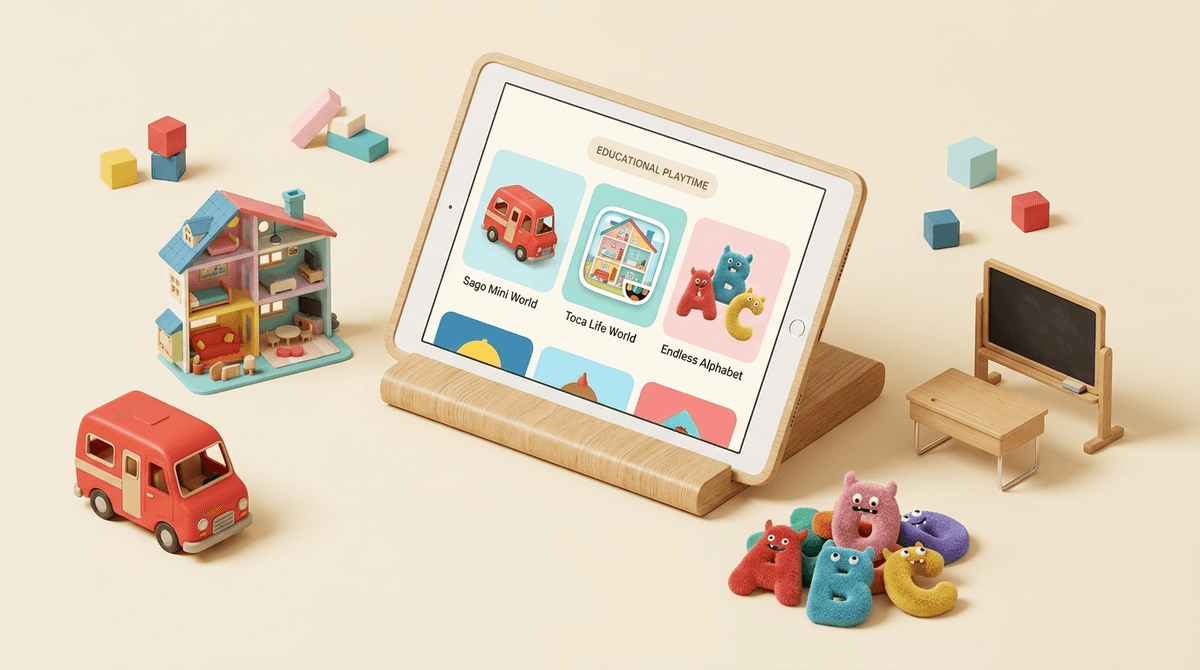
If you’re drowning in "free" toddler apps that are actually just vehicle-delivery systems for ads and accidental in-app purchases, Sago Mini is the relief you’re looking for. These are "digital toys," not games—meaning no high scores, no "Game Over" screens, and zero stress. The new Piknik Bundle is essentially a "Netflix for Toddlers" subscription that gives you full access to Sago Mini World, Toca Life World, and Endless Alphabet for one monthly fee. It’s the gold standard for ages 2-5.
Get a screen time plan for your toddler
Think of Sago Mini as a digital version of a physical toy box. In most "kids' games," there’s a specific goal: win the race, match the colors, or earn the stars. Sago Mini flips that script. It’s built on the philosophy of open-ended play.
When your toddler opens Sago Mini World, they pick a character—like Harvey the Dog or Jinja the Cat—and just... explore. They might go to a digital hair salon, build a robot, or go on a "road trip" where they decide when to stop for gas or ice cream. There are no instructions because a three-year-old doesn't need them. They just poke things to see what happens.
It’s the antithesis of the "brain rot" content found on certain YouTube Kids channels. Instead of passive consumption, it’s active decision-making.
A few years ago, you could buy Sago Mini apps individually for a few bucks each. Those days are mostly gone. Sago Mini is now part of Piknik, a subscription bundle owned by Spin Master (the same company behind Paw Patrol).
What’s included in the bundle:
- Sago Mini World: The flagship app with 40+ themed "mini-games."
- Toca Life World: The "big kid" version of digital dollhouses (huge with the 5-8 crowd).
- Sago Mini School: A more structured, curiosity-led learning app for preschoolers.
- Endless Alphabet: The best app ever made for teaching phonics and vocabulary.
The No-BS Take: If you have a toddler and a kindergartener, the Piknik bundle is a steal. If you only have one kid who only likes one specific game, paying $12/month (or about $80/year) feels like another annoying recurring charge. However, considering it removes all ads and stops your kid from accidentally buying $99 worth of "gems," it’s often worth it for the peace of mind alone.
Compare Piknik to other toddler subscriptions like Pok Pok
This is the "hub." It contains dozens of different environments. One day they’re playing "Super Juice," where they mix ingredients to make a drink for a dinosaur, and the next they’re in "Space Explorer."
- Why it works: It mimics the way kids actually play with physical toys. They don't want to "win" at playing house; they just want to move the characters around and make "boop" noises.
- Best for: Ages 2-4.
While Sago Mini World is pure play, Sago Mini School introduces "stealth learning." It uses topics kids are already obsessed with—like "Bugs" or "Big Trucks"—to teach early literacy and math.
- The Vibe: It feels less like a classroom and more like a guided discovery session. It’s great for that transition period before they head off to actual preschool.
- Best for: Ages 3-5.
Included in the Piknik bundle, this is the powerhouse of the "digital dollhouse" genre. It’s incredibly inclusive (you can customize characters with different skin tones, disabilities, and styles) and allows for complex storytelling.
- The Warning: While Sago Mini is very "safe," Toca World has a massive social media following. Kids often try to replicate "Toca Stories" they see on YouTube, which can occasionally lean into "teen drama" territory.
- Best for: Ages 5-9 (but toddlers love to poke around in it too).
This app is a masterpiece of educational design. Monsters run across the screen and knock over letters, and your child has to drag them back into place. As they drag a letter, it makes its phonetic sound (e.g., "G-G-G-G").
- Why we love it: It teaches sophisticated words like "Gargantuan" or "Cooperate" rather than just "Apple" and "Ball."
- Best for: Ages 2-6.
We’ve all seen it: the "zombie stare" kids get when they’ve been watching autoplaying YouTube videos for too long. Sago Mini apps generally avoid this because they require constant input. If the kid stops moving their finger, the action stops.
This is what developmental experts call "high-quality screen time." It’s interactive, it’s age-appropriate, and it doesn't use "dark patterns" (like flashy lights and gambling-style rewards) to keep kids addicted. When it’s time to turn it off, the transition is usually easier than when you're ripping them away from an episode of Cocomelon.
Read our guide on why interactive apps are better than passive video
- Ages 2-3: Stick to Sago Mini World. Focus on the "Road Trip" or "Forest Flyer" games. These are great for developing fine motor skills (dragging and dropping).
- Ages 4-5: Introduce Sago Mini School and Endless Alphabet. This is the "sweet spot" where they start to understand the humor in the games.
- Ages 6+: They might start to outgrow the "cuteness" of Sago Mini and want to move fully into Toca Life World or even Minecraft.
One of the biggest selling points for Sago Mini is that it is a closed loop.
- No Ads: You aren't going to see a random ad for a horror movie in the middle of a cupcake-making game.
- No Social Features: There is no chat. Your toddler is not talking to strangers.
- Parental Gate: To access settings or the store, you usually have to solve a simple math problem or follow a "hold for 3 seconds" prompt that toddlers haven't mastered yet.
The only "risk" is the subscription cost. If you forget to cancel, that $12/month will keep hitting your Apple or Google account indefinitely.
Sago Mini has done a brilliant job of creating a "universe." Harvey, Jinja, Robin, and Jack are the "Fab Four" of the Sago world. Don't be surprised if your kid starts asking for the physical plush toys or the "Sago Mini Box" (a monthly subscription craft box).
While it’s a commercial ecosystem, it’s one of the "kinder" ones. The characters are kind to each other, the humor is gentle (lots of silly hats and funny sounds), and the art style is clean and modern rather than over-stimulating.
Since Sago Mini is about exploration, it’s a great "co-play" opportunity. Instead of just handing over the iPad while you're at a restaurant, sit with them for five minutes and ask:
- "Where is Harvey going in his camper van?"
- "What kind of silly smoothie should we make for the monster?"
- "Oh no, the robot's head fell off! How do we fix it?"
This turns screen time into a shared language rather than an isolating activity.
If you are trying to be an intentional parent in a world full of digital junk, Sago Mini is a safe harbor.
Yes, the subscription model is a bit of a pill to swallow, and yes, it’s another thing to manage. But in exchange, you get a curated, ad-free, educational-ish, and genuinely delightful experience for your child. It’s one of the few apps that actually respects a toddler’s intelligence rather than just trying to farm their attention.
Next Steps
- Download the free version of Sago Mini World to see if your kid actually likes the mechanics.
- Check your existing subscriptions. If you're already paying for Toca Life World, you might be able to upgrade to the Piknik bundle for just a few dollars more.
- Set a timer. Even "good" screen time is still screen time. Use the built-in "Guided Access" on iOS to lock them into the app and set a limit.