

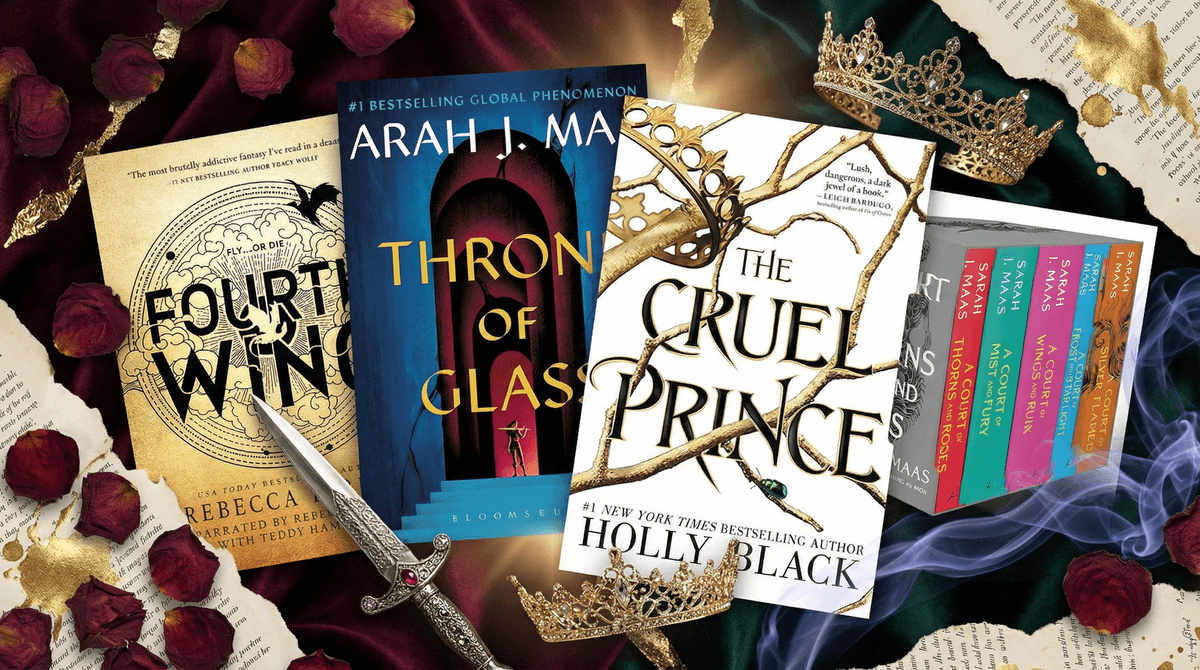
Romantic fantasy—often called "romantasy"—is the genre that's absolutely dominating teen reading right now, and if your kid has a BookTok account, their For You page is probably 90% people sobbing over fictional men with wings.
We're talking about books like A Court of Thorns and Roses (ACOTAR), Fourth Wing, The Cruel Prince, and basically anything by Sarah J. Maas. These stories blend fantasy world-building (magic systems, fae courts, dragon riders) with intense romantic relationships that often include explicit sexual content.
And when I say "explicit," I mean explicit. Not fade-to-black, close-the-bedroom-door stuff. We're talking detailed, multi-page sex scenes that would make your average romance novel blush.
The appeal is pretty straightforward: these books combine the escapism of fantasy with the emotional intensity of first love, wrapped up in stories about powerful female characters who don't apologize for their desires. The protagonists are often young women discovering their strength while navigating complex romantic relationships—usually involving morally gray love interests with tragic backstories and excellent bone structure.
BookTok has turned these books into a cultural phenomenon. Teens aren't just reading them; they're making fan art, writing fanfiction, debating team Rhysand vs. team Tamlin, and creating elaborate ranking videos of their favorite "book boyfriends." The community aspect is huge—reading romantasy is a shared experience, complete with its own vocabulary (if you don't know what "spice level" means, See an explanation of BookTok terminology ).
).
There's also something to be said for the fact that these books feature female desire front and center, written largely by women for women. In a culture that often shames girls for their sexuality, these books say "your feelings are valid and worth exploring."
Here's where it gets tricky: most romantasy books are marketed as YA (Young Adult), which theoretically means ages 12-18. But the content? That's adult romance territory.
ACOTAR, for example, starts relatively tame but by book two includes graphic sexual content that would earn an R rating if it were a movie. Fourth Wing has explicit scenes starting pretty early. The Cruel Prince is less sexually explicit but includes violence and some mature themes.
The disconnect happens because:
- Bookstores shelve these in the YA section
- The protagonists are often 18-20 years old (relatable to teens)
- BookTok doesn't age-gate content
- There's no rating system for books like there is for movies or games
So you've got 13-year-olds reading content that's genuinely written for adults, and parents often have no idea until they flip through the book themselves.
First: reading about sex is not the same as watching it. Books engage different parts of the brain than visual media, and teens can process written content differently than on-screen content. That said, the sexual content in these books is detailed and frequent.
Second: not all romantasy is created equal. There's a huge range:
- Lower spice: The Cruel Prince trilogy has romance but minimal sexual content
- Medium spice: Shadow and Bone has some sexual tension and fade-to-black scenes
- High spice: ACOTAR (especially books 2+), Fourth Wing, From Blood and Ash
Third: these books often include important conversations about consent. Many romantasy authors are intentional about depicting enthusiastic consent, communication between partners, and healthy relationship dynamics—even when the characters themselves are messy. That doesn't mean every book handles it well, but it's worth noting.
Fourth: the "morally gray love interest" trope can be problematic. A lot of these books feature male characters who are possessive, controlling, or outright violent, but it's framed as romantic because they're "protective" or "broken." This is worth discussing with your teen—what makes a relationship healthy vs. romanticized toxicity.
For ages 12-14: Most romantasy is too mature. Instead, try:
- Percy Jackson series (adventure with light romance)
- The School for Good and Evil (fairy tale fantasy with age-appropriate romance)
- Early Throne of Glass books (though the series gets spicier later)
For ages 15-16: Consider starting with lower-spice romantasy:
- The Cruel Prince trilogy
- Six of Crows duology (heist fantasy with romance subplot)
- An Ember in the Ashes (has violence and some sexual content, but less explicit)
For ages 17-18: If your teen is interested in the spicier stuff, they're close enough to adulthood that it becomes more about your family values than developmental appropriateness. This is where conversations matter more than restrictions.
If your teen is reading romantasy (or wants to), here's how to approach it:
Don't shame them. Reading about sex and relationships is a normal part of growing up. Shaming them will just make them hide what they're reading.
Ask questions: "What do you like about these books?" "How do you feel about the relationship between [characters]?" "Does anything make you uncomfortable?"
Talk about the difference between fantasy and reality. The relationships in these books are heightened, dramatic, and often include dynamics that wouldn't be healthy in real life. That's okay in fiction, but it's worth naming.
Discuss consent explicitly. Use scenes from the books as conversation starters: "I noticed they talked about what they both wanted before anything happened. Why do you think the author included that?"
Set boundaries that work for your family. Maybe you're comfortable with your 16-year-old reading ACOTAR. Maybe you'd prefer they wait until 18. Maybe you want to read it first. All of these are valid approaches.
Romantic fantasy is here to stay, and trying to keep your teen away from it entirely is probably a losing battle. These books are everywhere, and if they're not reading them, their friends are talking about them.
The better approach: stay informed, keep communication open, and use this as an opportunity to talk about relationships, consent, and healthy sexuality. These books can actually be a gateway to important conversations that might otherwise feel awkward to initiate.
And honestly? There are worse things than your teen reading books. At least they're reading.
- Check what they're reading: Look up the book on Common Sense Media or read the first few chapters yourself
- Start with lower-spice options: Check out age-appropriate fantasy with romance
- Have the talk: Use their current read as a conversation starter about relationships and consent
- Set family guidelines: Decide together what content levels feel appropriate for your teen's age and maturity
Remember: the goal isn't to control what they read, it's to help them process what they're consuming and develop critical thinking about relationships and media. You've got this.