

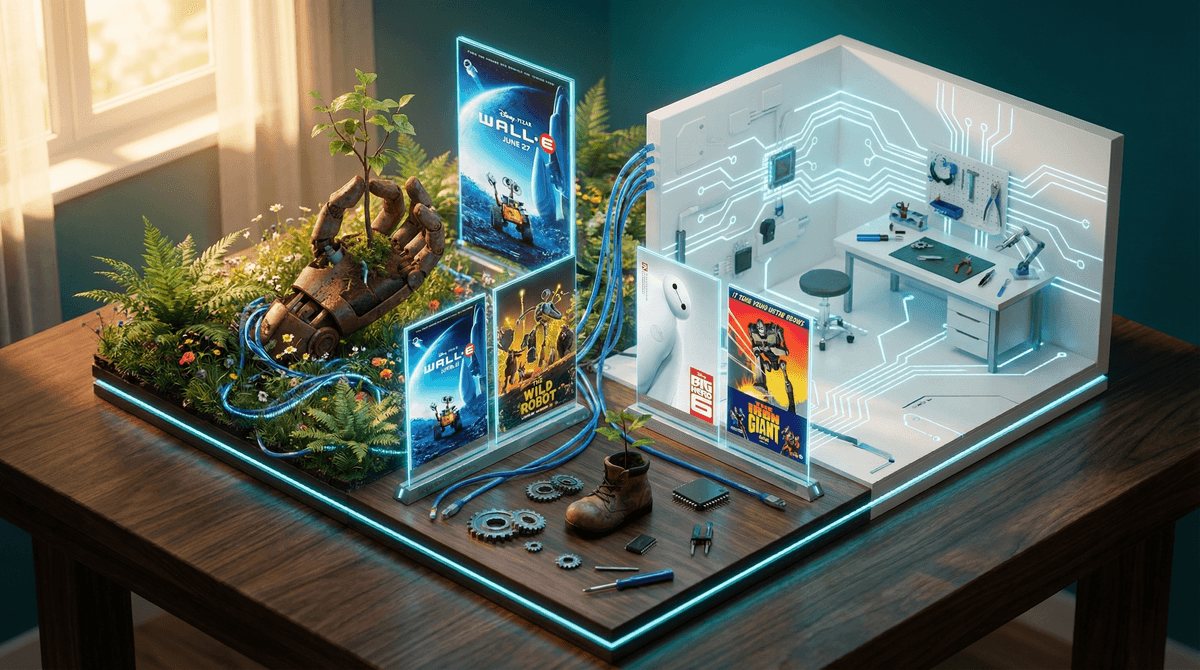
Look, we're not talking about Transformers explosions or Terminator nightmares here. The best robot movies for families are actually these beautiful, thoughtful stories about what makes someone (or something) a person. They're about loneliness, friendship, environmental responsibility, and whether having feelings is what makes you "real."
And honestly? In 2026, when our kids are growing up with ChatGPT doing their math homework and AI companions becoming actual things, these movies hit different than they did even five years ago.
The robot movie genre has given us some of the most emotionally intelligent kids' films ever made. WALL-E barely has dialogue but will wreck you. The Iron Giant is about choosing who you want to be. Big Hero 6 tackles grief through the lens of a healthcare robot. And the recent The Wild Robot explores motherhood and belonging in ways that feel both timeless and incredibly relevant.
Your kids are going to grow up in a world where AI isn't science fiction—it's just... life. They'll have conversations with chatbots, maybe form relationships with AI companions, definitely use AI tools for school and work. The question of "what makes something intelligent?" or "can machines have feelings?" isn't theoretical anymore.
Robot movies let you explore these massive questions in a safe, story-shaped way. They're conversation starters disguised as entertainment.
Plus, these films consistently tackle empathy in ways that feel more honest than a lot of "human" movies. When a robot learns to care, or when humans learn to see a robot as worthy of care, it's this beautiful mirror for how we treat anyone who seems "different."
Ages 4-7: The Gentle Introductions
The Wild Robot (2024) is absolutely stunning and surprisingly perfect for younger kids despite some intense moments. Roz the robot crashes on an island and has to learn to survive—and ends up adopting a gosling. It's about found family, adaptation, and the question of whether programming and parenting are really that different.
WALL-E (2008) remains the gold standard. A trash-compacting robot falls in love and accidentally saves humanity. The first 40 minutes are nearly dialogue-free, which makes it accessible for kids still building language skills, but the storytelling is so clear that even preschoolers get it. Fair warning: it will make your kids ask uncomfortable questions about consumerism and whether we're destroying Earth. (We are, but you know, age-appropriately.)
Ages 6-10: Building Complexity
Big Hero 6 (2014) deals with grief, revenge, and healing through the relationship between Hiro and his late brother's healthcare robot, Baymax. It's got action and humor, but it's fundamentally about processing loss. Some kids find the opening tragedy really hard—gauge your own kid's sensitivity here.
The Iron Giant (1999) is a absolute masterpiece that somehow flopped initially and is now rightfully considered one of the best animated films ever made. Set during Cold War paranoia, it's about a boy who befriends a giant robot and teaches him that "you are who you choose to be." The gun/weapon themes are handled thoughtfully, but you'll want to watch with kids under 8.
Robots (2005) is lighter fare—a robot inventor tries to make the world better while fighting corporate greed. It's funny, visually creative, and sneaks in themes about planned obsolescence and economic inequality. Not as emotionally deep as the others, but solid entertainment.
Ages 8-12: Ready for Real Questions
The Mitchells vs. The Machines (2021) is chaotic, hilarious, and surprisingly poignant about family dynamics and tech dependence. When AI decides to capture all humans, a dysfunctional family has to save the world. It's self-aware about phone addiction and the ways technology mediates our relationships—your kids will catch references you miss.
Next Gen (2018) on Netflix tackles loneliness, anger, and friendship through a girl who bonds with a secret military robot. It's got more action and emotional intensity than the younger-skewing films. Some kids find the protagonist's anger and family dysfunction relatable; others find it heavy.
Ron's Gone Wrong (2021) is basically "what if your AI best friend was broken?" It's a surprisingly sharp critique of social media, data collection, and the commodification of friendship. The "B-bots" are clearly inspired by smartphones and social platforms, and the movie doesn't pull punches about tech companies' actual business models.
Ages 10+: The Sophisticated Stuff
A.I. Artificial Intelligence (2001) is Spielberg doing Pinocchio with robots, and it's genuinely challenging. A robot child programmed to love gets abandoned by his human family. It's beautiful and devastating and raises questions about the ethics of creating beings that can suffer. Definitely preview this one—it's emotionally intense and the ending is ambiguous enough to spark real debate.
WALL-E deserves a rewatch at this age too. What seemed like a cute robot love story to your 6-year-old becomes a pretty scathing environmental and social commentary to your 11-year-old.
These movies will generate questions. Big ones. "Can robots really have feelings?" "Is Alexa alive?" "If we make something that can think, is it wrong to turn it off?" Don't panic—you don't need to have perfect answers. The conversation is the point.
The empathy lessons are transferable. When kids learn to see a robot as deserving of kindness and consideration, they're building the same muscles they need to extend empathy to humans who seem different from them. It's moral reasoning practice.
Some of these films are genuinely sad. The Iron Giant's sacrifice scene, the abandonment in A.I., even WALL-E's memory loss moment—these hit hard. That's not a bug, it's a feature. Kids need practice feeling big feelings in safe contexts. Just maybe have tissues ready.
The tech commentary is often sophisticated. Ron's Gone Wrong is essentially explaining surveillance capitalism to 10-year-olds. The Mitchells vs. The Machines is about how tech companies design for addiction. These aren't subtle. Use them as jumping-off points for conversations about how the apps your kids use actually work .
.
Watch together. I know, I know—sometimes you just want to fold laundry while they watch. But these particular films are so much more valuable when you're there to pause and discuss.
Ask open-ended questions. Not "did you like it?" but "Do you think Baymax could actually feel sad or was he just programmed to act sad? What's the difference?" Let them wrestle with it.
Connect to their actual tech use. After Ron's Gone Wrong, talk about how their actual apps collect data. After The Mitchells vs. The Machines, discuss how hard it is to put phones down and why that is. Make it concrete.
Let them be smarter than you expect. Kids can handle philosophical complexity about consciousness and personhood. They're often better at it than adults because they haven't decided on their answers yet.
Revisit at different ages. WALL-E hits completely differently at 5, 9, and 13. The Iron Giant means something new when your kid is old enough to understand Cold War paranoia or has experienced real loss.
Robot movies are having a moment, and it's not an accident. We're all trying to figure out how to live with increasingly sophisticated AI, and these stories give us a framework for thinking about it that doesn't require a philosophy degree.
They're also just really, really good movies. The best ones make you cry, make you think, and make you want to be kinder—to robots, sure, but really to everyone.
Start with The Wild Robot or WALL-E if you've somehow missed it. Work your way through the list based on your kids' ages and emotional readiness. And when they ask you whether their robot vacuum has feelings, take the question seriously.
Because in a few years, the questions are going to get a lot more complicated, and these movies are helping build the foundation for how your kids will think about intelligence, consciousness, empathy, and what it means to be alive in a world where the boundaries keep shifting.
Want to explore more? Check out our guides on AI and kids, teaching digital empathy, or browse our full collection of family movie recommendations. And if you want to dig deeper into any specific film, our media pages have age ratings, parent reviews, and detailed content breakdowns to help you decide what's right for your family.