

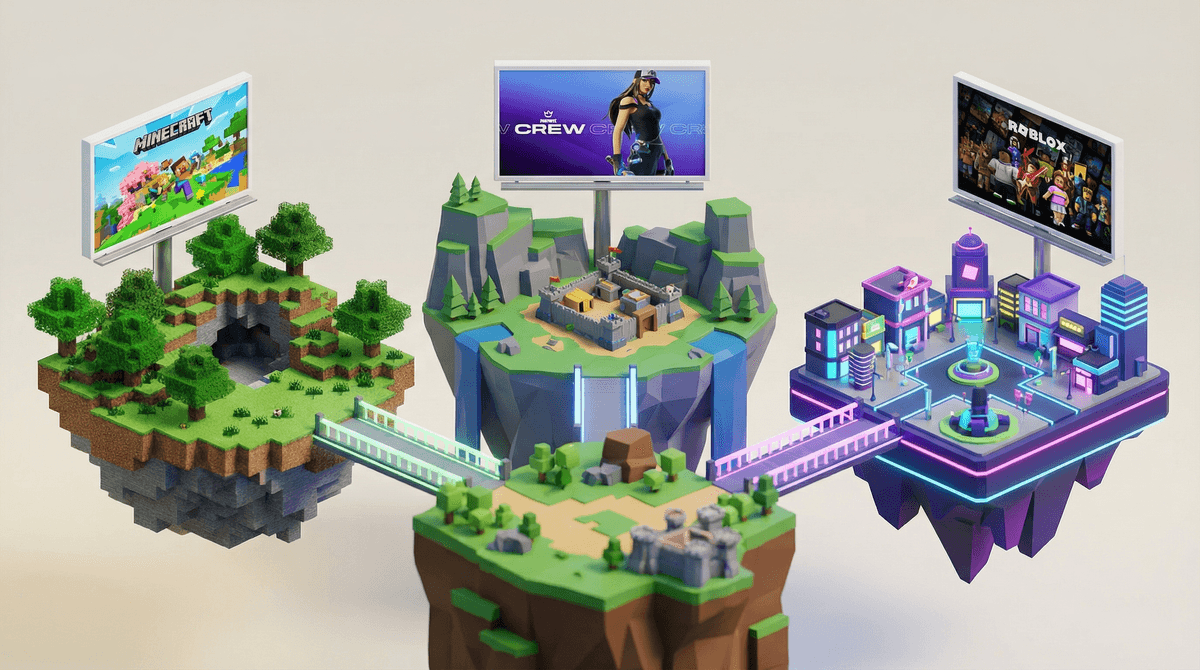
Let's start with the basics, because these three names get thrown around like everyone knows exactly what they are—but they're actually pretty different beasts.
Roblox isn't really a game—it's a platform where kids play millions of user-created games. Think of it like YouTube, but for games. Your kid might be playing a horror game one minute, a fashion show the next, and then a pizza delivery simulator. The variety is genuinely wild.
Minecraft is the digital Lego set of video games. Kids build, explore, mine resources, and create in blocky 3D worlds. It comes in different versions—you can play solo, with friends on private servers, or on public servers with strangers. The platform nature of both Minecraft and Roblox is actually really important to understand.
Fortnite is a battle royale shooter—100 players drop onto an island, gather weapons and resources, and the last person (or team) standing wins. Yes, it involves shooting, but it's cartoonish and there's no blood or gore. Kids also spend a surprising amount of time in Fortnite's creative mode, which is basically... building stuff. (Sound familiar?)
Here's what's actually happening with families like yours: 55% of kids are gaming regularly, which means if you're feeling like you're the only one dealing with this, you're definitely not.
For Roblox specifically, 60% of families report their kids are playing on public servers with other people, while 15% keep it offline-only, and 25% don't use it at all. That's the majority engaging with the social aspects, which is both the draw and the concern for most parents.
Minecraft has a more even split—40% don't use it, 35% play offline, and 25% play on servers. It tends to skew as the "safer" option for families wanting multiplayer without quite as much chaos.
Fortnite is the least common of the three, with 70% of families reporting no usage. When kids do play, it's usually with voice chat enabled—12% play with friends only, and 8% play with everyone (which, yeah, we need to talk about that).
Roblox is all about variety and social connection. Kids love that they can play whatever they're in the mood for, hang out with friends, and even try making their own games. The entrepreneurial angle is real—some kids are learning actual game design and even making money. But let's be honest, most are just playing Adopt Me! and begging for Robux.
Minecraft appeals to the builder, the explorer, the creative kid. It's genuinely open-ended—there's no "winning," just creating and surviving. Kids love showing off their builds, working on massive projects with friends, and the satisfaction of gathering resources to make something cool. It's also become a way to hang out virtually—like a digital clubhouse.
Fortnite is the adrenaline rush. It's fast-paced, competitive, and has that "just one more game" quality. Kids also love the pop culture crossovers (Marvel characters! Star Wars! Ariana Grande concerts!), the dance emotes, and honestly, the social cache of being good at it.
Roblox is officially rated E10+ (ages 10 and up), but tons of younger kids play. The challenge? Every game within Roblox has different content. There are genuinely kid-friendly games and also some surprisingly mature content. The chat feature is the other big consideration—kids can message other players, and while there are filters, they're not perfect.
Minecraft is rated E10+ as well, but it's generally considered the most age-flexible. A 6-year-old can play creative mode peacefully, while a 14-year-old can get into complex redstone engineering. The main age consideration is whether they're playing on public servers (more risk) or private worlds with known friends.
Fortnite is rated T for Teen (13+), and honestly, that rating makes sense. The shooting mechanics, the intensity, and the voice chat environment skew older. Some mature 10-11 year olds handle it fine, but it's definitely not for everyone.
All three games have figured out how to get money from your wallet , but in different ways.
Roblox uses Robux, and kids will absolutely tell you they "need" it for literally everything. Basic game: free. Looking cool, accessing certain games, getting advantages: that's where they get you. Budget $10-20/month if you're going to engage with this at all.
Minecraft has the most straightforward cost—you buy the game once (around $30), and that's mostly it. There are optional marketplace purchases for skins and worlds, but the pressure is way less intense.
Fortnite is free to download and play, but the Battle Pass ($10 every few months) and skins create serious FOMO. Kids will tell you everyone has a certain skin. They're not entirely wrong about the social pressure, but you can absolutely play for free.
Chat and voice communication is the big one across all three. Roblox has text chat, Fortnite has voice chat, Minecraft has both depending on the server. You can disable these features, but it significantly changes the social experience—which is often why kids want to play in the first place.
Who they're playing with matters more than the game itself. Playing Fortnite with three school friends on a private squad? Pretty different from Roblox on public servers with strangers. Understanding multiplayer settings is worth your time.
Screen time quality varies wildly. Minecraft building projects can be genuinely creative and engaging. Roblox can be social connection or it can be mindless game-hopping. Fortnite is intense and stimulating—some kids get genuinely dysregulated after playing.
There's no single "right" game. Minecraft tends to be the parent favorite for good reason—it's creative, less socially chaotic, and has clear boundaries. Roblox is the most popular with kids because of the variety and social aspects, but requires the most active parenting. Fortnite is the most intense and probably best saved for older kids who can handle both the gameplay and the voice chat environment.
The real question isn't which game is "best"—it's which one fits your kid's age, maturity, your family's values, and your bandwidth for staying involved. Because here's the thing: any of these games can be fine with the right setup and supervision, and any of them can be a problem without it.
Start by understanding what your kid actually wants from gaming. Social connection? Creative outlet? Competition? That'll help you figure out which game might work best.
Then set up the safety features before they start playing—privacy settings, chat restrictions, friend lists. It's way easier to start strict and loosen up than to take things away later.
And maybe most importantly: spend a little time watching them play or even playing with them. You'll learn more in 20 minutes of watching than in hours of reading parent guides (though obviously, we're glad you're here).
Want to dig deeper into any of these games specifically? Check out our detailed guides for Roblox, Minecraft, and Fortnite—or Find out which game is right for your kid your specific questions about your kid's age and situation.