

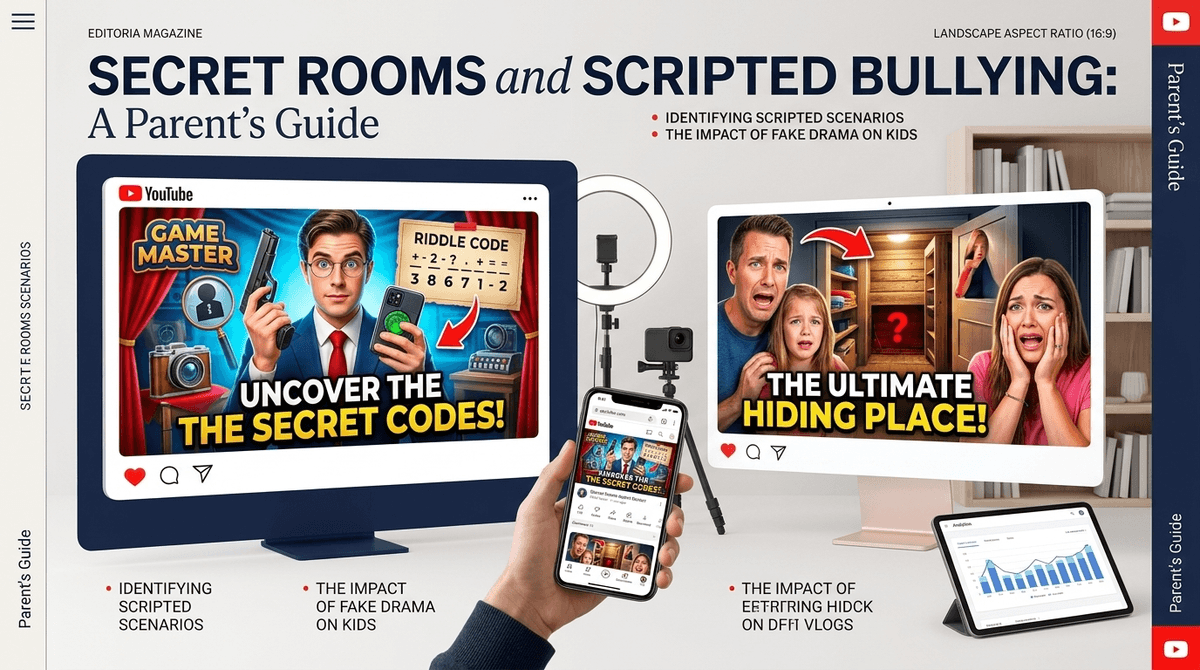
Secret Rooms and Scripted Bullying: A Parent's Guide to Rebecca Zamolo
Why the shift to high-decibel family vlogs and 'mean' challenges is leaving parents—and kids—confused about what's real.
Rebecca Zamolo is genuinely one of the more complicated YouTube channels to navigate as a parent — not because of the Game Master stuff (that's basically harmless mystery theater), but because her family vlog content has a specific flavor that a lot of parents find unsettling once they actually sit down and watch it. The materialism, the manufactured drama, the challenges where she can come across as genuinely unkind — and then, occasionally, something that crosses a line most parents would call a real problem.
That line got crossed recently in a way worth talking about seriously.
TL;DR: Rebecca Zamolo's family channel content is louder, more materialistic, and more emotionally manipulative than the Game Master series your kid is probably telling you she watches. The recent video involving her daughter's alleged bullying situation — complete with a secret room reveal, a clearly coached smile, and Rebecca confronting teenage kids on camera — is a useful case study in why this genre deserves more than a one-video-per-day limit. It deserves a real conversation.
Rebecca Zamolo built her audience on the Game Master Network — an elaborate, serialized mystery universe with secret agents, coded messages, and puzzle-solving. That content is theatrical and over-the-top, but it's basically harmless. Kids love it for the same reason they love escape rooms and spy movies.
But that's not what's keeping your daughter hooked.
The content that's actually driving engagement now — and the stuff that tends to get kids really attached — is the family vlog format. Rebecca, her husband Matt, and now increasingly their daughter Zoe, living their lives on camera. Hauls. Challenges. Reactions. Home reveals. And yes, interpersonal drama — sometimes between adults, sometimes involving their child.
This is a different genre with different risks, and it deserves to be evaluated separately.
The parasocial pull of family vlogging is strong, especially for kids in the 7–12 range. Watching Rebecca's family feels like watching a friend's life — except that friend has a bigger house, more stuff, and something dramatic happening every single day. That's not an accident. It's the format.
The challenges are designed to be emotionally activating. The hauls normalize a constant stream of new things. The interpersonal moments — even the mean ones, especially the mean ones — are compelling in the way that reality TV is compelling. Kids aren't watching because they want to be mean. They're watching because the emotional stakes feel real and the format is engineered to keep them watching.
The problem is that a lot of it isn't real. And the line between performance and genuine emotion is rarely explained to the audience — which is mostly children.
This is the part that warrants a direct conversation with your kid.
The video in question — posted recently — shows Rebecca building a secret room in her daughter Zoe's bedroom to "discover a secret she was hiding." The secret turned out to be that Zoe was being bullied. Zoe was smiling throughout. Clearly performing for the camera. And then Rebecca went into what can only be described as intimidation mode, going after the teenage kids she suspected of being involved.
Let's be honest about what's happening here.
A child's bullying situation — something genuinely painful and private — was turned into content. The smile on Zoe's face isn't a sign that everything is fine. It's a sign that she's learned to perform "okay" for the camera even when she isn't. That's not a small thing. That's a kid who has grown up with her emotional life as a production asset.
And the response — Rebecca going "crazy mode" (as one parent described it) and confronting or intimidating teenage kids on camera — models something genuinely problematic. It frames adult intimidation of children as satisfying. It frames public exposure as justice. It frames a parent going nuclear as heroic rather than, potentially, making a bullying situation significantly worse for the kid who's already being targeted.
This isn't a "well, every family is different" situation. Filming your child's bullying crisis and broadcasting it to millions of people is not a healthy response to bullying. Full stop.
This is the part parents often miss because they're focused on whether the content is age-appropriate, not what the framing teaches.
Kids watching this video absorb several lessons, none of which are great:
- Privacy is conditional. Your room, your problems, your friendships — all of it can be content.
- Emotional pain is a performance opportunity. Zoe's smile isn't authentic, but it's what the audience expects, so that's what gets delivered.
- Confrontation is entertainment. The more dramatic the response, the better. Going "crazy mode" gets views.
- Bullying is a mystery to solve, not a relationship to navigate. The framing turns a complex social situation into a villain-hunt.
If your daughter is watching this and internalizing it as "how families handle hard things," that's worth a conversation.
Separate from the bullying video, the broader pattern you've noticed — the materialism, the challenges where Rebecca can come across as genuinely unkind — is consistent with what a lot of parents report about this channel.
The haul content and constant acquisition framing is pretty standard for this genre, but it's worth naming: research on materialism in kids consistently shows that exposure to aspirational consumption content increases kids' desire for stuff and reduces satisfaction with what they have. That's not alarmism — it's just what the data shows.
The "mean" challenge content is trickier. Some of it is probably just Rebecca's on-camera personality being abrasive in a way that reads as unkind. Some of it may be more intentional. Either way, if your kid is watching someone they admire model unkindness as entertainment, it's worth occasionally asking: what did you think about how she talked to that person?
In our Screenwise community data, 42% of kids are watching YouTube solo — no supervision, no co-watching, just a kid and an algorithm. Another 38% watch with some supervision. Only 20% of families have opted out of YouTube entirely.
Meanwhile, the average child in our community is logging 4+ hours of screen time on weekdays and 5 hours on weekends. YouTube is a significant chunk of that for most families.
The one-video-per-day limit you've set is genuinely thoughtful — that's a real boundary, and it's more than most families have in place. But the which video matters as much as the how many. YouTube's recommendation algorithm is very good at surfacing the most emotionally activating content, which on a channel like Rebecca Zamolo's tends to be exactly the content you're most concerned about.
You don't need to ban Rebecca Zamolo to make this a learning moment. Some questions worth asking your daughter:
-
"Zoe was smiling in that video, but do you think she was actually happy about her mom filming her bullying situation?" This opens a conversation about performed emotion vs. real emotion — a genuinely important media literacy skill.
-
"If something hard happened to you, would you want it on YouTube?" This helps kids think about privacy as something they have a right to, not just something parents impose.
-
"What do you think happened after the camera turned off?" This is a great question for any reality-adjacent content. What's the version of this story we didn't see?
-
"Was Rebecca being fair to those teenagers?" Kids often have strong instincts about fairness. Let her work through it.
Get more conversation starters about family vloggers and kids
If your daughter is drawn to the "watching a family live their life" format, there are better versions of that itch to scratch. Good Mythical Morning scratches the "two people being goofy together" energy without the family drama. For kids who like the mystery/puzzle angle of the Game Master stuff, Escape the Night delivers that in a more clearly fictional format.
If she's open to non-YouTube content, The Mysterious Benedict Society (Disney+) hits a lot of the same puzzle-solving, secret-room, mystery-solving notes — without a real child's emotional life being used as a plot device.
Find more YouTube alternatives for kids who love drama and mystery
Q: Is Rebecca Zamolo appropriate for kids?
The Game Master content is generally fine for kids 6 and up — it's theatrical mystery content with no real objectionable material. The family vlog content is more complicated: it's not age-inappropriate in the traditional sense, but it models materialism, performed emotion, and adult behavior that parents may not want normalized. The recent bullying video specifically is worth watching before your kid does.
Q: Why does my daughter like Rebecca Zamolo if she's not watching the Game Master stuff?
Family vlogging has a powerful parasocial pull — it feels like watching a friend's life, which is deeply engaging for kids 7–12. The drama, the hauls, the interpersonal dynamics all activate the same emotional circuits as reality TV. It's engineered to be compelling, and for many kids it is.
Q: Is it okay that Rebecca Zamolo confronted her daughter's bullies on camera?
This is genuinely concerning content. Filming a child's bullying situation and broadcasting it publicly can make bullying situations worse for the child, teaches kids that private pain is content, and models adult intimidation of teenagers as heroic. It's a reasonable thing to flag with your kid and discuss directly. Get tips on how to talk to kids about bullying content online.
Q: How do I limit YouTube without a huge fight?
The one-video-per-day approach you're already using is solid. Beyond that, co-watching occasionally — even just once a week — gives you visibility into what she's actually watching and opens natural conversation. YouTube parental controls can also help you block specific channels or limit recommendations.
Q: What age is Rebecca Zamolo for?
Rebecca Zamolo's content is primarily aimed at kids roughly ages 6–12, and that's largely who watches it. But the family vlog content — with its adult relationship dynamics, materialism, and occasional manufactured crises — skews toward the older end of that range in terms of what kids are actually processing from it.
The one-video-a-day rule is a reasonable response to a channel that's genuinely hard to stomach in large doses. But the more important move is treating the bullying video as an opening — not to ban Rebecca Zamolo, but to have a real conversation about what your daughter just watched.
A kid smiling while her mom films her bullying crisis is not a heartwarming moment. It's a kid who's learned to perform for an audience. Your daughter probably sensed something was off. That instinct is worth honoring and building on.