

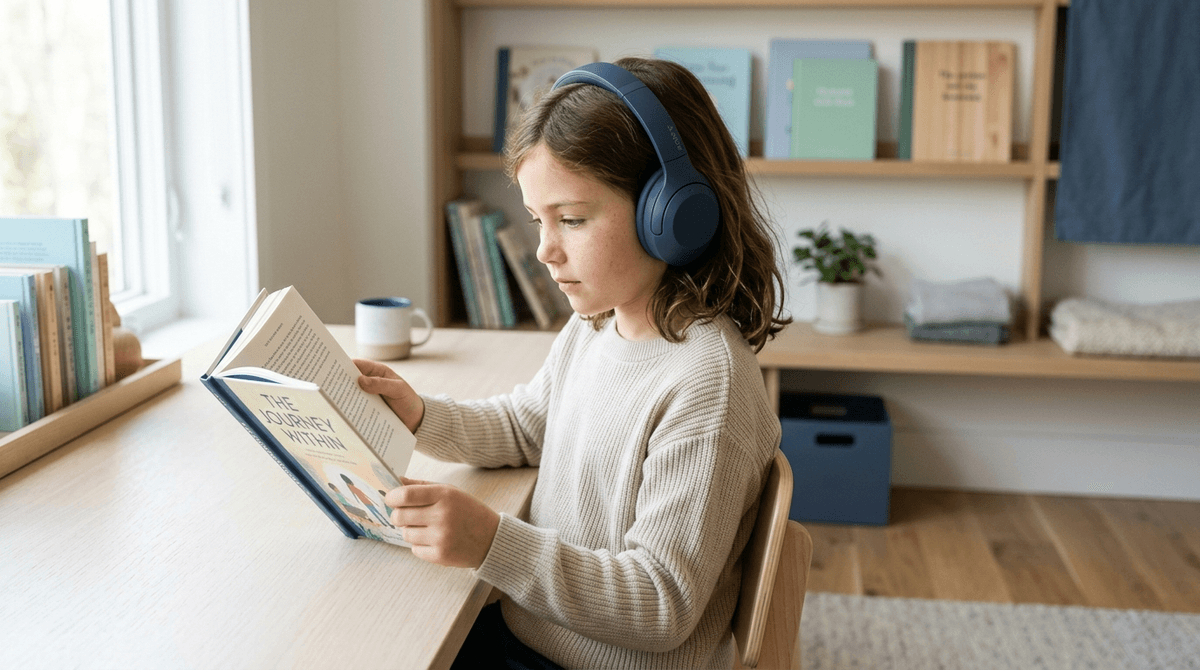
Reading and listening to a story aren't the same cognitive task for young kids. Third and fourth graders process these inputs on separate tracks, meaning skill in one doesn't automatically translate to the other.
Reading and listening comprehension are separate skills that develop at different speeds
While we often treat "understanding a story" as a single ability, elementary students show distinct growth patterns for reading versus listening. Reading skills are highly responsive to formal classroom instruction, while listening comprehension follows its own independent trajectory that isn't as easily moved by standard lessons.
Reading skills respond more to classroom instruction than listening does
Third and fourth graders show significant jumps in reading comprehension following formal school periods, whereas listening skills develop more steadily and are less influenced by specific teaching. This suggests that while kids "pick up" listening through exposure, they "learn" reading through targeted, direct practice.
A child’s ability to listen to a story does not predict how well they will read it
Kids who excel at following a read-aloud aren't necessarily the ones who will ace a reading comprehension test on the same material. Because these two pathways develop independently, a child can be a sophisticated listener while still needing significant support to translate those same ideas from a printed page.
Comprehension pathways remain distinct throughout the school year
The gap between listening and reading skills persists over time rather than merging into a single, unified "understanding" skill. Longitudinal data shows that the independence of these two cognitive tracks is a stable feature of early elementary development, meaning the "listening brain" and the "reading brain" are doing different work.
What this means for your family
- Don't swap independent reading for audiobooks and expect the same literacy growth; both are valuable, but they train different cognitive muscles.
- Use read-alouds to introduce complex themes and vocabulary that are currently above your child’s independent reading level.
- Prioritize direct reading practice at home, as this specific skill is highly "plastic" and improves significantly with targeted attention.
- If your child is a great listener but struggles with reading, treat it as a common developmental gap rather than a sign of a general comprehension problem.
Honest caveats
The study tracked 151 children, which is a moderate sample size but not large enough to represent every learning style or demographic. The data was collected in 1990, pre-dating the digital era and modern literacy curricula which may influence how children process information today. Additionally, the researchers used a specific "sentence verification" method to measure comprehension rather than a wide range of different testing styles.
Where this comes from
Royer, James M., And Others (1990). Patterns of Individual Differences in the Development of Listening and Reading Comprehension. Contemporary Educational Psychology. — https://eric.ed.gov/?id=EJ409678