

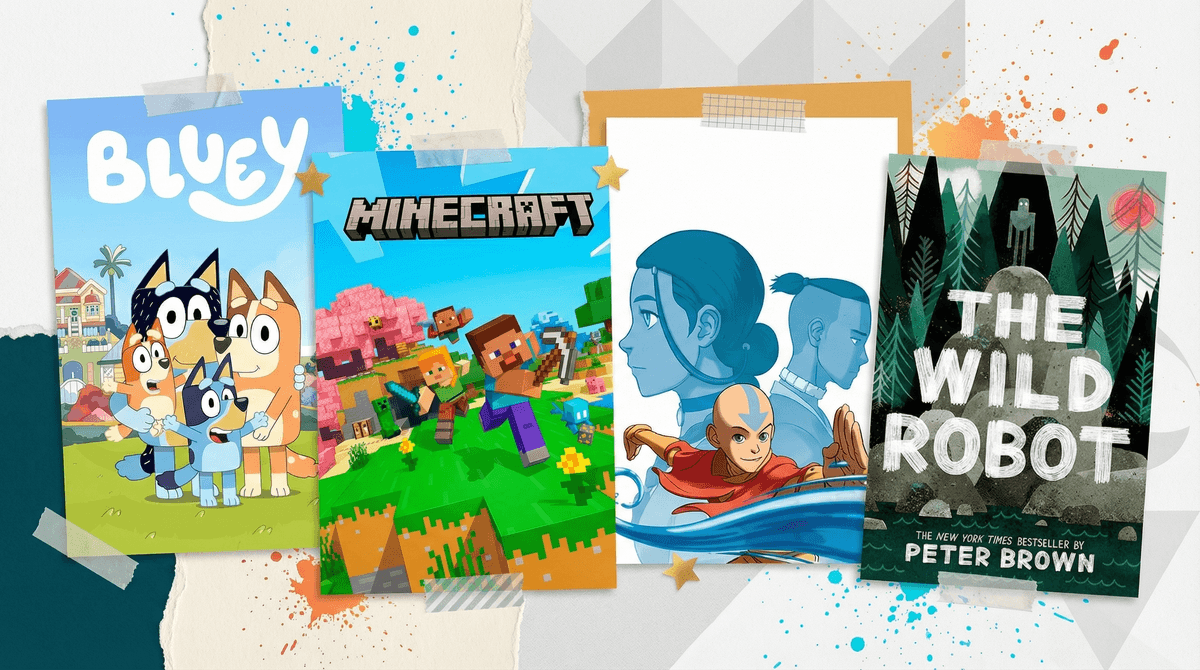
Let's be honest: the phrase "quality media" can sound a little pretentious, like you're only letting your kids watch PBS documentaries narrated by David Attenborough while other families are living their best lives with Bluey and Minecraft. But here's the thing—quality media isn't about being a snob. It's about being intentional.
Quality media is content that does something positive for your kid beyond just filling time. It might teach them something, make them think, help them process emotions, inspire creativity, or just genuinely entertain them without rotting their brain in the process. And yes, that can absolutely include Bluey, Minecraft, and even some YouTube channels that aren't just unboxing videos or Skibidi Toilet remixes.
The challenge? We're drowning in options. Netflix alone has thousands of titles. YouTube has creators uploading 500 hours of content every minute. Your kid's friends are all playing different games, watching different shows, and you're supposed to somehow vet all of it while also, you know, working and feeding people and occasionally sleeping.
So let's talk about how to actually evaluate this stuff without getting a PhD in media studies.
Here's what the research tells us: not all screen time is created equal. A kid watching a well-crafted show like Avatar: The Last Airbender is having a fundamentally different experience than a kid watching an AI-generated YouTube video of cartoon characters doing random nonsense for 47 minutes.
Quality media can:
- Build vocabulary and literacy (especially for younger kids)
- Model emotional regulation and problem-solving
- Introduce diverse perspectives and experiences
- Spark genuine interests (astronomy, cooking, coding, whatever)
- Create shared family culture (inside jokes, discussion topics, values)
Meanwhile, low-quality content often:
- Keeps kids in a passive, zoned-out state
- Overstimulates without engaging (fast cuts, loud noises, no narrative)
- Promotes consumption over creation
- Models behavior you'd rather your kid not adopt
The gap between these two experiences is enormous. And it matters way more than whether your kid gets 1 hour or 2 hours of screen time.
When you're evaluating any piece of media—a show, game, app, book, whatever—run it through these five questions:
1. Does it respect my kid's intelligence?
Quality media doesn't talk down to kids. It trusts them to handle complex emotions, follow intricate plots, and think critically. Gravity Falls is a great example—it's got mysteries, character development, and jokes that work on multiple levels. Compare that to content that just throws bright colors and loud noises at kids like they're tiny slot machines.
2. Does it invite interaction or just consumption?
The best media makes kids want to do something afterward. Bluey episodes regularly inspire elaborate pretend play. Minecraft is basically a creativity engine. Brains On! makes kids want to ask questions and do experiments. If your kid just sits there glazed over and then asks "what's next?" the second it ends, that's a red flag.
3. What values is it modeling?
Every piece of media teaches something, whether it means to or not. What does this show/game/channel say about how to treat other people? How to handle conflict? What matters in life? The Hunger Games has violence, sure, but it's fundamentally about the cost of violence and the importance of compassion. Meanwhile, some content models casual cruelty, materialism, or stereotypes without any critical lens.
4. Is it age-appropriate in a meaningful way?
This isn't just about violence or language. It's about whether the content matches your kid's developmental stage. A 7-year-old and a 12-year-old need different things. The 7-year-old might love Wild Kratts while the 12-year-old needs something with more narrative complexity like Percy Jackson. Content that's too young is boring; content that's too old can be confusing or anxiety-inducing.
5. Would I be okay with my kid consuming this regularly?
One episode of something mediocre isn't going to break your kid. But if this became their go-to, their default, what they watched/played for hours every week—would you be okay with that? That's your litmus test.
Start with trusted curators. You don't have to evaluate everything from scratch. Common Sense Media has detailed reviews. Screenwise has WISE scores that break down educational value, positive messages, and potential concerns. Find reviewers whose values align with yours and use them as a filter.
Ask other parents—but be specific. Don't just ask "what does your kid watch?" Ask "what shows have actually led to interesting conversations?" or "what games have kept your kid engaged in a creative way?" You want the thoughtful recommendations, not just the popular ones.
Sample before committing. Watch the first episode with your kid. Play the game for 20 minutes. Listen to a podcast episode together. You'll know pretty quickly if it's a fit. And honestly, sometimes you'll be surprised—Hilda looks like just another kids' cartoon but it's genuinely lovely and thoughtful.
Pay attention to what sticks. If your kid watches something and then wants to draw the characters, act out scenes, or ask you questions about it, that's quality. If they watch something and immediately forget about it, that's filler.
Don't be afraid to course-correct. If you realize something isn't working—it's making your kid anxious, or hyperactive, or they're picking up phrases you don't love—it's totally fine to say "you know what, we're going to take a break from that one." You're not ruining their life, I promise.
Ages 2-5: Look for content with clear narratives, emotional learning, and not too many fast cuts. Daniel Tiger's Neighborhood and Bluey are gold standard here. For games, focus on creative play like Toca Boca apps.
Ages 6-9: This is when kids can handle more complex stories and start to distinguish fantasy from reality. Avatar: The Last Airbender, Hilda, and The Wild Robot are all excellent. For games, Minecraft and Animal Crossing offer open-ended creativity.
Ages 10-13: Tweens need content that respects their growing sophistication while still being appropriate. The Hunger Games, Spider-Man: Into the Spider-Verse, and Stardew Valley all work here. This is also when podcasts like Radiolab can be great for car rides.
Ages 14+: Teens can handle (and benefit from) more mature themes, moral complexity, and challenging content. The key is that it should still be thoughtful—The Bear is intense but purposeful, while some reality TV is just... not great for anyone's brain.
Quality media isn't about being perfect or pretentious. It's about being intentional. It's about recognizing that what your kids consume shapes how they think, what they value, and who they become—and then making choices that align with that reality.
You don't have to ban everything fun. You don't have to only allow educational content. You just have to pay attention, ask good questions, and be willing to say "actually, that one's not working for us" when something isn't serving your family.
And here's the secret: when you curate thoughtfully, your kids often end up preferring the quality stuff anyway. Because it's actually more satisfying. It sticks with them. It gives them something to think about and play with and talk about.
So yes, your kid can absolutely watch YouTube. Just maybe SciShow Kids instead of whatever algorithmic nightmare the autoplay was about to serve up next.
Ready to get specific? Use Screenwise to explore detailed reviews and ratings for the shows, games, and apps your kids are asking about. Check out alternatives to their current favorites that might be a better fit. And if you're ever stuck wondering "is this actually good or am I just tired?" — trust your gut. You know your kid better than any algorithm does.