

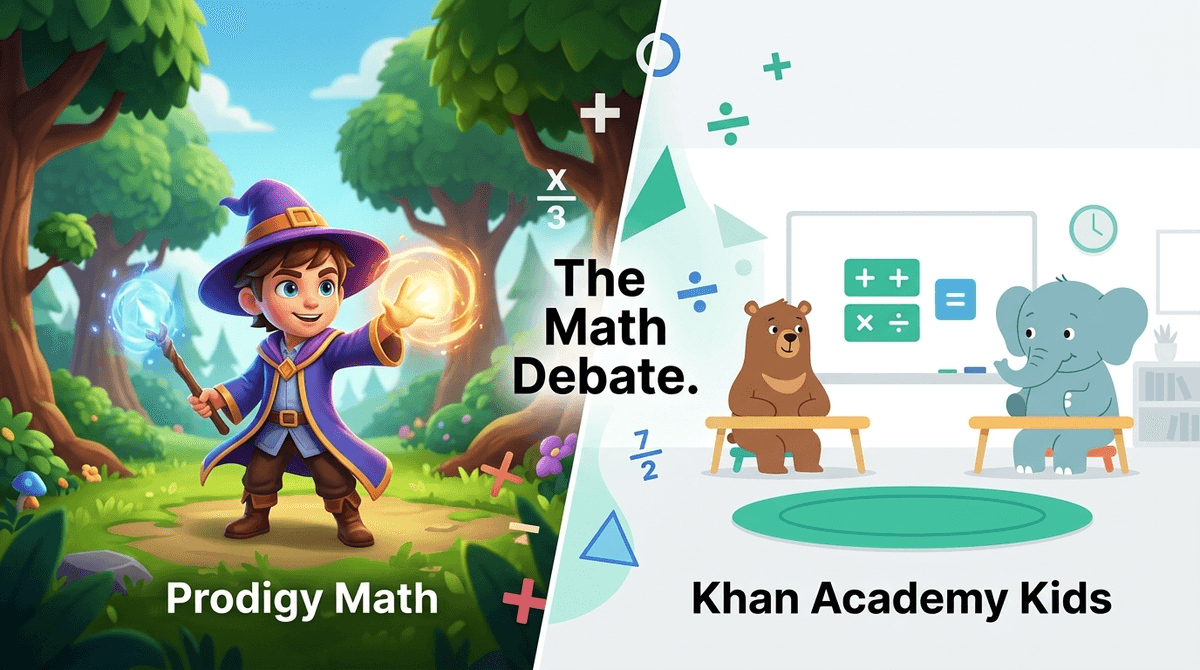
TL;DR: Prodigy Math is a "math-flavored" video game that is incredible for engagement but can feel like a "pay-to-win" trap if you don't buy the membership. Khan Academy Kids is the gold standard for actual learning—it’s 100% free, ad-free, and covers everything from phonics to logic, but it lacks the "high-octane" dopamine hits that keep older kids coming back.
If your kid hates math, get Prodigy Math. If you want a solid educational foundation without the "brain rot" gaming mechanics, stick with Khan Academy Kids.
We’ve all been there: you’re trying to cook dinner, the kids are vibrating at a frequency only dogs can hear, and you hand over the iPad. You tell yourself, "It’s fine, they’re doing something educational." But then you look over and see your seven-year-old engaged in an epic wizard battle, throwing fireballs at a sentient pile of sludge.
You ask, "Is that math?" and they scream, "I’m catching a Chill & Char, Mom!"
Welcome to the modern dilemma of Prodigy Math versus Khan Academy Kids. One feels like a Pokémon clone with a calculator attached, and the other feels like a digital version of the best Montessori classroom you can’t afford.
Here is the breakdown of which one actually deserves that precious storage space on your device.
Prodigy Math is a fantasy role-playing game (RPG). Your child creates an avatar (a wizard), wanders through various "worlds," and engages in battles. To win a battle or cast a spell, they have to solve a math problem.
It is essentially a "math-flavored" video game. The math is the barrier to entry for the fun stuff—the gear, the pets, and the leveling up. It covers curriculum-aligned math for Grades 1-8, but the gameplay loop is pure Roblox energy.

Khan Academy Kids is a multi-disciplinary learning app designed for children ages 2 to 8. It’s created by the folks at Khan Academy (the non-profit that probably got you through college stats).
Unlike the main Khan Academy site, which is heavy on instructional videos and practice, the "Kids" version is vibrant, interactive, and character-driven. It features a cast of animals like Kodi the Bear and Ollo the Elephant who guide kids through math, reading, social-emotional lessons, and even "executive function" games.
Kids love Prodigy Math because it doesn't feel like school. It taps into the same psychological triggers as Minecraft or Pokémon. They want to:
- Collect "Epic" pets.
- Unlock new outfits for their wizard.
- See their friends' avatars in the "world" (don't worry, the social interaction is very limited and safe).
- Win battles.
The math is almost incidental to them. They will solve 50 addition problems just to get a new hat. If you have a "reluctant learner" who treats a math worksheet like a personal insult, Prodigy Math is a miracle worker.
The Good: It keeps them quiet and they are technically doing math. The dashboard for parents is actually quite good—it tells you exactly which skills your kid is struggling with (like "geometry" or "fractions") and sends you weekly reports.
The Bad: The "Membership" push is relentless. Prodigy Math is "freemium." The basic math content is free, but all the "cool" stuff—the best pets, the fast leveling, the exclusive gear—is locked behind a subscription that costs about $15 a month (or less if you pay yearly).
If your kid is playing the free version, they will see other kids with "Member" gear and pets. It creates a "haves vs. have-nots" dynamic that can lead to some serious begging at the dinner table. It’s not "brain rot" in the sense of Skibidi Toilet videos, but it is a very commercialized experience.
If Prodigy Math is a sugary cereal that happens to be fortified with vitamins, Khan Academy Kids is organic oatmeal with fresh berries.
- Zero Cost: It is completely, 100% free. No ads, no "memberships," no "buy this dragon for $4.99."
- Holistic Learning: It isn't just math. It has an incredible library of digital books (some from National Geographic), phonics lessons, and even "yoga" breaks.
- High Quality: The pedagogy is top-tier. It doesn't just ask "What is 2+2?" It uses "manipulatives" (digital blocks or items) to help kids understand the concept of addition.
The downside? Around age 7 or 8, kids might start to find it "babyish." It doesn't have the high-stakes competitive edge of a game. It’s "fun," but it’s not "addictive."
| Feature | Prodigy Math | Khan Academy Kids |
|---|---|---|
| Best For Ages | 6–14 (Grades 1-8) | 2–8 (Pre-K to 2nd) |
| Primary Focus | Math only | Math, Reading, Logic, SEL |
| Cost | Free (with $15/mo premium) | 100% Free |
| Engagement Style | High-octane RPG battle game | Calm, interactive activities |
| "Distraction" Level | High (lots of non-math gameplay) | Low (focused on learning) |
| Offline Mode | No | Yes (limited) |
Learn more about the best math websites for elementary students
Both platforms are very safe, but they have different vibes.
Kids can see other players' avatars in the game world. They can use "canned" phrases to communicate (e.g., "Hello!" or "Let's battle!"), but there is no open chat. Your child cannot be groomed or bullied by a stranger here. However, the pressure to spend money (the "membership") is a psychological safety point to consider—it can cause "FOMO" (fear of missing out) and frustration.
This is a walled garden. There is no social component. No one can see your child, and your child cannot see anyone else. It is a solo experience. It is one of the few apps where you can truly "set it and forget it" without worrying about what they might click on.
One of the biggest complaints about Prodigy Math is that kids spend 70% of their time "walking" around the world, customizing their house, or choosing their outfit, and only 30% of their time doing math.
If you are looking for efficiency—meaning you want your kid to master 20 problems in 10 minutes—Prodigy Math is a bad choice. You’d be better off with IXL or Zearn.
But if your goal is "positive math sentiment"—meaning you want your kid to stop crying when you say the word "subtraction"—then that 70% "wasted" time is actually the secret sauce. It builds a positive association with the subject.
If you decide to let them play Prodigy Math, have the "Membership Talk" early.
Say this: "You can play this game because it helps you practice math, but we are using the free version. You're going to see other wizards with cool dragons and capes that we aren't going to buy. If you can enjoy the game without complaining about the member stuff, we can keep it. If it makes you feel sad or grumpy that you don't have the 'Epic' pets, then this isn't the right game for us."
For Khan Academy Kids, the conversation is easier. It’s more about exploration.
Say this: "I found this app that has some really cool books about animals and some fun logic puzzles. Why don't you try to complete the 'Daily Path' and show me what you learned?"
Choose Khan Academy Kids if:
- Your child is under 7.
- You want a "pure" educational experience without commercial pressure.
- You want a mix of reading and math.
- You are on a budget (it's free!).
Choose Prodigy Math if:
- Download both. Let your child try Khan Academy Kids first to see if they engage with the calmer, multi-subject approach.
- Set a timer. If they move to Prodigy Math, set a 20-30 minute limit. Because of the gamification, it is much harder for kids to "log off" than it is with other educational apps.
- Check the reports. Both apps offer great parent insights. Actually look at them! If your kid is "playing" Prodigy for an hour but only answered 3 questions, it’s time to move to a more focused tool like Zearn.