

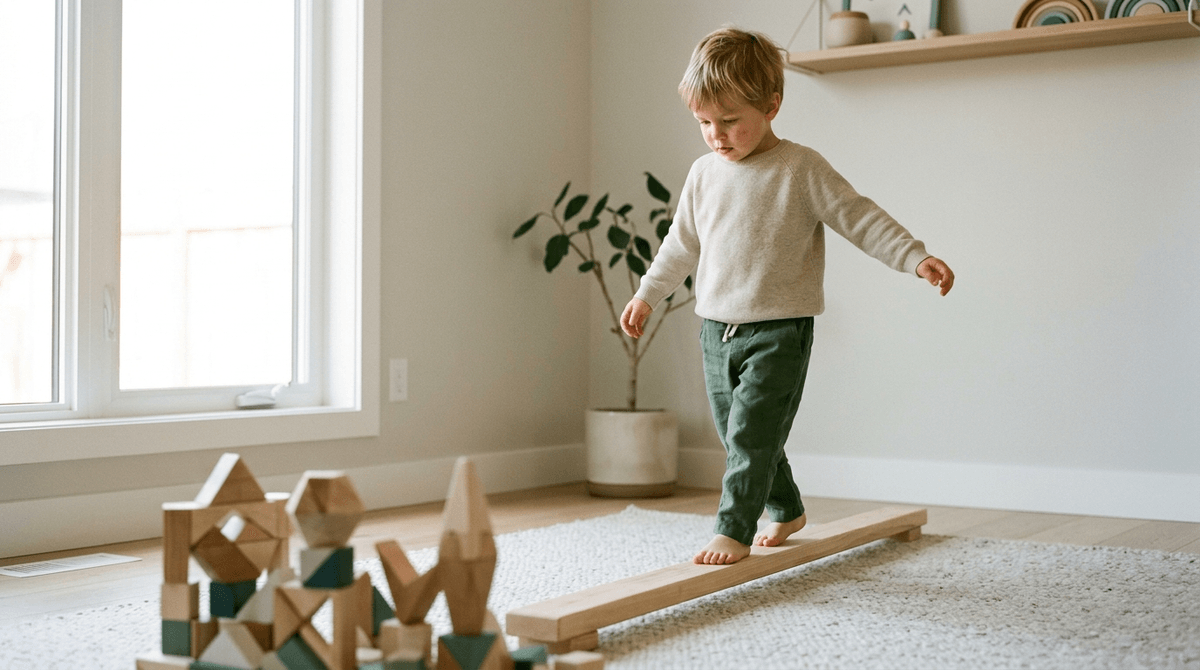
A child’s physical coordination splits into independent pathways by age four, meaning a single motor skills test can no longer capture their full athletic potential.
Assessments of a toddler's motor skills stop lining up by the time they hit preschool, proving that balance, technique, and speed develop as separate talents rather than one "athletic" package. If a child is evaluated at age four, their performance on a "speed" test will tell you nothing about their "form" or technique.
Most parents view athleticism as a single trait: you either have it or you don’t. This research proves that by age four, a child’s physical identity is actually a fragmented map of different strengths. This matters because a child who is flagged for "delayed" motor skills based on one test might be perfectly fine—or even advanced—on another.
Relying on a single screening score can lead to unnecessary anxiety or a false sense of security. If a coach or doctor only measures how fast a kid runs (the product), they might miss that the child is running with a gait that will cause injury later. Conversely, a child with beautiful throwing form who lacks the power to get the ball to the target might be unfairly labeled as "uncoordinated."
Developmental researchers wanted to see if the two main ways we measure kids—how they move (technique) versus what they achieve (speed or accuracy)—stay related as they grow. They suspected that as the brain and body mature, these skills specialize and stop predicting one another. Because many preschools and pediatricians use these tests to determine if a child needs physical therapy, understanding if the tests agree with each other is a high-stakes question.
The researchers tracked 117 preschoolers using two gold-standard assessments: the TGMD-3, which looks at the quality of movement (form), and the MABC-2, which looks at the outcome (success or speed).
- At age three, the tests overlap. A child’s score on one test predicted about 14% of their score on the other. They were different, but still in the same ballpark.
- By age four, the relationship evaporated. The correlation between the two tests hit zero. Performance on one test had no bearing on the other.
- Skills are self-consistent. A child’s baseline score was a strong predictor of how they’d score on that same test a year later. If they were good at technique at three, they were good at it at four.
- Percentile scores declined. On average, children’s scores relative to national averages dropped over the year. This suggests that motor skills don't just "show up" with age; they require active reinforcement.
The "clumsy" label is often a measurement error. By age four, a child's motor system is becoming highly specialized. One pathway handles the "process" (the mechanics of how to kick a ball), while another handles the "product" (hitting the target). When these paths diverge, a parent might see a child who looks athletic but fails at tasks, or a child who looks awkward but is highly effective. The study implies that we shouldn't judge a child's physical future based on a single snapshot of their performance.
The study suffered from significant attrition; 38% of the children dropped out before the one-year follow-up. Those who left the study were more likely to be Black, from lower-income households, and have higher screen time. Because the final sample of 72 children was skewed toward more advantaged families, the general "decline" in motor scores might actually be worse in the general population where opportunities for structured physical play are more limited.
- If your child is undergoing a developmental screening, ask the evaluator which test is being used and whether it measures "process" (how the movement looks) or "product" (speed and success).
- If you want to keep your child on track with developmental benchmarks, prioritize intentional play—like playing catch or navigating an obstacle course—rather than assuming they will naturally improve as they get taller and older.
- If your child is labeled "uncoordinated" in one setting (like gym class), look for other physical outlets that prioritize different skills; a child who struggles with the speed of team sports may have the precision and form required for martial arts or dance.
- If you see a decline in your child's physical confidence, check their screen time; the researchers noted that children with higher screen usage were more likely to struggle with motor development and were more likely to be lost to follow-up in the study.
There is no such thing as a single "coordination" switch in a child's brain. By age four, physical development is a collection of separate skills that require individual practice and different types of measurement to understand.
Webster EK, Spring KE, Moore JX et al. (2026). Diverging Paths: Longitudinal and Reciprocal Associations Between Two Fundamental Motor Skill Assessments in Preschoolers. Child: care, health and development. doi:10.1111/cch.70295 — https://pubmed.ncbi.nlm.nih.gov/42151099/