

Look, I get it. You're trying to pry your kid away from their seventh consecutive hour of Roblox, and someone suggests "maybe try poetry?" And you're thinking... poetry? Like, the stuff that made us all pretend to understand metaphors about roads not taken in high school?
But here's the thing: poetry books for kids are actually kind of genius. They're short (attention span win), they play with language in weird and wonderful ways (creativity win), and the good ones are legitimately funny or moving or just plain cool. We're not talking about stuffy sonnets here. We're talking about books where words bounce, rhyme schemes surprise, and a whole story or feeling lands in like 12 lines.
Poetry collections for kids range from silly rhyming picture books for toddlers to powerful verse novels for teens. The best ones make language feel like a toy you can take apart and put back together in new ways. And in a world where so much of our kids' language consumption is through screens—TikTok captions, YouTube comments, Discord chats—there's something really valuable about slowing down with words that were chosen very carefully.
Kids are natural poets, honestly. They make up nonsense words, they love repetition, they get obsessed with how things sound. Ever had a four-year-old discover the word "buttocks" and use it 47 times in one afternoon? That's basically poetry.
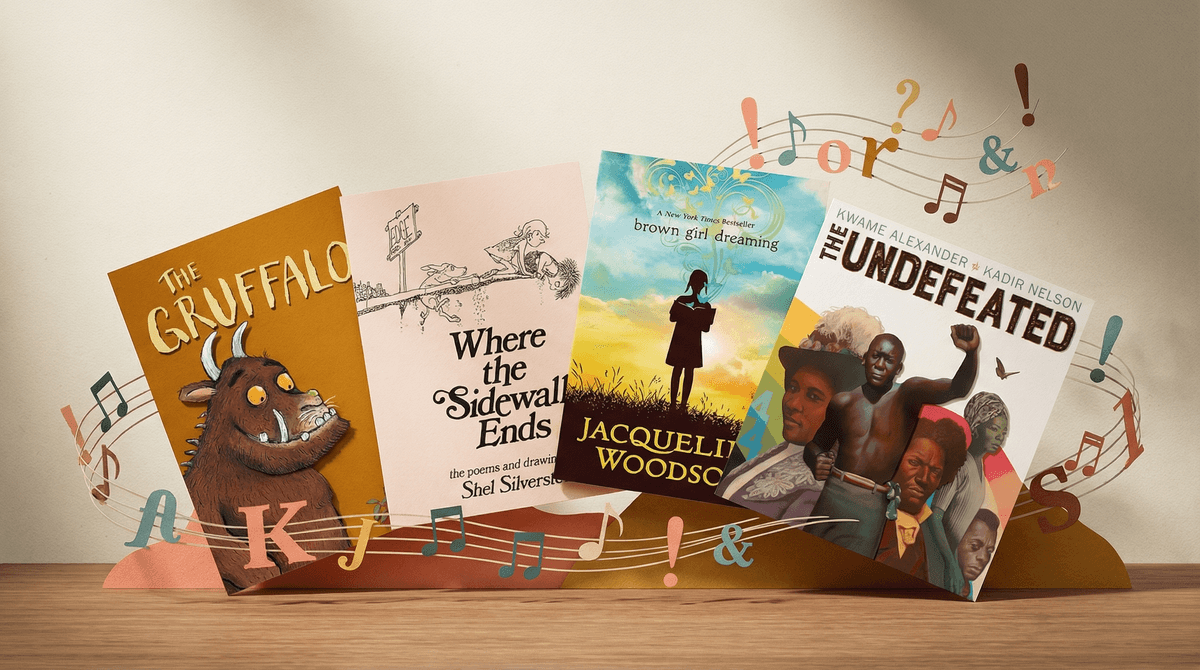
The rhythm thing is real. Poetry has beats, patterns, surprises. It's like music but with words. Shel Silverstein knew this. Dr. Seuss knew this. Every parent who's read "The Gruffalo" 900 times knows this—that rhythm is sticky. Kids will memorize poems without trying because they just sound good.
Poetry is bite-sized. In an age where we're all worried about attention spans (guilty), poetry meets kids where they are. One poem, two minutes, done. You got a whole experience. No commitment to a 300-page novel. No waiting for the plot to develop. Just... boom, here's a feeling or an image or a joke, perfectly packaged.
It makes language feel like play. Good poetry shows kids that you can bend words, break rules, make up sounds, put line breaks in weird places. It's creative permission in book form. And for kids who are learning to write, that's incredibly freeing.
Ages 0-5: Sound and Silliness At this age, poetry is basically music. Board books with rhymes, collections like "Where the Sidewalk Ends" by Shel Silverstein (which technically works for all ages), anything by Sandra Boynton. The weirder the sounds, the better. Don't worry about "meaning" yet—just let them feel how language can bounce.
Ages 6-9: Humor and Heart This is the sweet spot for poetry collections that are genuinely funny. Jack Prelutsky, Kenn Nesbitt, Douglas Florian—these folks write poems about boogers and homework and pets that make kids actually laugh out loud. But you can also introduce poems with more feeling here. Kwame Alexander's picture books like "The Undefeated" are stunning and accessible.
Ages 10-13: Identity and Emotion Middle schoolers are feeling ALL the feelings, and poetry gives them language for that. Verse novels like "Inside Out and Back Again" by Thanhha Lai or "Brown Girl Dreaming" by Jacqueline Woodson are incredible. These books tackle big topics—immigration, racism, family, identity—through poetry that feels both accessible and profound. Plus, honestly, some reluctant readers find verse novels way less intimidating than prose.
Ages 14+: Everything Teens can handle the full range. Rupi Kaur, Amanda Gorman, Ocean Vuong, Mary Oliver. Contemporary poetry that deals with mental health, love, social justice, nature, existence. If your teen is chronically online (and let's be real, they are), poetry can be a bridge to deeper thinking about the stuff they're already seeing in their feeds.
Poetry books are a gateway drug to reading. I'm not saying your kid will go from Shel Silverstein to Shakespeare overnight, but poetry can hook reluctant readers. The short format feels achievable. The white space on the page feels less overwhelming. One poem leads to another, and suddenly they've read a whole book without realizing it.
You can read poetry together in tiny doses. This is huge for busy families. You don't need a 30-minute reading session. Read one poem at breakfast. One at bedtime. One in the car (okay, you read it, they listen, please keep your eyes on the road). It fits into the cracks of your day.
Poetry builds emotional vocabulary. Kids are dealing with complex feelings they don't always have words for. Poetry gives them those words. It shows them that other people have felt confused or sad or angry or joyful in specific, nameable ways. This is especially valuable for kids who struggle to articulate their emotions.
It's a screen-free creativity boost. After your kid has watched their fifth YouTube video about Minecraft mods, poetry can reset their brain. It's creative input that's slow, intentional, and human-made. Not algorithmically generated. Not optimized for engagement. Just... art.
Some poetry books tackle hard topics beautifully. If your family is going through something—grief, divorce, moving, discrimination—there's probably a poetry book that addresses it in a way that feels both honest and gentle. Verse novels especially can help kids process big life stuff.
Poetry books aren't a replacement for screen time management or a magic solution to digital overload. But they're a really solid tool in your toolkit. They're short enough to compete with TikTok's attention economy, they're creative enough to feel different from school reading, and they're powerful enough to actually matter.
Start with one collection. Put it on the coffee table. Read a poem out loud at dinner and see what happens. Maybe your kid rolls their eyes. Maybe they ask for another one. Maybe nothing happens immediately, but three weeks later you find them reading it on their own.
The goal isn't to raise a poet (though hey, cool if that happens). The goal is to show your kids that language can be playful, powerful, and personal. That words can do more than convey information—they can make you feel something.
And in a digital world that's increasingly about consumption and speed, that's a pretty valuable thing.
Looking for specific recommendations? Check out our guide to the best poetry books for kids by age for detailed suggestions.
Want to balance reading time with screen time? Our guide to building a reading habit has practical strategies that actually work.
Curious about verse novels specifically? They're having a moment, and for good reason. Learn more about why verse novels work for reluctant readers.