

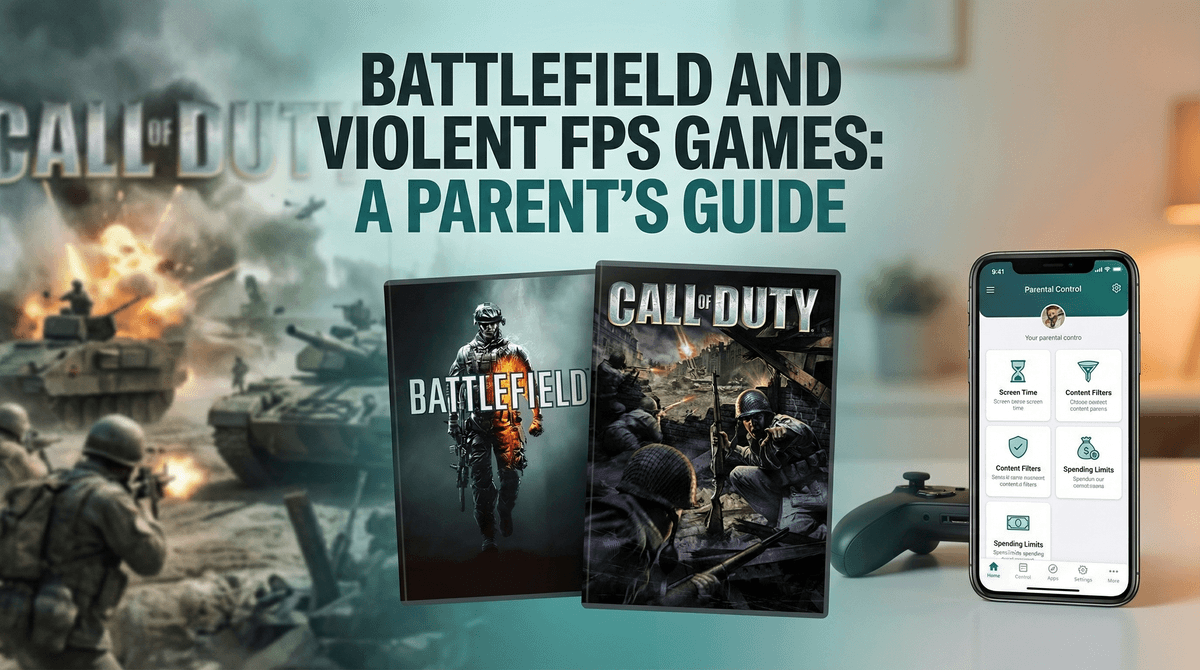
Battlefield and Violent FPS Games: What Parents Need to Know
TL;DR: M-rated first-person shooters like Battlefield are designed for adults and feature realistic military violence, blood, strong language, and intense combat scenarios. Most kids under 17 shouldn't be playing them, despite what "everyone else" is doing. If your teen is ready, you'll need clear conversations about violence, desensitization, and real-world context. Better alternatives for younger players include Splatoon 3, Fortnite, or Overwatch 2.
When we say "violent FPS games like Battlefield," we're talking about games where you're looking through a soldier's eyes (first-person perspective) and shooting other players or NPCs in realistic military combat scenarios. The Battlefield series specifically focuses on large-scale warfare with tanks, helicopters, destructible environments, and squad-based tactics.
These games are rated M (Mature 17+) by the ESRB for intense violence, blood and gore, and strong language. They're not Fortnite with cartoonish graphics and no blood. They're designed to simulate modern warfare with realistic weapons, injuries, and death animations.
Other games in this category include Call of Duty (the biggest franchise in the space), Counter-Strike, Rainbow Six Siege, and Escape from Tarkov. Each has different levels of realism and intensity, but they all feature humans shooting other humans with realistic weapons.
Let's be honest about the appeal:
Social pressure is massive. By middle school, a significant chunk of kids are playing these games, especially boys. The "everyone plays Call of Duty" narrative is strong, and your kid genuinely might feel left out of gaming conversations at school.
They're genuinely fun games. These aren't trash games designed to rot brains. Battlefield requires teamwork, strategy, spatial awareness, and quick decision-making. The games are technically impressive, the progression systems are engaging, and the multiplayer experience creates genuine bonding moments with friends.
They feel grown-up. For tweens and teens, playing M-rated games is a status symbol. It signals maturity (even if that's not actually what it means). The realistic military setting feels "serious" compared to games they perceive as "for kids."
Their friends are playing them. This is the big one. If your kid's friend group has moved to Battlefield or Call of Duty as their primary hangout space, your kid is facing real social consequences for not being there. This isn't hypothetical FOMO—it's actual exclusion from where their friends are spending time together.
The violence is the obvious concern, but let's break down what matters:
The Desensitization Question
The research on violent video games and aggression is... complicated. Despite what you might have heard, there's no clear evidence that playing violent games causes violent behavior. But there IS evidence that repeated exposure to graphic violence can lead to desensitization—meaning kids become less shocked by or responsive to violence.
This matters more for younger kids whose brains are still developing emotional regulation and empathy. A 10-year-old playing Battlefield daily is getting thousands of repetitions of "kill enemy, get reward" without the cognitive development to fully separate game violence from real-world consequences.
A 16-year-old with good emotional development? Different story. They can usually understand the game as a game while maintaining empathy for real violence.
The Online Voice Chat Reality
Here's what nobody tells you: the violence in the game is often less concerning than the voice chat.
These games are filled with adults (and teens pretending to be adults) who use racist slurs, homophobic language, misogynistic insults, and graphic sexual references casually and constantly. Your kid will hear things in a single Battlefield match that would get someone expelled from school.
The toxicity in competitive gaming is real, pervasive, and often worse than the in-game violence for shaping your kid's worldview and language.
The Time Sink Factor
M-rated shooters are designed with progression systems that keep players coming back. Battle passes, daily challenges, seasonal content, weapon unlocks—these games are engineered to be habit-forming. A kid who starts playing Battlefield "just on weekends" can quickly slide into 3-4 hours daily because that's what it takes to keep up with their squad and unlock the new gun everyone's using.
The Emotional Regulation Challenge
These games are intense. Competitive matches mean winning and losing, and losing often means your team blaming each other. Kids who struggle with frustration tolerance or emotional regulation can spiral hard in these environments. Rage-quitting, controller-throwing, and verbal outbursts are common responses to the high-stakes, high-pressure gameplay.
Under 13: No. Just no. There are zero good reasons for a 10-year-old to be playing Battlefield. The M rating exists for a reason. If they're being left out socially, help them find friend groups around age-appropriate games like Minecraft, Rocket League, or Among Us.
Ages 13-15: This is the gray zone where you'll get the most pushback. "Everyone else plays it" becomes a real argument because statistically, a lot of 8th graders ARE playing Call of Duty. But that doesn't make it appropriate.
If you're considering it, ask yourself:
- Can they handle losing without melting down?
- Do they understand the difference between game violence and real violence?
- Can they recognize and reject toxic behavior in voice chat?
- Will they respect time limits without constant negotiation?
If the answer to any of these is "not really," they're not ready.
Ages 16+: This is when M-rated games become more defensible. A mature 16-year-old can likely handle the content and context. But you still need clear boundaries around time, voice chat behavior, and emotional regulation.
If your kid wants the FPS experience without the M-rated content:
Splatoon 3 (Nintendo Switch): The best "my first shooter" game. It's colorful, creative, genuinely strategic, and you're shooting ink instead of bullets. The community is significantly less toxic.
Fortnite: Yes, it has guns, but the cartoonish graphics and lack of blood make it fundamentally different. It's rated T (Teen 13+) for a reason. Still requires monitoring for time management and in-game purchases.
Overwatch 2: Team-based shooter with diverse characters and abilities. Still T-rated with some violence, but more stylized than realistic. Better community moderation than most competitive shooters.
Valorant: Tactical shooter that's T-rated. Still intense and competitive, but less graphic than Battlefield or Call of Duty.
You're not a bad parent if you let your 15-year-old play Battlefield. But you need to be intentional about it:
Have the violence conversation explicitly. Not "violence is bad, mkay?" but actual discussion: "These games show war as entertainment. Real war involves trauma, PTSD, civilian casualties, and lifelong consequences. This game is fun because it's not real. Can you hold both those truths at once?"
Disable or monitor voice chat. Most games let you turn off voice chat or limit it to friends only. This eliminates 80% of the toxicity problem. Yes, they'll complain about not being able to communicate with their team. That's the trade-off.
Set clear time boundaries. These games don't have natural stopping points. A match ends, the next one starts. You need external limits: "You can play for 90 minutes" or "Two matches, then you're done." Use screen time tools if needed.
Watch them play occasionally. Not in a hovering way, but genuine interest. "Show me what you're working on" or "Teach me how this works." You'll learn what they're actually experiencing and they'll know you're paying attention.
Check in about how they feel after playing. If they're regularly angry, frustrated, or can't transition back to family life after playing, that's a red flag that the game isn't a good fit right now.
Talk about the online behavior they witness. When they hear racist or homophobic language (and they will), that's a teaching moment about bystander behavior and digital citizenship. "What do you do when someone in your squad uses a slur?"
M-rated first-person shooters like Battlefield are designed for adults and most kids under 16 aren't ready for them—not because they can't handle seeing violence, but because they're not developmentally equipped to process the combination of realistic violence, toxic online culture, and addictive game design.
The "everyone else is playing it" argument is partially true and genuinely creates social pressure. That's real and it sucks. But it doesn't change what's appropriate for your kid's development level.
If you do allow these games, you can't just hand over the controller and hope for the best. You need ongoing conversations, clear boundaries, and active monitoring of both time spent and emotional impact.
And if you're saying no? That's completely valid. You're not ruining your kid's social life by enforcing age ratings. You're parenting.
- Check out age-appropriate FPS alternatives if your kid wants the shooter experience without M-rated content
- Learn about setting up parental controls on gaming consoles
- Read more about managing gaming time and addiction
- Explore how to talk to kids about online toxicity