

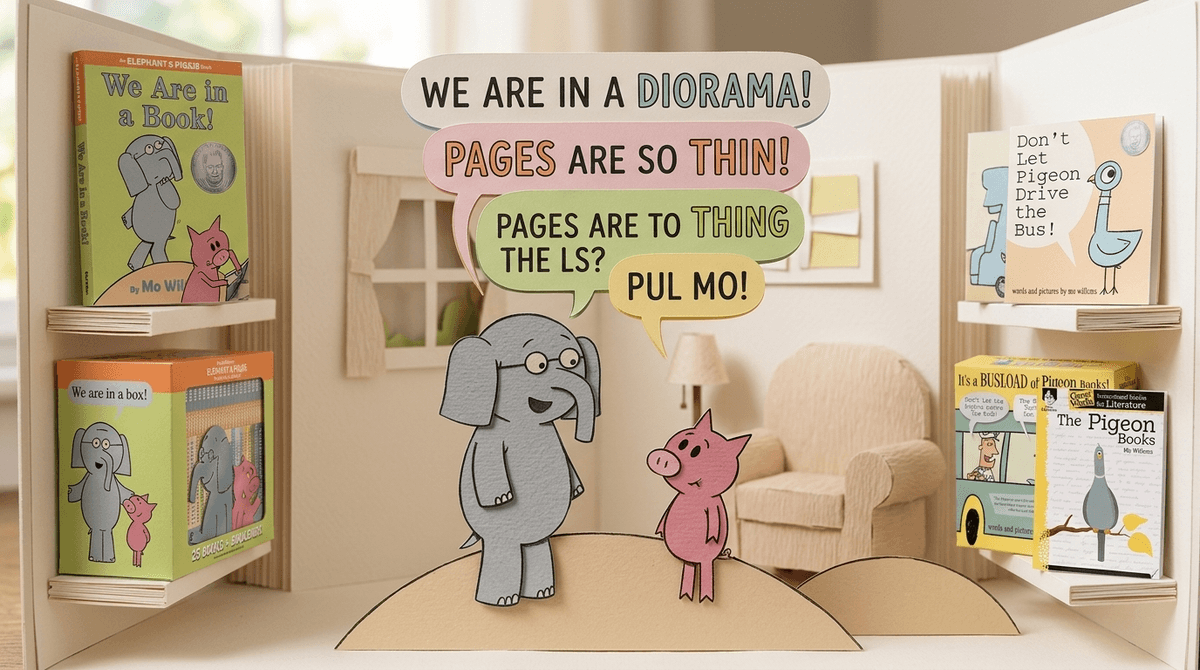
Most "early reader" books are a special kind of torture for parents. You know the ones—stilted sentences, repetitive vocabulary lists disguised as stories, and a total lack of soul that makes the ten minutes before lights-out feel like an hour. Elephant & Piggie by Mo Willems is the antidote. It’s the rare series that understands that just because a kid has a limited vocabulary doesn't mean they have a limited emotional range or a broken sense of humor.
TL;DR: The Elephant & Piggie 10-Book Box Set is the ultimate gateway to independent reading because it prioritizes comedic timing and real friendship over "See Spot Run" boredom. Mo Willems uses minimalist art and speech bubbles to build independence and confidence, making it a staple for any intentional home library.
If you aren't familiar with the dynamic, here’s the setup: Gerald is an elephant who is prone to existential dread, overthinking, and intense caution. Piggie is a pig who is an exuberant, "act now, think never" optimist. They are a classic comedy duo—think Abbott and Costello or Frog and Toad, but with more meta-commentary and better hats.
The 10-book collection usually includes heavy hitters like We Are in a Book!, Can I Play Too?, and I Will Take a Nap!. Each one is a masterclass in how to tell a complex story using about 50 unique words.
Why the Format Actually Works for New Readers
Most books for this age group rely on "leveling" systems that feel like homework. Willems ignores all of that and focuses on how kids actually communicate.
- The Speech Bubble Advantage: There are no "he saids" or "she saids" here. Everything is in speech bubbles. The color of the bubble matches the character (grey for Gerald, pink for Piggie). This is a massive win for kids just starting to track text because it removes the "narrator" friction and lets them focus on the dialogue.
- Expression Over Backgrounds: Look at the pages—there is almost zero background art. No trees, no houses, no distractions. It’s just two characters and their body language. This teaches kids to read emotions and social cues, which is just as important as reading the words.
- Typography as Performance: When a character yells, the font is huge. When they whisper, it’s tiny. When they’re nervous, the text might wobble. This gives kids a "script" for how to read aloud with expression, turning "reading practice" into a performance.
Parents often look for "lesson books"—books about sharing, books about being inclusive, books about patience. The problem is that most lesson books are preachy and kids can smell the "learning" from a mile away.
Elephant & Piggie handles these topics by letting the characters be kind of... messy. In Can I Play Too?, a snake wants to play catch. Instead of a moralizing speech about inclusion, we get the hilarious, practical problem of how a snake (who has no arms) is supposed to catch a ball. It’s funny first, and the "lesson" about adapting for friends lands naturally because the reader is laughing.
In I Will Take a Nap!, Gerald is just cranky and wants to sleep. We’ve all been there. It validates the kid’s own big emotions without telling them how they should feel. That's the Mo Willems magic: he treats kids like people, not like projects to be optimized.
While every book in the set is a winner, a few do specific things better than anything else on the shelf:
This is the "meta" masterpiece. Gerald and Piggie realize they are being watched by a reader. They realize they can make the reader say words (like "banana!"). It’s a brilliant introduction to the concept of the "fourth wall" and makes the kid feel like an active participant in the story, not just a passive observer.
A great one for the perfectionist kid. Gerald is convinced he can’t dance because "the book says so." It’s a story about trying anyway and realizing that your "failure" might actually be someone else's "cool new style."
As mentioned, this is the gold standard for teaching inclusion. It’s absurd, it’s physical comedy, and it ends with a creative solution that makes everyone feel smart.
If you’re reading these with a kid who isn't quite reading solo yet, try The Part-Swap. You read Gerald (the worrier), they read Piggie (the enthusiast). Because the text is so repetitive and the visual cues are so strong, they’ll memorize their "lines" quickly. This isn't just cute; it’s building the "fluency" muscles they need for harder books later.
Also, don't sleep on the Pigeon series or Knuffle Bunny once they finish the 10-book set. Willems has a whole ecosystem of books that hit this same frequency.
The only "friction point" with Elephant & Piggie is that they are high-energy. If you are looking for a "lullaby" book to put a kid to sleep, I Will Take a Nap! might actually get them riled up because it’s so funny. These are "active" books. They manage bedtime by making the transition to the bedroom something the kid actually looks forward to, but don't expect them to be a sedative.
Q: What age is Elephant & Piggie appropriate for? The sweet spot is ages 4 to 8. Preschoolers love the physical comedy when read aloud, while Kindergarteners and 1st graders find them perfect for their first "I can read this myself" moment.
Q: Is the 10-book set better than buying them individually? Yes, mostly for the price and the "binge-ability." Once a kid clicks with one, they’ll want to power through the rest. Having the set on the shelf encourages them to grab the next one without waiting for a library trip.
Q: Are these books "educational" or just for fun? They are both. They teach "sight words" and punctuation through context, but more importantly, they build "reading stamina"—the ability to sit with a book and finish it. That’s the skill that actually matters for long-term literacy.
Q: My kid is already a strong reader. Are these too babyish? Even 2nd and 3rd graders often come back to these because the humor holds up. They might read them in five minutes, but they'll do it with "voices" and a sense of comedic timing that shows they're getting the subtext.
Elephant & Piggie is the rare "essential" purchase. It’s the series that proves reading doesn't have to be a chore, and that "simple" doesn't have to mean "dumb." If you have a reluctant reader or a kid who is just starting to sound out words, this 10-book set is the best investment you can make in their library.
- Check out our best books for kids list for what to read after Mo Willems.
- Explore the digital guide for preschoolers for more ways to build early literacy.
- Get a book recommendation
 based on your kid's specific sense of humor.