

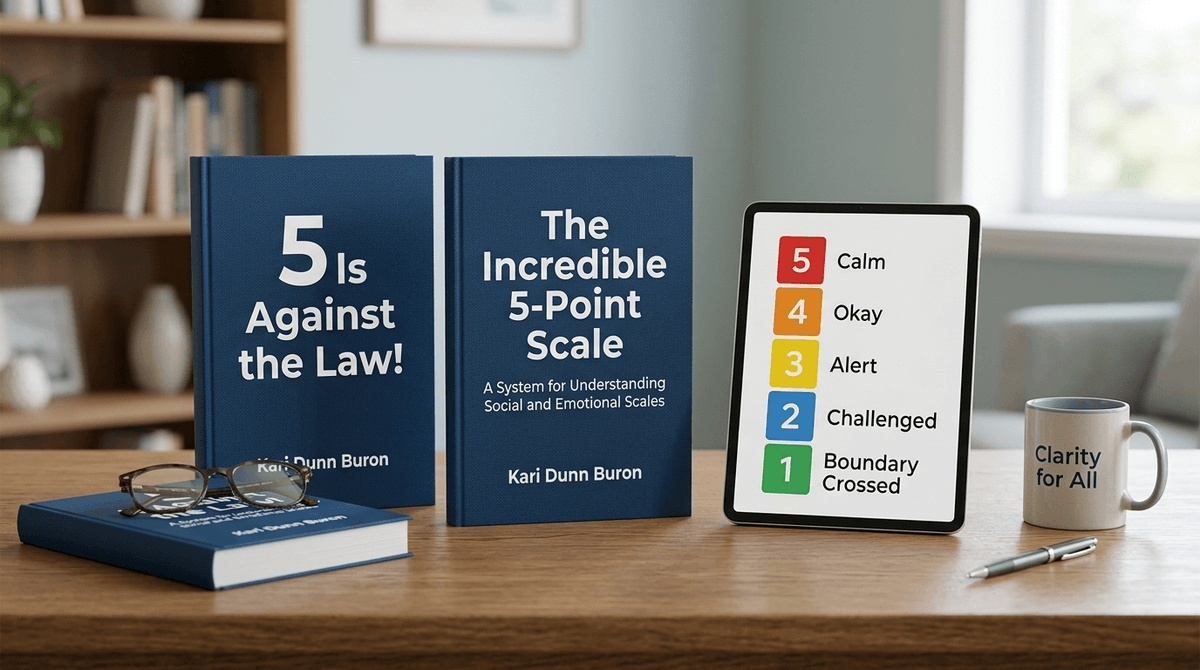
5 Is Against the Law! by Kari Dunn Buron is essentially a translation manual for kids who find "social cues" as readable as ancient Sanskrit. It takes the fuzzy, subjective world of "don't be weird" and turns it into a hard-coded logic gate, helping teens—especially neurodivergent ones—understand exactly where a social faux pas ends and a legal problem begins.
5 Is Against the Law! is a high-utility social-emotional tool that categorizes behavior on a 1-to-5 scale, moving from "totally fine" to "illegal." It is the gold standard for teaching neurodivergent teens the objective difference between being socially awkward and committing harassment or a crime. Use it as a framework for real-world scenarios to build confidence and prevent the kind of misunderstandings that have actual consequences.
The problem with most "social skills" advice is that it’s incredibly vague. We tell kids to "read the room" or "be polite," which is about as helpful as telling someone to "just drive better" without explaining what a red light is.
For a lot of teens, especially those with ASD or ADHD, the "unwritten rules" of society feel like a game everyone else got the instructions for. 5 Is Against the Law! fixes this by assigning a numerical value to behaviors. It’s not about being a "good" or "bad" kid; it’s about understanding the "magnitude" of an action.
The Scale: From "Cool" to "Call a Lawyer"
Level 1: It’s All Good. This is the baseline. You’re being yourself, you’re following the standard flow, and nobody is thinking twice about what you’re doing.
Level 2: The "Social Tax" (A Little Weird). This is where you might stand a little too close to someone or talk about your obsession with 19th-century steam engines for twenty minutes straight without checking if the other person is still awake. It’s socially awkward, but it’s not a "problem" in the grand scheme of things. You might not get invited to the next party, but you aren't in trouble.
Level 3: The "Please Stop" Zone (Uncomfortable). Now we’re getting into friction. This is behavior that makes people actively want to leave the room. Think: making personal comments that are a bit too "honest," or refusing to take a hint when someone says they’re busy. This is the level that loses you friends.
Level 4: The "HR/Principal" Zone (Scary/Harassment). This is the critical threshold. Level 4 behavior is where things stop being "socially off" and start being "threatening." Following someone, touching someone without permission, or making repeated sexual comments falls here. In a school or workplace, this gets you suspended or fired. It’s the "pre-illegal" stage.
Level 5: Against the Law. This is the hard line. Theft, physical assault, or serious digital crimes. The police get involved. There is no "oops" at Level 5.
One of the best things about this system is that it validates the "weird." Screenwise parents generally aren't looking to raise mindless clones; we like kids with personality. 5 Is Against the Law! makes it clear that being a Level 2 or 3 is a choice about social standing, whereas Level 4 and 5 are choices about freedom and safety.
It removes the shame. Instead of saying "You’re being creepy," which is a character judgment, you can say, "Hey, that comment was a Level 4. In the real world, that’s harassment." It turns a lecture into a data point.
Teens on the spectrum often struggle with "theory of mind"—understanding that other people have different thoughts and feelings than they do. They might not realize that their "persistent interest" in a classmate is actually making that classmate feel hunted.
The 5-point scale provides an objective yardstick. It’s a way to categorize the world that doesn't rely on "feeling" the vibe—it relies on identifying the behavior. If your teen is a fan of systems, they’ll likely find this much more intuitive than a standard "how to make friends" book.
While 5 Is Against the Law! is the anchor, you’ll want to build out a full "social logic" library.
- For the "How-To" of Friendship: The Science of Making Friends by Elizabeth Laugeson is the perfect companion. It breaks down the actual steps of entering a conversation or handling a bully like a lab manual.
- For Emotional Regulation: The Zones of Regulation (book or app) helps kids identify their internal state before they hit a Level 4 or 5 behavior.
- For Younger Kids: If you have a younger sibling in the mix, The Incredible 5-Point Scale is the "junior" version of this concept, focusing more on anxiety and anger than legal boundaries.
For more resources tailored to this age group, check out our digital guide for middle school or our digital guide for high school.
Don't just read the book and put it on the shelf. The magic is in the "Social Autopsy."
When a situation goes sideways—whether it’s a conflict at school or a weird interaction on a Discord server—sit down and "score" it together.
- "Where was that on the scale?"
- "What behavior would have kept it at a Level 2?"
- "How did a Level 3 turn into a Level 4?"
By treating social interactions like a post-game film review, you take the heat out of the moment and build the "social muscle" your teen needs for the real world.
The hardest part for parents is often staying neutral. When your kid does something that "looks bad," our instinct is to get emotional or fearful about their future. The 5-point scale is your shield against that. It allows you to be the "coach" rather than the "judge." If your kid is already engaging with complex social environments (online or off), this framework is a non-negotiable safety net.
Q: Is "5 Is Against the Law!" only for kids with Autism? No. While it was designed with neurodiversity in mind, it’s incredibly useful for any teen who is impulsive, socially isolated, or struggling to understand the high stakes of high school and workplace boundaries.
Q: What age is this book appropriate for? It’s specifically written for teens and young adults. The examples involve things like dating, workplace behavior, and legal consequences, making it most relevant for ages 12 and up.
Q: My kid thinks this is "babyish." How do I get them to buy in? Frame it as "legal protection" or "social hacking." Don't call it a "feelings book." Call it a guide to making sure they don't get banned from platforms or end up in a dean's office because of a misunderstanding.
Q: Does the book cover online behavior? The principles apply perfectly to the digital world. A Level 4 "scary" behavior in person is Level 4 "harassment" in a DM. You can easily adapt the scale to talk about things like Discord safety or commenting on social media.
5 Is Against the Law! is a rare resource that respects a teen's intelligence while acknowledging their struggle with social nuances. It’s a "straight-up" guide that prioritizes clarity over comfort, which is exactly what a teen needs to navigate the transition to adulthood safely.
- Pick up a copy of 5 Is Against the Law! and read it yourself first so you can use the language naturally.
- Explore our best books for kids list for more social-emotional heavy hitters.
- Get specific scenarios for practicing at home
 to help you practice the "Social Autopsy" at home.