

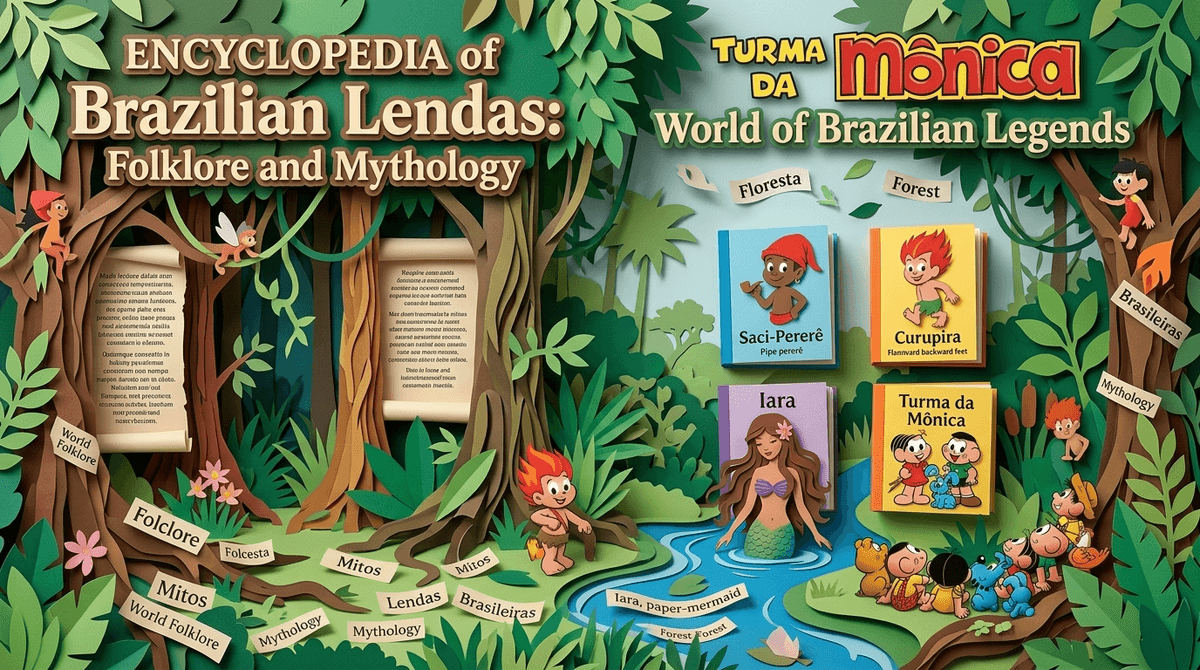
Brazilian folklore is what happens when you mix the Amazon’s intensity with a deep, diverse history of Indigenous, African, and European influences. If you’re tired of the same three sanitized European fairy tales, these legends are the upgrade—they’re weirder, more vibrant, and usually have a much stronger environmental "don't mess with nature" backbone than anything in the standard Western canon.
TL;DR
Brazilian folklore offers a high-energy alternative to generic stories, featuring environmental protectors like Curupira and tricksters like Saci-Pererê. For the best bilingual experience, look for collections like Brazilian Tales for Kids or the Turma da Mônica folklore series, which provide side-by-side Portuguese and English text to build heritage language skills while keeping the stakes high and the art vibrant.
Most bilingual books are, frankly, a bit dry—lots of "The cat is on the mat" energy. Folklore solves that. When you’re reading about a fire-breathing snake or a one-legged prankster who travels in dust devils, the brain stays engaged. For families trying to maintain Portuguese (or introduce it), these stories provide the cultural "why" behind the language. It’s not just grammar; it’s heritage.
The "side-by-side" format is the gold standard here. It allows the reader to bridge the gap between a comfortable language and a target one without the friction of constantly reaching for a dictionary.
In Brazilian lore, the forest isn't just a setting; it’s a character that fights back. These stories land well with kids who are already into The Wild Robot or environmental themes.
Curupira is the GOAT of Brazilian folklore. He has bright red hair and feet turned backward to confuse hunters and loggers. If you follow his tracks, you’re actually walking away from him. It’s a masterclass in clever character design.
- The Bilingual Edge: Great for learning directional vocabulary (left, right, forward, backward) in both languages.
A giant, transparent snake with eyes like lanterns that protects the fields from those who set fires. It’s visually spectacular and a bit eerie, which usually means kids will actually pay attention.
- The Vibe: High-stakes environmentalism. It’s basically a kaiju movie in book form.
Often depicted as a small Indigenous person or a creature riding a wild peccary (a pig-like animal). Caipora is the one who makes sure hunters don't take more than they need.
- Conversation Starter: Ask your kid why Caipora cares more about balance than just stopping all hunting. It’s a more nuanced take on conservation than most kids' media.
These are the stories that explain why things go wrong in the house or why the woods feel "busy" at night.
The most iconic figure in Brazil. Saci wears a red cap that gives him magical powers, smokes a pipe, and disappears in mini-whirlwinds. He’s not evil; he’s just annoying—he hides keys, sours the milk, and tangles horses' manes.
- Why it works: Every kid understands the urge to be a little chaotic.
If your kid knows the song "Dormi Cuca," they know the threat: "Sleep, or the Cuca will catch you." She’s an old witch with the body of an alligator and a messy blonde wig.
- The Screenwise Take: Cuca is the Brazilian "Boogeyman," but with way more personality. Check out Sítio do Picapau Amarelo for the most famous TV version of her.
A woman cursed to turn into a mule with fire coming out of her neck (where the head should be) every Friday. It’s a bit dark, but the imagery is metal.
- The Bilingual Edge: Look for versions that focus on the "curse" vocabulary—it’s a great way to learn more dramatic Portuguese adjectives.
The Amazon River is a central pillar of these stories. These legends are often more atmospheric and slightly more "grown-up" in their themes of longing and mystery.
Brazil’s answer to the mermaid, but with more agency. Iara is a beautiful warrior who lives in the Amazon and lures men into the water.
- Pro-Tip: Skip the "Disney-fied" mermaid books. Iara’s story is about power and the danger of the river, which makes for a much better bedtime read for older elementary kids.
At night, the pink river dolphin turns into a handsome man in a white suit and a hat (to hide his blowhole) to charm people at parties.
- Why it lands: It’s a classic shapeshifter story. It captures the magic of the Amazon’s actual pink dolphins, which are weird enough to be mythical anyway.
An Indigenous legend about a girl who fell in love with the moon and tried to touch its reflection in the water, eventually transforming into the giant water lily.
- The Vibe: This is the "pretty" one. If you want a break from the monsters and tricksters, the art in these books is usually stunning.
These aren't as famous internationally, but they add real depth to a folklore collection.
A somber but hopeful tale from Southern Brazil about a young enslaved boy who is helped by the Virgin Mary after being mistreated. He is now the patron of lost things.
- Cultural Context: This story deals with Brazil’s history of slavery. It’s a heavy topic, but folklore is often the best "on-boarding" for these conversations.
Think Bigfoot, but with one eye and a second mouth on his belly. He’s a protector of the deep forest.
- If they love this: They’ll probably also like cryptid podcasts for kids.
The 7th son in a family of all boys is said to turn into a werewolf on Friday nights. It’s a classic trope with a specific regional flavor.
- The Bottom Line: It’s a familiar entry point for kids who like "spooky" stuff but want to see how other cultures handle the monster-under-the-bed.
The biggest friction point with Brazilian folklore is that it can be intense. These stories come from a time when nature was a genuine threat, and the "consequences" in the stories reflect that. If your kid is sensitive to "scary" imagery (like the Headless Mule), start with the Turma da Mônica versions—they use famous comic characters to act out the legends, which lowers the "scare factor" significantly.
Don't just read the books. Brazilian folklore is a living thing.
- Search for the music: Many of these legends have corresponding "cantigas" (folk songs). Hearing the Portuguese rhythm helps the language stick.
- Compare and Contrast: If your kid knows Greek myths or Grimm’s fairy tales, ask them: "Who is the 'Saci' of the stories we already know?" (Hint: It’s probably Hermes or Loki).
- Check the Art: Brazilian illustrators like Roger Mello or Mauricio de Sousa bring a specific, non-American aesthetic that’s worth pointing out.
Q: Are these stories too scary for a 5-year-old? It depends on the edition. Most bilingual "Short Story" books for kids are toned down. If you're worried, start with Saci-Pererê—he's mostly just a prankster who likes to hide socks.
Q: Where can I find actual bilingual Portuguese-English books? Look for publishers like Editora Melhoramentos or Girassol. You can also find many "indie" bilingual versions on Amazon that are specifically designed for heritage learners.
Q: Is Brazilian folklore religious? It’s a mix. You’ll see Indigenous spirituality, African Yorubá influences, and Catholic elements all mashed together. It’s a reflection of Brazil’s "melting pot" reality.
Q: Which story is the best for teaching Portuguese? Curupira is great for body parts and directions. Saci-Pererê is great for verbs of action and household items.
- Check out our best books for kids list for more global heritage picks.
- Explore our digital guide for elementary school to see how to balance reading with screen time.
- Find more bilingual books like these
