

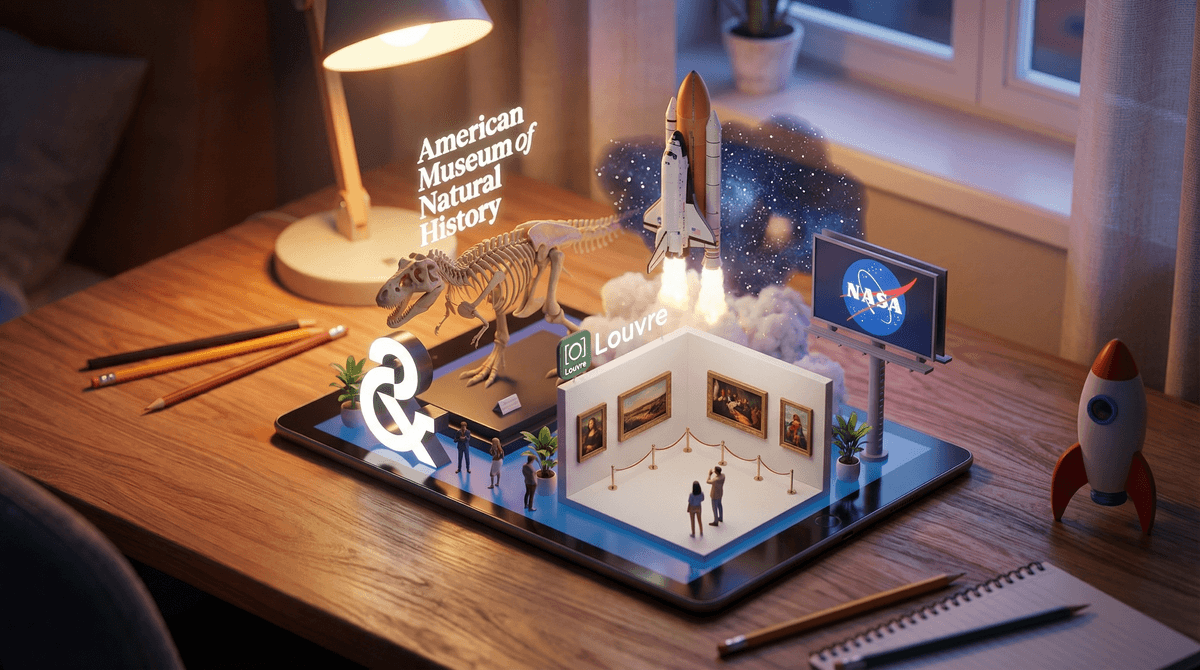
Virtual museum tours are exactly what they sound like—a way to explore some of the world's most incredible museums from your couch. We're talking the Smithsonian, the Louvre, the Natural History Museum in London, NASA's archives, and hundreds more. Most offer free access to their collections through interactive websites, virtual tours, and kid-friendly activities.
Think of it as a field trip without the permission slip, the bus ride, or the inevitably lost jacket. Your kid can stand (virtually) in front of the Mona Lisa, explore ancient Egyptian tombs, walk through the International Space Station, or examine dinosaur fossils up close—all before lunch.
The quality varies wildly. Some museums offer full 360-degree tours where you can "walk" through galleries. Others provide high-resolution images of their collections with detailed descriptions. The best ones have created actual educational content specifically for kids, with games, scavenger hunts, and age-appropriate explanations.
Look, I get it. "Virtual museum" sounds about as exciting as "educational screen time"—which is to say, it sounds like something that's good for you but kind of boring. But here's the thing: these aren't your dusty childhood field trip memories.
Modern virtual museums can be genuinely engaging. Kids can zoom in on a Van Gogh painting to see individual brushstrokes. They can rotate a 3D scan of a T-Rex skull. They can explore the Apollo 11 command module from every angle. It's the kind of access that even an in-person visit doesn't always provide (because there's a velvet rope and thirty other people blocking your view).
More importantly, this is screen time that actually builds something. While there's nothing inherently wrong with entertainment-focused screen time, virtual museums offer exposure to art, history, science, and culture in a format that many kids find more accessible than a textbook. For kids who are naturally curious, these resources are genuinely exciting. For kids who aren't naturally drawn to museums, the interactive elements and ability to control their own exploration can be a gateway.
And let's be real: if your kid is going to be on a screen anyway, having them explore the British Museum's ancient Greece collection is objectively better than watching someone else play Minecraft on YouTube for the 47th time.
Ages 4-7: At this age, you're looking for museums with specific kids' sections and interactive elements. The Smithsonian's National Zoo has live animal cams (the pandas are a hit). The San Diego Zoo also has excellent webcams. NASA Kids' Club has games and activities. The Natural History Museum in London has a "Museum of the Moon" virtual experience that's visually stunning enough to hold attention.
Keep sessions short—15-20 minutes max. Sit with them and make it interactive by asking questions: "What do you think that dinosaur ate?" "Which painting is your favorite?" Let them click around and follow their interests rather than trying to create a structured "lesson."
Ages 8-12: This is the sweet spot for virtual museums. Kids have the attention span and reading skills to actually engage with the content, but they're still young enough to find it genuinely cool rather than "homework."
Try the Louvre's virtual tours (the Egyptian Antiquities section is incredible), the Smithsonian's Natural History Museum, the Van Gogh Museum in Amsterdam, or the British Museum. Many of these have scavenger hunt-style activities or specific kids' trails you can follow.
At this age, kids can explore somewhat independently, but it's still worth checking in. "What's the most interesting thing you've found?" can lead to actual conversations about history or art or science.
Ages 13+: Teens can access pretty much any virtual museum independently. The Metropolitan Museum of Art has over 400,000 high-resolution images available. The Anne Frank House offers a powerful virtual tour. The Holocaust Memorial Museum has extensive online resources. These become tools for school projects, personal interests, or just genuine curiosity about the world.
The key here is letting them lead. Teens don't need you hovering over their shoulder while they explore the Guggenheim's collection. But you can still facilitate by sharing interesting finds or suggesting museums related to their interests—fashion history, space exploration, ancient civilizations, whatever they're into.
It's still screen time: Virtual museums are educational, but they're not magic. Your kid is still looking at a screen. That doesn't make them bad—just don't kid yourself that this somehow "doesn't count" toward daily screen time limits. It's a better use of screen time, but it's still screen time.
Quality varies dramatically: Not all virtual museum experiences are created equal. Some are beautifully designed, intuitive, and genuinely engaging. Others are clunky, poorly organized, or basically just a PDF of their collection. Don't be afraid to try a few and bail if something isn't working. The Smithsonian's offerings are generally excellent. Google Arts & Culture aggregates content from thousands of museums and is a good starting point.
Free doesn't mean low-quality: Most of the best virtual museum content is completely free. Museums want people engaging with their collections. You don't need to pay for some subscription service that promises "educational content"—just go directly to museum websites.
This works best as a starting point: Virtual museums are amazing for exposure and exploration, but they're not a replacement for everything. If your kid gets really into ancient Egypt through a virtual tour, that's your cue to grab some library books, watch a documentary, or (if possible) plan an actual museum visit. Think of virtual tours as a gateway, not the destination.
Some kids will love this, some won't: And that's fine. Some kids are naturally drawn to museums and will happily spend an hour exploring the Rijksmuseum's collection. Others will last five minutes before asking if they can play Minecraft instead. Neither response makes you a parenting success or failure. Meet your kid where they are.
Here are some virtual museums that consistently deliver quality experiences for kids:
Smithsonian National Museum of Natural History: The virtual tour is excellent, and the collection is massive. Dinosaurs, gems, ocean life, human origins—it's all there. The Hope Diamond alone will hold attention for longer than you'd expect.
NASA's Website and Virtual Tours: Multiple space centers offer virtual tours. You can explore the International Space Station, see spacecraft up close, and access thousands of images from space missions. For space-obsessed kids, this is gold.
The British Museum: Their virtual tour covers 60 galleries and two million years of human history. The ancient Egypt and Greece sections are particularly strong. The 3D models of artifacts are impressive.
Google Arts & Culture: This platform aggregates content from over 2,000 museums worldwide. It's a bit overwhelming, but once you figure out the navigation, it's an incredible resource. They also have specific collections curated for kids.
The Louvre: The virtual tours of select galleries are beautifully done. Even if your kid has zero interest in art history, walking through the virtual Egyptian Antiquities section is pretty cool.
Monterey Bay Aquarium: Live webcams of jellyfish, sea otters, penguins, and more. This is perfect for younger kids or as a calming background during quiet time.
Virtual museums aren't going to replace actual field trips, and they're not going to magically transform your kid into a culture-loving intellectual. But they're a legitimately good use of screen time that exposes kids to art, history, science, and culture in an accessible format.
The key is keeping expectations realistic. This is exploration, not education in the formal sense. Let kids follow their interests. Keep sessions relatively short. And if your kid would rather watch Bluey for the hundredth time instead of touring the Met, that's okay too.
The best part? These resources aren't going anywhere. Bookmark a few favorites, and pull them out when your kid is curious about something, when you need a screen time option that feels a bit more substantial, or when you just want to show them something beautiful or interesting or weird from somewhere else in the world.
It's not perfect, but it's pretty good. And in the world of kids and screens, "pretty good" is honestly a win.