

TL;DR
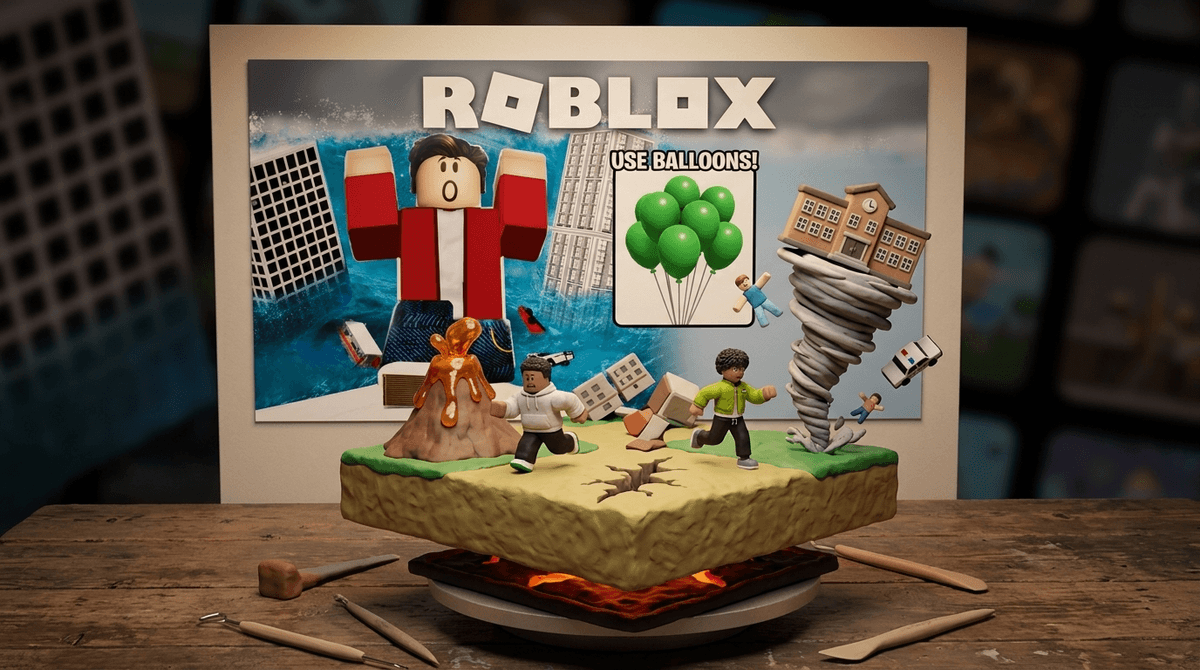
If your kid is on Roblox, they are almost certainly playing Natural Disaster Survival. It is the digital equivalent of "The Floor is Lava" mixed with a 90s disaster movie, but with Lego-style characters. It’s non-violent, highly social, and surprisingly strategic. It’s one of the few "OG" games on the platform that hasn't been ruined by aggressive "pay-to-win" mechanics.
Quick Links:
- Roblox (The platform)
- Natural Disaster Survival (The game)
- Minecraft (The logical next step for builders)
- How to set up Roblox parental controls
Natural Disaster Survival (often abbreviated as NDS) is a "classic" experience within Roblox. Created by user Stickmasterluke back in 2008, it has survived the test of time because the premise is brilliantly simple: you and about 30 other players are dropped onto an island with a specific structure—like a school, a prison, a launch land, or a skyscraper.
Suddenly, a disaster is announced. It could be a flash flood, a tornado, a meteor shower, or a viral outbreak. You have about three minutes to not die. If you survive, your name goes on the leaderboard for that round. If you don't, you "oof" (the classic Roblox sound) and wait for the next round.
Unlike Fortnite, there is no combat. You aren't fighting other players; you are fighting the environment. This makes it a great "entry-level" game for younger kids who want the thrill of a battle royale without the "battle" part.
There’s a specific kind of "controlled chaos" in NDS that appeals to the elementary and middle school brain. Here’s why it’s currently sitting in the "Most Played" category for about 45% of 2nd through 6th graders:
- Low Stakes, High Reward: A round only lasts a few minutes. If you fail, you're back in the action almost immediately. It’s perfect for the short attention spans of the "Skibidi Toilet" generation.
- Emergent Gameplay: Every round is different. A tornado hitting the "Glass Office" map is a completely different experience than a tornado hitting the "Party Palace." Kids love seeing how the physics engine breaks things apart.
- Social Spectating: When you die, you float around as a ghost and watch your friends struggle. This leads to a lot of "Go left! No, the other left!" shouting over Discord or during playdates.
- The "Green Balloon": There are very few items you can buy, but the Green Balloon is legendary. It allows players to float and fall slowly, which is a massive advantage during floods or earthquakes. Owning one is a status symbol, but not an "I win" button.
We hear the term "brain rot" a lot lately—usually regarding Skibidi Toilet or mindless TikTok scrolling. Natural Disaster Survival actually leans more toward the "digital playground" side of the spectrum.
To survive, kids have to understand basic physics. If there’s a flood, you go high. If there’s lightning, you stay away from the highest point. If there’s an earthquake, you stay away from tall buildings that might collapse on you. It’s spatial awareness training disguised as a chaotic disaster simulator.
Compared to something like Adopt Me!, which is heavily focused on trading and "pet inflation," NDS is refreshingly pure. It’s just a game about staying alive on a crumbling island.
Screenwise data shows that Natural Disaster Survival is most popular with the 7-12 age range.
- Ages 5-7: They might find the "disaster" aspect a little stressful if they are sensitive to the idea of fires or floods, but the graphics are so blocky and abstract that most kids see it as a "silly physics game" rather than a scary one.
- Ages 8-10: This is the sweet spot. They are old enough to understand the strategy (e.g., "don't stand on the roof during a tornado") and love the social aspect.
- Ages 11+: Many older kids still play this as a "comfort game" or a way to hang out with friends without the high-pressure environment of Valorant or Rocket League.
The main thing to remember is that Natural Disaster Survival lives inside Roblox. Think of NDS as a specific playground in a massive, city-sized park. The playground itself is safe, but the park has millions of people in it.
- The Chat: Like all Roblox games, there is a public chat window. While Roblox filters out "bad words," it doesn't always catch "weird vibes" or people asking for personal info.
- Robux Drip: While NDS isn't the worst offender, your child will eventually ask for Robux to buy that Green Balloon or a compass. It’s a great opportunity to talk about digital currency and "value." Is a digital balloon worth $5 of real-world money?
- The "Oof" Factor: Characters do break apart into blocks when they die. There is no blood, no screaming, and no gore. It’s very "Looney Tunes."
If you see your kid staring intensely at a blocky island while a volcano erupts in the background, don't panic. They aren't watching "brain rot." They are likely calculating whether the structural integrity of that virtual lighthouse will hold up against a tsunami.
However, keep an eye on the clock. Because the rounds are so short ("Just one more round, Mom!"), it’s very easy for a 20-minute session to turn into two hours. The "just one more" loop is very real here.
How to Talk About It
Instead of asking "What are you doing?", try these:
- "Which disaster is the hardest to survive?" (Spoiler: It's usually the Meteor Shower or the Acid Rain).
- "How did you get that balloon? Did you earn that or was it a gift?"
- "I saw you survived the flood—what was the strategy there?"
Natural Disaster Survival is one of the "good ones" on Roblox. It encourages quick thinking, spatial reasoning, and social cooperation. It’s a far cry from the more exploitative, gambling-adjacent games that have started to pop up on the platform.
If your child is looking for more games with a similar vibe but maybe a bit more "building" focus, I’d highly recommend checking out Minecraft or even Terraria. If they love the "social survival" aspect but you want to move away from Roblox, Among Us is a great alternative for the 10+ crowd.
- Check their Chat: Open Roblox and look at who they've been talking to. If it's just friends from school, you're in the clear.
- Set a "Round Limit": Instead of a time limit, try a round limit. "You have three more disasters, then we're heading to dinner." It’s much easier for them to wrap their heads around.
- Play a Round: Seriously. Ask them to show you how to survive a meteor shower. It’ll take three minutes, and you’ll earn some major "cool parent" points for knowing what a "Yellow Compass" does.
Learn more about how Robux is in fact real money Find age-appropriate alternatives to Roblox