

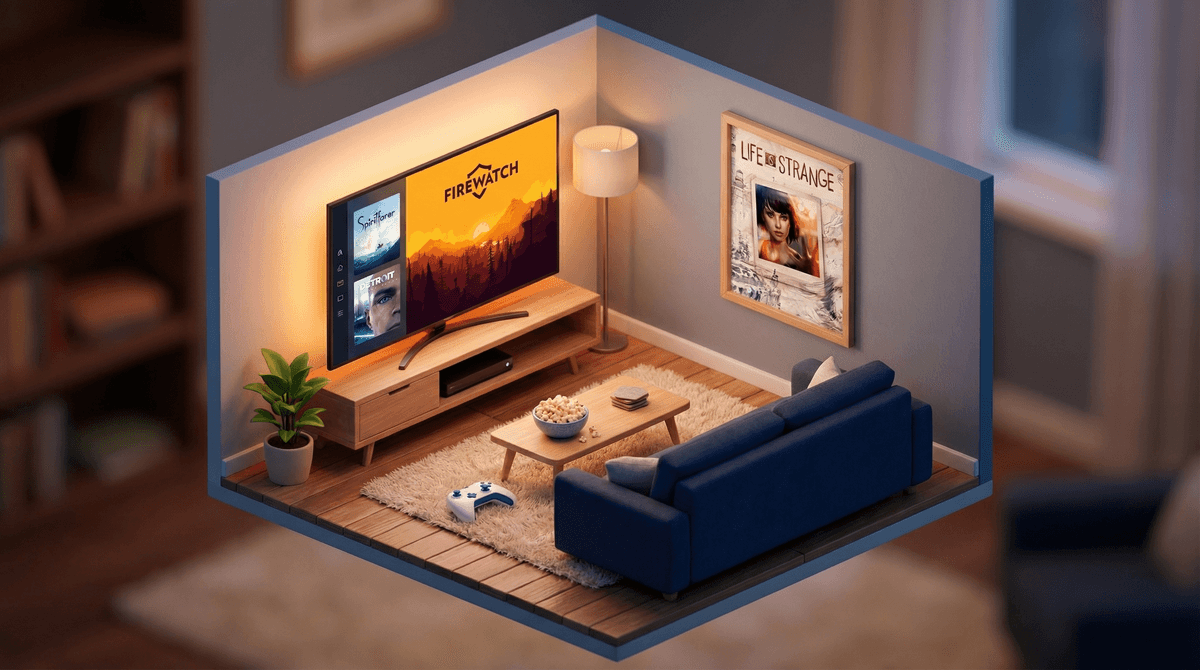
Think of narrative video games as interactive movies where your kid holds the controller. Instead of just watching a hero make choices, they are the hero making choices. Games like The Last of Us, Red Dead Redemption 2, and Life is Strange offer cinematic experiences with storylines that rival prestige TV shows—complete with character development, plot twists, and genuine emotional moments.
When these games are played on Xbox through your living room smart TV, they become a family room centerpiece. The screen that usually shows Netflix suddenly transforms into an interactive storytelling medium. And honestly? It can be pretty impressive to watch.
Here's what makes them different from other games: the story is the point. Sure, there's gameplay—exploring environments, solving puzzles, making dialogue choices—but the primary draw is experiencing a narrative unfold. Your kid isn't grinding for loot or chasing high scores. They're invested in characters, consequences, and how the story ends.
Narrative games offer something uniquely compelling: agency in storytelling. When your 13-year-old plays Detroit: Become Human, their choices genuinely affect the outcome. That character who died? In their friend's playthrough, that character survived and changed the whole ending.
This creates incredible investment. Kids will talk about these games the way we talked about Lost or Game of Thrones—theorizing, debating choices, comparing outcomes. It's a shared cultural experience, just interactive.
There's also the production value. Modern narrative games feature Hollywood-level voice acting (often actual Hollywood actors), motion capture, and cinematography. When played on a big TV, they're genuinely cinematic. Parents often find themselves watching over their kid's shoulder, actually engaged in the story.
And let's be real: about 55% of families in our community have gaming consoles, and 92% have TVs. These games represent where those two devices intersect in interesting ways.
Here's where it gets tricky. A typical narrative game session isn't a quick 20-minute match. These stories take hours to complete—sometimes 15-30 hours total. And unlike Fortnite matches that have natural stopping points every 20 minutes, narrative games are designed to keep you hooked through cliffhangers and "just one more chapter" pacing.
Our community data shows families average about 4.2 hours of screen time daily (4 hours on weekdays, 5 on weekends). A narrative game session can easily eat 2-3 hours in one sitting if you're not paying attention.
But here's the nuance: not all screen time is equivalent. Is playing through A Plague Tale: Innocence—a historical narrative about siblings surviving the Black Death—the same as doomscrolling TikTok? Many parents would argue no, but it still counts toward total screen exposure.
The TV placement matters too. When gaming happens on the big screen in a shared space, it's naturally more transparent than gaming on a device in their room. You can see what they're playing, hear the dialogue, notice when content gets intense. That visibility is actually valuable.
Narrative games span an enormous range of maturity levels, and the ESRB ratings actually matter more here than with many other games.
Ages 8-12: Look for E10+ or T-rated games with lighter themes:
- It Takes Two (requires two players—great parent-kid option)
- A Short Hike (gentle, exploration-focused)
- Firewatch (mystery with mature themes but minimal violence)
- Spiritfarer (deals with death but beautifully)
Ages 13-15: T and some M-rated games become appropriate, depending on your family:
- Life is Strange (teen drama, real issues like bullying and mental health)
- What Remains of Edith Finch (family stories, some dark themes)
- Telltale's The Walking Dead (zombie violence but story-focused)
Ages 16+: Most M-rated narrative games become options:
- The Last of Us (intense violence, mature themes)
- Red Dead Redemption 2 (Western epic, violence and moral complexity)
- God of War (2018) (mythology, father-son story, fantasy violence)
The key difference from movies: games are longer and more immersive. Your kid isn't just watching violence for 2 hours—they're participating in it for 20+ hours. That changes the psychological impact. Learn more about how game violence differs from movie violence .
.
These games can be legitimately educational. Many tackle complex themes—grief, morality, history, relationships—in ways that spark real conversations. God of War explores father-son dynamics and Norse mythology. Hellblade: Senua's Sacrifice depicts psychosis with input from mental health experts.
The social element is different. Unlike multiplayer games, narrative games are often solitary experiences. But kids share them through discussion, watching each other play, or comparing choices. It's more like book club than team sports.
Save systems matter. Many narrative games auto-save frequently, but some have checkpoint systems. This affects your ability to enforce "five more minutes" boundaries. Understanding how a specific game saves helps you set realistic stopping points.
Watch for content surprises. Even T-rated games can have intense moments. What Remains of Edith Finch is rated T but includes a suicide scene that's emotionally heavy. Preview games yourself or check Common Sense Media for detailed content breakdowns.
Narrative games on your living room TV represent a genuine evolution in storytelling—one that your kids are experiencing as natives while many of us are immigrants. They're not inherently better or worse than other gaming genres, just different.
The big-screen format creates natural transparency and can facilitate family engagement in ways that mobile gaming or PC gaming in a bedroom can't. That's actually a win for intentional parenting.
But they also demand longer time commitments and can contain mature content that requires careful age-matching. The key is knowing what your kid is playing and having honest conversations about both time limits and content.
Try co-playing. Pick an age-appropriate narrative game and play it together, or watch them play. You'll understand the appeal and have shared context for conversations.
Set session boundaries, not just daily limits. Instead of "2 hours of screens," try "one gaming session per day with a clear stopping point."
Use the TV placement strategically. Gaming in shared spaces naturally creates accountability and opportunities for engagement.
Check out Screenwise's gaming guides for specific game recommendations matched to your family's values and your kid's age.
The goal isn't to ban narrative games or to let them run wild. It's to approach them as the sophisticated storytelling medium they've become—with appropriate boundaries, age-matching, and genuine curiosity about what your kid is experiencing.