

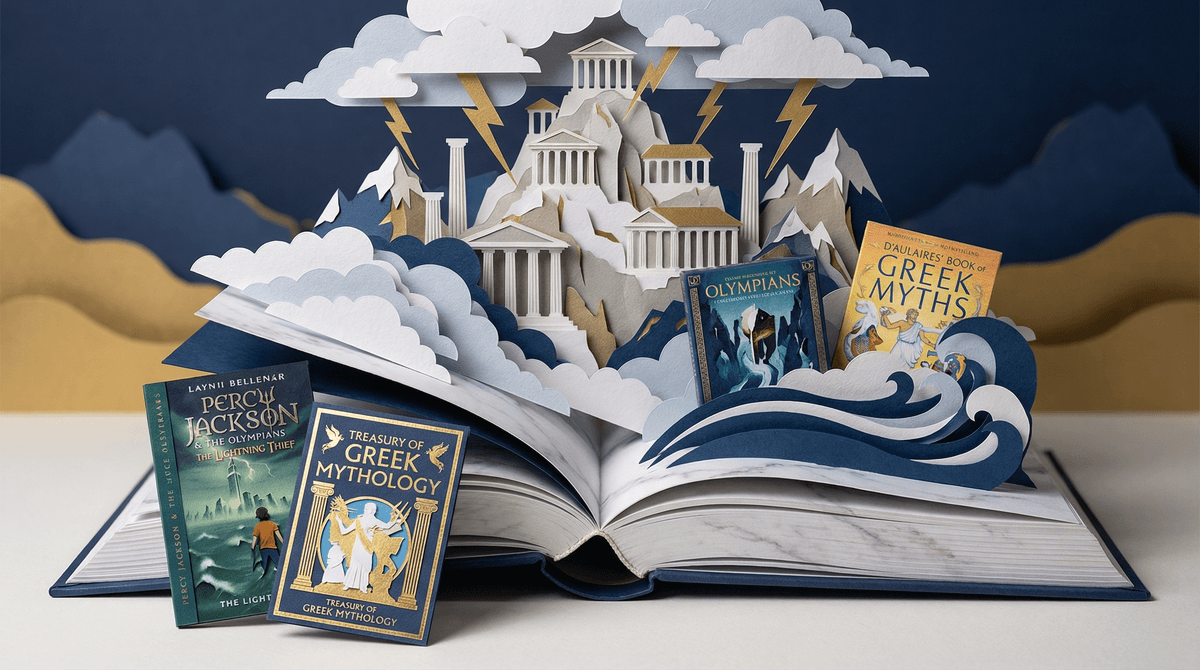
Mythology books introduce children to ancient stories from cultures around the world—Greek gods throwing lightning bolts, Norse heroes battling frost giants, Egyptian deities with animal heads, and countless other tales that humans have been telling for thousands of years. These aren't just dusty old stories your English teacher made you read. They're the original superhero universes, complete with powers, drama, family dysfunction, and epic battles.
The modern mythology book market for kids ranges from straightforward retellings that stick close to the source material, to graphic novel adaptations, to chapter book series that remix ancient tales for contemporary readers. Some are beautifully illustrated picture books perfect for elementary schoolers. Others are thick anthologies that middle schoolers can get lost in for weeks.
And here's the thing: your kid has probably already encountered mythology without you realizing it. Percy Jackson turned Greek mythology into a gateway drug for an entire generation of readers. Minecraft has Norse-inspired realms. Disney's Hercules (wildly inaccurate, but whatever) introduced millennials to Mount Olympus. Marvel's Thor franchise is basically Norse mythology with better special effects and worse accuracy.
Kids are drawn to mythology for the same reasons adults have been retelling these stories for millennia: they're exciting as hell.
There are monsters to fight, impossible quests to complete, magical weapons, shape-shifting, flying horses, underworld journeys, and gods who are petty and jealous and make terrible decisions. Mythology doesn't talk down to kids—these stories feature violence, betrayal, romance, and complex moral situations. A god turns someone into a spider out of spite. A hero's fatal flaw leads to their downfall. A trickster deity causes chaos just for fun.
Mythology also gives kids a framework for understanding big concepts: creation and destruction, good and evil, justice and revenge, loyalty and betrayal, mortality and legacy. These stories ask the same questions kids are starting to grapple with, just wrapped in tales about gods and monsters instead of suburban middle school drama.
Plus, there's the collection aspect. Once a kid gets into Greek mythology, they want to know ALL the gods, ALL the heroes, ALL the monsters. It's like Pokémon but with educational value that makes parents happy.
In a world where your kid's screen time is dominated by YouTube shorts and Roblox, mythology books offer something genuinely valuable: cultural literacy that will follow them through life.
Mythology references are everywhere in our culture—in literature, movies, brand names (Nike, Amazon, Pandora), idioms (Achilles' heel, Pandora's box, Herculean task), and even in understanding current events and political discourse. When your teenager eventually reads Shakespeare or studies the Renaissance or takes AP Literature, they'll already have the foundational knowledge that makes everything click.
Beyond cultural literacy, mythology teaches critical thinking about storytelling itself. Kids start to recognize patterns: the hero's journey, the trickster archetype, the creation myth structure. They see how different cultures answered similar questions in different ways. Why did the Greeks imagine their gods as basically immortal humans with superpowers, while the Egyptians envisioned animal-human hybrids? What does that tell us about those cultures?
And honestly? It's one of the few "educational" topics that kids will voluntarily read about for fun. A mythology phase can turn a reluctant reader into someone who actually enjoys books. That's worth celebrating.
Ages 4-7: Picture Books and Simple Retellings
Start with beautifully illustrated picture books that introduce individual myths or focus on specific characters. At this age, you want stories that capture the wonder without the more intense violence or complex themes. Books like "D'Aulaires' Book of Greek Myths" have been introducing kids to mythology for generations with gorgeous illustrations and age-appropriate storytelling.
Egyptian mythology often works well for this age group—the animal-headed gods are visually engaging and less violent than some Greek tales. Norse mythology can be trickier (it's pretty dark), but there are kid-friendly versions that focus on the more adventurous aspects.
Ages 8-11: Chapter Books and Series
This is prime mythology age. Rick Riordan's Percy Jackson series remains the gold standard—it makes Greek mythology accessible and exciting while staying remarkably true to the source material. Once kids finish Percy Jackson, Riordan's other series cover Egyptian (Kane Chronicles) and Norse (Magnus Chase) mythology.
"The Heroes of Olympus" series expands into Roman mythology, and here's where it gets interesting: kids start understanding that Romans basically copied Greek gods and gave them different names and slightly different vibes. That's a genuinely sophisticated cultural insight for a 10-year-old.
Other solid options: "Treasury of Greek Mythology" by Donna Jo Napoli for straightforward retellings, or graphic novel versions like "Olympians" by George O'Connor that make the stories visually dynamic.
Ages 12+: Deeper Dives and Original Texts
Middle schoolers can handle more complex retellings that don't shy away from the mature themes in mythology—the violence, the sexual content, the moral ambiguity. Madeline Miller's "The Song of Achilles" and "Circe" are technically adult books but are popular with mature teens and offer sophisticated, feminist retellings of classic tales.
This is also when kids can start reading actual translations of Homer's "Odyssey" or "Iliad" (maybe start with condensed versions), or exploring world mythology beyond the Greek/Roman/Norse trinity—Hindu epics, Chinese mythology, African folklore, Indigenous American stories.
The Violence Thing
Let's address this head-on: mythology is violent. Gods dismember each other. Heroes kill monsters in graphic ways. There's incest, rape, and murder. The original stories were not written for children.
Modern children's versions handle this by either softening the violence significantly (picture books), acknowledging it but not dwelling on details (middle-grade books), or presenting it more fully for older readers who can handle mature themes.
You know your kid's sensitivity level. Some 8-year-olds can handle Percy Jackson's monster battles just fine. Others might need to wait a year or two. The good news is that even sanitized versions of mythology still convey the core stories and lessons.
The Religion Question
Some families worry about mythology conflicting with their religious beliefs. Here's the thing: most kids naturally understand that these are stories people used to believe, not active religions. Greek mythology is taught as mythology, not as a competing faith system.
That said, if your family has specific concerns, you can frame it as "this is what ancient Greeks believed" or "these are important stories that help us understand history and culture." Most religious families find mythology books perfectly compatible with their faith—after all, understanding other cultures' stories is part of being an educated person.
Beyond Greek and Norse
The mythology section tends to be dominated by Greek and Norse tales, but there's a whole world of mythology out there. African, Asian, Indigenous American, Polynesian, Celtic—these stories are equally rich and important. Seek out diverse mythology books to give your kids a more complete picture of how humans across cultures have tried to explain the world.
Mythology books are one of those rare wins where kids think they're just reading cool stories about gods and monsters, but they're actually building cultural literacy, critical thinking skills, and a love of reading. Whether your kid devours Percy Jackson in a week or slowly works through a beautifully illustrated anthology, they're engaging with stories that have survived for thousands of years because they tap into something fundamentally human.
Start with whatever mythology tradition interests your kid most—Greek is popular for a reason, but don't sleep on Norse, Egyptian, or world mythology. Match the complexity to their age and reading level. And enjoy watching them discover that the best stories ever told don't require a screen.
Next Steps:
- Visit your library and let your kid browse the mythology section—the covers alone will tell you what appeals to them
- If your kid loves Percy Jackson, explore alternatives to Percy Jackson for what to read next
- Consider mythology-themed board games for family game night—there are some excellent ones that bring these stories to life in a different format