

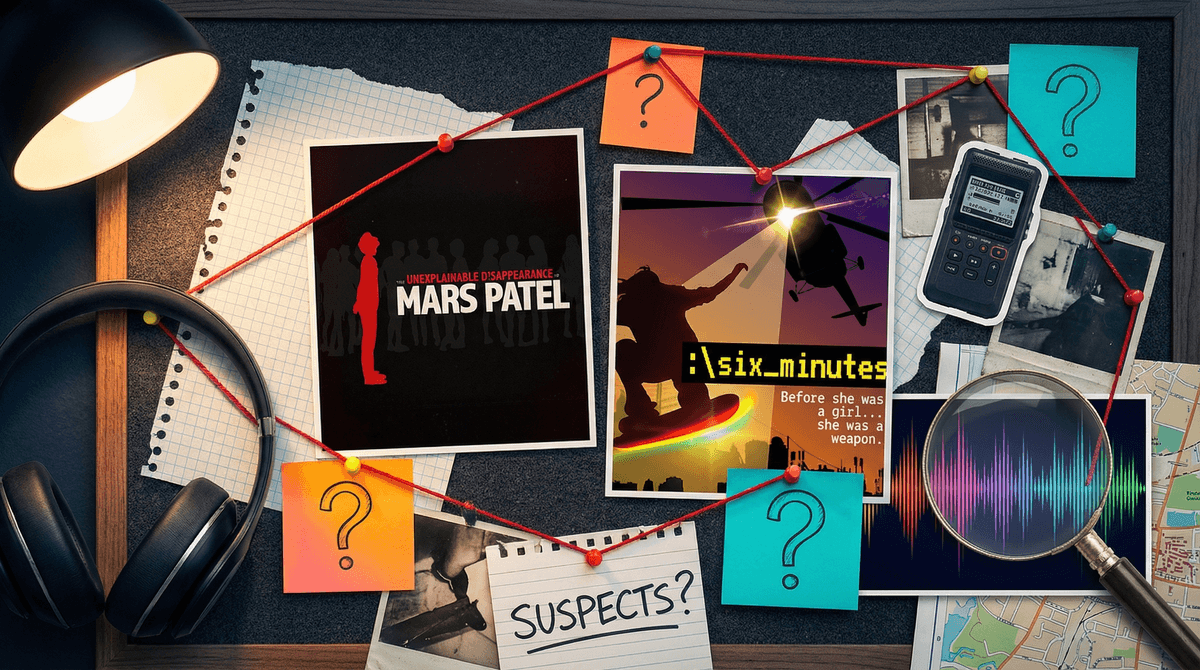
Mystery podcasts are exactly what they sound like: audio shows built around puzzles, whodunits, spooky stories, and the occasional true crime case. They range from fully-produced fictional dramas with sound effects and voice actors to conversational shows where hosts dissect real unsolved cases. Think Serial meets Scooby-Doo, but with way more variety in between.
For kids, these shows scratch the same itch as mystery books or detective shows—but they're consuming them during car rides, while drawing, or (let's be honest) when they're supposed to be falling asleep. And unlike YouTube, where you never know what autoplay will serve up next, podcasts feel more contained. More parent-approved. More... safe?
Well, mostly.
Mystery podcasts tap into something primal: kids love figuring things out. They want to solve the puzzle before the host does, debate theories with friends, and feel that dopamine hit when they're right. It's the same reason escape rooms and mystery board games are huge right now.
Plus, podcasts feel sophisticated. A 10-year-old listening to a mystery podcast feels older, more independent. They're not watching cartoons—they're listening to stories. It's a badge of maturity, even if the show is about a missing hamster.
The best mystery podcasts for kids also tend to be genuinely well-produced. Shows like The Unexplainable Disappearance of Mars Patel and Six Minutes have movie-quality sound design, cliffhangers that actually work, and stories that respect young listeners' intelligence. They're not dumbed down—they're just age-appropriate.
Here's where things get tricky: a lot of kids are listening to true crime podcasts meant for adults. And I mean a lot. Shows like Crime Junkie, My Favorite Murder, and Morbid are wildly popular with middle schoolers (and even some younger kids who've figured out how to bypass parental controls or just... ask Alexa to play them).
Why? Because true crime is everywhere. It's normalized. It's what their older siblings listen to, what TikTok references constantly, what their friends are talking about at lunch. And honestly, some kids are genuinely fascinated by forensics, psychology, and the justice system. That's not inherently bad.
But here's what parents should know: most adult true crime podcasts include graphic descriptions of violence, sexual assault, and trauma. They're not designed for developing brains. And while your 12-year-old might say they can handle it, exposure to repeated violent content—especially real violence—can increase anxiety, desensitization, and even nightmares.
Is true crime actually harmful for kids, or is this just moral panic? It's a fair question, and the answer is: it depends on the kid, the content, and the context.
Ages 6-9: Stick with fictional mysteries designed for this age group. Wow in the World has some mystery-adjacent episodes, and Story Pirates occasionally does whodunit-style stories. These are silly, safe, and engaging without any real scares.
Ages 10-12: This is the sweet spot for scripted mystery podcasts. The Unexplainable Disappearance of Mars Patel is a genuine thriller about missing kids, but it's fiction and age-appropriate. Six Minutes is another great option—fast-paced, mysterious, and designed for this exact age group. Tumble does science mysteries that are fascinating without being scary.
Ages 13+: Teens can handle more, but that doesn't mean they should jump straight to adult true crime. Radiolab has some incredible mystery-style episodes that are thought-provoking without being graphic. If they're really into true crime, look for shows specifically designed for teens, or listen together so you can talk through what they're hearing.
Podcasts feel invisible. Unlike a TV show or game, you can't glance over and see what they're consuming. Kids can listen to pretty much anything with earbuds in, and unless you're checking their podcast app, you might not know what they're hearing. About 50% of families in our community let kids use tablets unsupervised, and that often includes podcast access.
Podcast apps don't have great parental controls. Apple Podcasts, Spotify, and most other platforms don't let you block specific shows or set age ratings. You can use Screen Time or similar tools to limit app access entirely, but there's no "Netflix Kids" equivalent for podcasts.
The algorithm doesn't care about age. If your kid listens to one mystery podcast, the app will recommend others—including adult true crime shows. The platforms don't distinguish between a 10-year-old and a 30-year-old listener.
Listening together is underrated. Seriously. Pick a mystery podcast and listen to an episode during a car ride. It's a natural conversation starter, and you'll get a sense of what they're into and whether it's appropriate.
Mystery podcasts can be amazing for kids. They build listening skills, spark imagination, and offer screen-free entertainment that doesn't rot their brains. But like everything else in the digital world, they require some intentionality.
Check what your kid is actually listening to. If they're into true crime, don't just shut it down—talk about why they find it interesting and help them find age-appropriate alternatives. And if you're not sure where to start, explore kid-friendly mystery podcasts or ask in your parent community what other families are listening to.
The good news? Unlike TikTok or Roblox, podcasts are a relatively low-stakes way for kids to explore their interests independently. You've just got to make sure they're not accidentally stumbling into content meant for someone twice their age.
- Check their podcast app. See what's in their library and listen history.
- Set up a shared family account on Spotify or Apple Podcasts so you can see what they're subscribing to.
- Start a podcast routine. Listen to one episode together each week and talk about it.
- Use Screen Time limits if you're worried about unsupervised listening.
- Ask them what they like about mysteries. It might open the door to books, games, or other activities you can do together.
And if you're wondering whether your kid's 4.2 average screen hours per day (the average in our community) should include podcast time? Let's talk about whether audio content counts as screen time.