

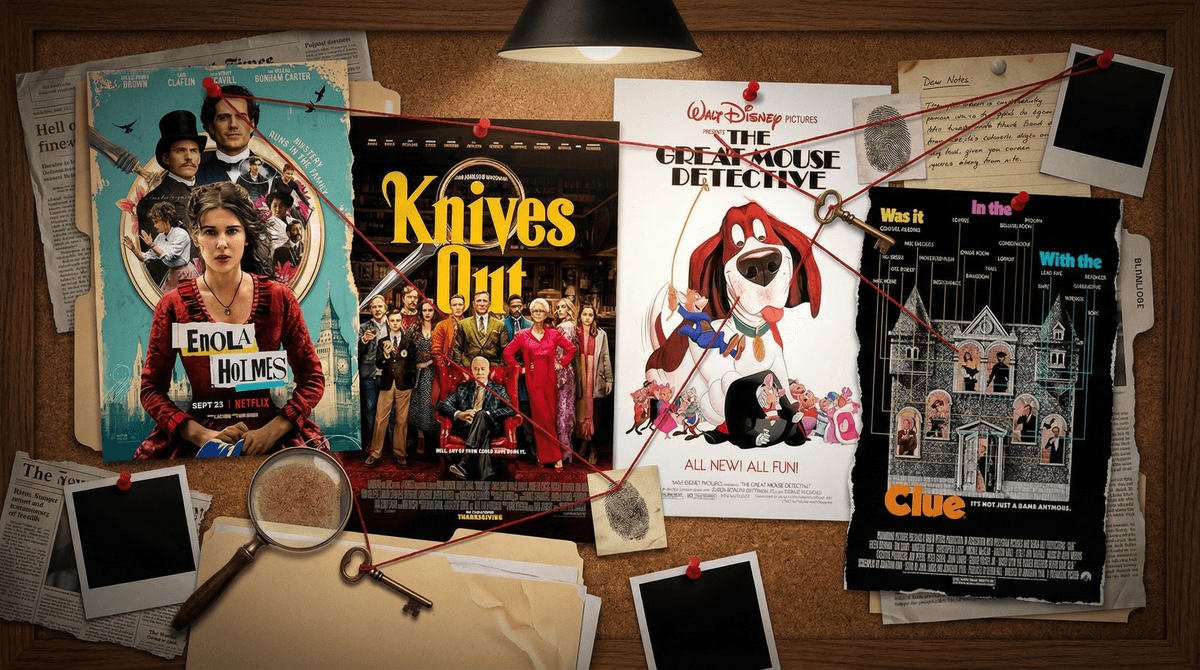
Mystery movies for families are exactly what they sound like: whodunits, detective stories, and puzzle-solving adventures that keep everyone guessing until the big reveal. Think Knives Out, Enola Holmes, classic Clue, or even animated gems like The Great Mouse Detective.
But here's what makes them different from your average family movie night: these films actively engage your kid's brain in a way that most screen time doesn't. They're not passive entertainment—they're interactive puzzles that happen to be projected on a screen.
Screenwise Parents
See allMost screen time is consumptive. Kids watch, laugh, maybe cry, and then it's over. Mystery movies? They turn viewers into participants. Your kid is literally doing detective work alongside the characters—tracking clues, forming theories, arguing about red herrings during the movie (yes, this is allowed and encouraged).
This is the kind of screen time that actually sparks conversation. You're pausing to debate who did it. You're rewinding to catch a detail you missed. You're talking about it at breakfast the next day when someone suddenly realizes "WAIT—the butler's tie was the same color as the poison bottle!"
It's screen time that extends beyond the screen. And honestly? That's the holy grail for intentional parents trying to make media consumption more meaningful.
Let's talk about what's actually happening in your kid's brain during a good mystery:
Pattern recognition: They're scanning for visual clues, noticing inconsistencies in alibis, tracking who was where when.
Logical reasoning: "If the necklace was stolen at 8pm, and she was at dinner until 9pm, then she couldn't have done it... unless she had an accomplice."
Hypothesis testing: Kids form theories, gather evidence, adjust their thinking when new information contradicts their original idea. This is literally the scientific method in action.
Attention to detail: Mystery movies reward careful watching. That throwaway line in act one? It's probably the key to solving the whole thing.
Compare this to the passive consumption of most YouTube content or the dopamine-slot-machine of TikTok, and you can see why mystery movies are a completely different beast.
Ages 5-8: Start with lighter fare that introduces mystery concepts without being scary or too complex.
- Scooby-Doo movies (the animated ones, not the live-action which can be surprisingly crude)
- Paddington 2 (yes, it's a mystery! Who framed Paddington?)
- The Great Mouse Detective
Ages 9-12: This is the sweet spot for classic whodunits.
- Enola Holmes series (feminist detective work, period costumes, Millie Bobby Brown—what's not to love?)
- Murder on the Orient Express (2017 version is gorgeous and kid-friendly despite the title)
- Knives Out (some language, but most 10+ kids can handle it, and it's genuinely brilliant)
Ages 13+: Time for more complex narratives and darker themes.
- Glass Onion (the Knives Out sequel, equally clever)
- See How They Run (meta-mystery about murder mysteries)
- Classic Agatha Christie adaptations
Pro tip: The Clue movie from 1985 is a family favorite across ages 8-adult. It's campy, fast-paced, hilarious, and has THREE different endings. Watch all three and vote on which one makes the most sense.
Not all mysteries are created equal. Some modern "thrillers" marketed as mysteries are really just horror films with a whodunit veneer. Always check ratings and parent reviews before assuming something is family-friendly just because it has "mystery" in the description.
The replay value is real. Once kids know whodunit, they'll want to rewatch to catch all the clues they missed. This is actually great—it's a different kind of media literacy, learning to "read" visual storytelling.
Mystery movies can lead to mystery everything else. Once kids get hooked on the format, they often branch out to mystery books, mystery podcasts, even detective-themed board games. This is a gateway drug to reading, and we're here for it.
Some kids find suspense stressful. If your kid is sensitive to tension or gets anxious not knowing what's coming, mysteries might not be their jam. That's totally fine—not every kid needs to love every genre.
Here's how to level up mystery movie night:
Create a detective notebook. Give kids paper to jot down clues, suspects, and theories as they watch. This transforms passive viewing into active investigation.
Pause for predictions. At key moments (right before the big reveal, usually), pause and have everyone share their theory. No judgment—wild theories are encouraged.
Rewatch with purpose. After you know whodunit, watch again and track how the filmmaker planted clues. This teaches visual literacy and storytelling structure.
Follow up with conversation. "What clue made you suspicious?" "When did you figure it out?" "What would you have done differently as the detective?"
Mystery movies aren't just entertainment—they're brain workouts disguised as family fun. They teach critical thinking, attention to detail, and logical reasoning. They spark conversation and debate. They reward careful watching and create that rare thing: screen time that actually brings families together in active engagement.
Are they going to replace outdoor play or reading time? No, and they shouldn't. But in the hierarchy of screen time options, mystery movies are pretty close to the top. They're the kind of media consumption that intentional parents can feel genuinely good about.
Start with one movie night this month. Pick something age-appropriate from the list above, make some popcorn, and commit to watching together (not scrolling phones, actually watching). See if your kids get hooked on the format.
Branch out to mystery books. If they love the movies, check out mystery book series for kids to keep the critical thinking going.
Try a mystery board game. Games like Clue or Mysterium extend the mystery-solving fun beyond the screen entirely.
And if you're wondering whether your family's screen time balance is healthy compared to others in your community, Screenwise can help you understand your habits in context—no judgment, just data and guidance.