

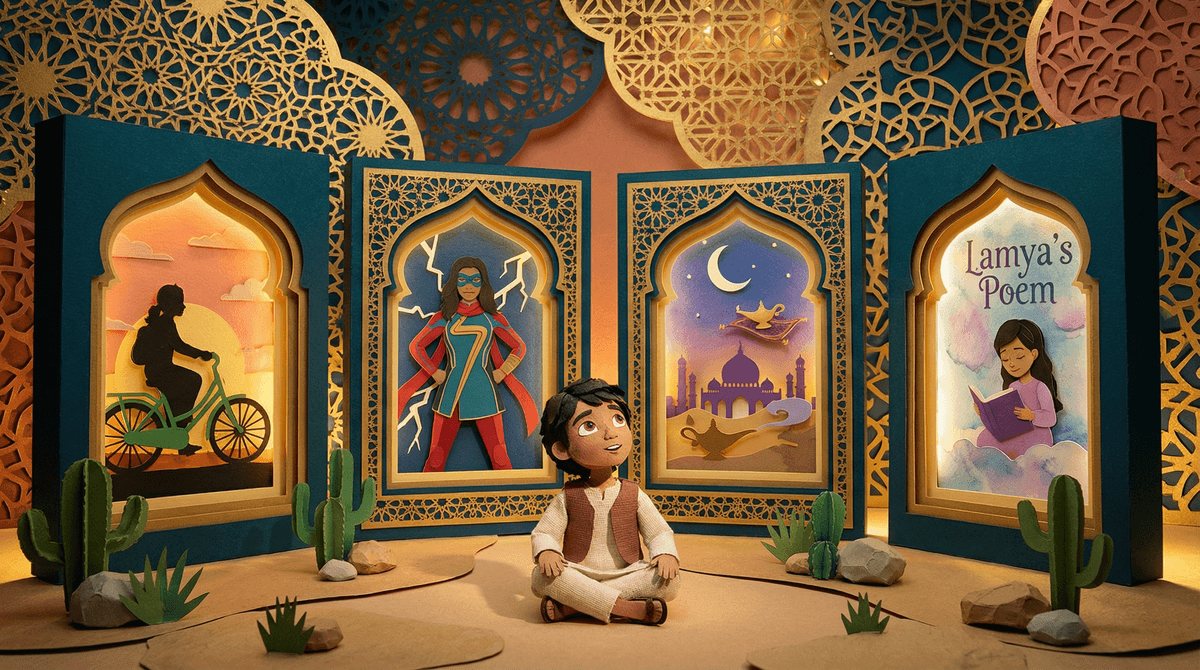
Let's be real: when you're scrolling through Netflix or Disney+ trying to find something for family movie night, how often do you see an Arab character as the actual protagonist? Not the sidekick, not the mystical guide, not the villain—the hero of the story?
Movies with Arab leads are exactly what they sound like: films where Arab characters drive the narrative, make the choices, save the day, fall in love, mess up, grow, and generally do all the things protagonists do. These aren't films about being Arab as an issue or problem to solve—they're films where Arab people get to be fully realized characters living their lives.
And here's the thing: representation isn't just a buzzword or something to check off a diversity bingo card. When kids see characters who look like them (or don't look like them) in leading roles, it shapes how they understand who gets to be the hero, who gets to be funny, who gets to be complex. It matters.
You might be thinking, "We're not Arab, so is this relevant to us?" Or conversely, "We are Arab and Hollywood has let us down so many times, why bother?"
Both valid. But here's why it's worth paying attention:
For Arab kids: Seeing yourself as the protagonist—not the punchline or the problem—is huge. It's the difference between feeling like you're a guest in the story of culture versus actually belonging there. Films like Ms. Marvel (okay, it's a show, but same principle) or Aladdin (the 2019 version with actual Arab actors) let Arab kids see themselves as powerful, funny, romantic, heroic.
For non-Arab kids: Exposure to different cultures through media helps build empathy and normalize diversity. When your kid grows up watching heroes from all backgrounds, they're less likely to see "different" as "other" or "weird." It's cultural literacy, and in 2026, it's kind of essential.
For everyone: Good stories are good stories. Period. And we've been missing out on a whole lot of good stories by having such a narrow view of who gets to be the main character.
Here's where we need to be honest: the options are still pretty limited, especially for kids' content. Hollywood has a long way to go. But there are some solid choices:
For Younger Kids (Ages 5-10):
- Aladdin (2019): The live-action remake cast actual Middle Eastern and South Asian actors (Mena Massoud, Naomi Scott) and while it's still a Disney fairy tale with all the usual tropes, it's a massive upgrade from the 1992 version's problematic stereotypes.
- Lamya's Poem: An animated film that connects a 12th-century poet with a modern refugee girl. It's beautiful, age-appropriate, and deals with heavy themes (displacement, war) in a way that's accessible for kids.
For Tweens/Teens (Ages 10+):
- The Breadwinner: An animated film about an Afghan girl who disguises herself as a boy to support her family under Taliban rule. It's intense but important, and the animation style is stunning. Definitely preview this one—it deals with real hardship.
- Capernaum: This Lebanese film is rated R and is absolutely not for younger kids, but for mature teens (16+), it's a powerful look at poverty and childhood in Beirut. It's not easy viewing, but it's the kind of film that stays with you.
For Family Viewing (with discussion):
- Wadjda: A Saudi Arabian film about a girl who wants to buy a bicycle in a society that doesn't approve of girls riding bikes. It's gentle but subversive, and rated PG. Great conversation starter about gender norms across cultures.
The representation isn't monolithic: "Arab" encompasses 22 countries and countless cultures, religions, and experiences. A film from Lebanon is different from one from Egypt or Saudi Arabia or Palestine. This is a feature, not a bug—it's an opportunity to learn about diversity within Arab cultures.
Some films deal with heavy themes: Many films featuring Arab leads (especially those made by Arab filmmakers) deal with war, displacement, discrimination, and poverty. This isn't trauma porn—these are real experiences that deserve to be told. But it does mean you need to preview and decide what your kid is ready for.
Streaming is your friend: You're not going to find a ton of these at your local multiplex, but platforms like Netflix, Hulu, and especially international streaming services have been expanding their libraries. Check out what's available on your platforms .
.
Language matters: Some of these films are in Arabic with subtitles. If your kids aren't used to subtitles, start with shorter content or films with simpler plots. Reading subtitles is actually a great skill—it improves reading speed and comprehension.
Ages 5-8: Stick with lighter fare like the 2019 Aladdin. At this age, representation can be as simple as "the princess looks like me" or "that family eats similar food to us."
Ages 8-12: Lamya's Poem and Wadjda work well here. Kids this age can start understanding cultural context and having conversations about why certain rules or restrictions exist in different societies.
Ages 12+: The Breadwinner and other more intense content becomes appropriate, though you should still watch together and be ready to discuss. Teens can handle complexity and moral ambiguity.
Ages 16+: For mature teens, films like Capernaum or The Insult (a Lebanese courtroom drama) offer sophisticated storytelling and real-world issues.
Just throwing on a movie and calling it "cultural education" isn't enough. Here's how to make it count:
Before watching: Look up where the film is set, who made it, and what it's about. A 30-second Google search gives you enough context to orient your kids.
During watching: Pause and ask questions. "Why do you think she made that choice?" "How is their school different from yours?" "What do you notice about their home?"
After watching: This is where the magic happens. Talk about what surprised them, what they related to, what they didn't understand. If your kid is Arab, ask how they felt seeing themselves represented—was it accurate? Empowering? Weird?
Follow up: One movie isn't enough. Make it a regular thing. Rotate through different cultures and types of representation. Explore other films with diverse leads.
Movies with Arab leads aren't a separate category of "educational content" you have to force-feed your kids like vegetables. They're just... movies. Good ones, bad ones, funny ones, sad ones. The only difference is who gets to be the hero.
In a world where Arab people are often portrayed as terrorists, victims, or background characters, seeing Arab protagonists who are complex, flawed, heroic, and human is revolutionary. And it's not just important for Arab kids—it's important for all kids to grow up understanding that heroes come in all colors, speak all languages, and live all over the world.
Start with one movie. See how it goes. Pay attention to what resonates with your kids. And remember: perfect representation doesn't exist, but some representation is infinitely better than none.
- Check your streaming services: Search "Middle Eastern cinema" or specific countries like "Lebanese films" or "Egyptian cinema"
- Preview before committing: Common Sense Media has reviews that can help you gauge age-appropriateness
- Make it a series: Once a month, pick a film from a different culture or region
- Get recommendations for age-appropriate movies with Arab leads based on what your kids already like
And hey, if you try one of these and it's a dud? That's okay. Not every movie is going to land. The point is you tried, you exposed your kids to something new, and you're building a habit of seeking out diverse stories. That's the win.