

TL;DR
If you loved Stalactite by Drew Beckmeyer, you're looking for books that slow down, invite reflection, and create genuine emotional connection without being saccharine. These 2026 Caldecott-honored and similar picture books are the antidote to "brain rot" content—they're what I call "slow media" for kids. Here are the best heartwarming reads in this vein:
- The Polar Bear by Jenni Desmond (Ages 4-8)
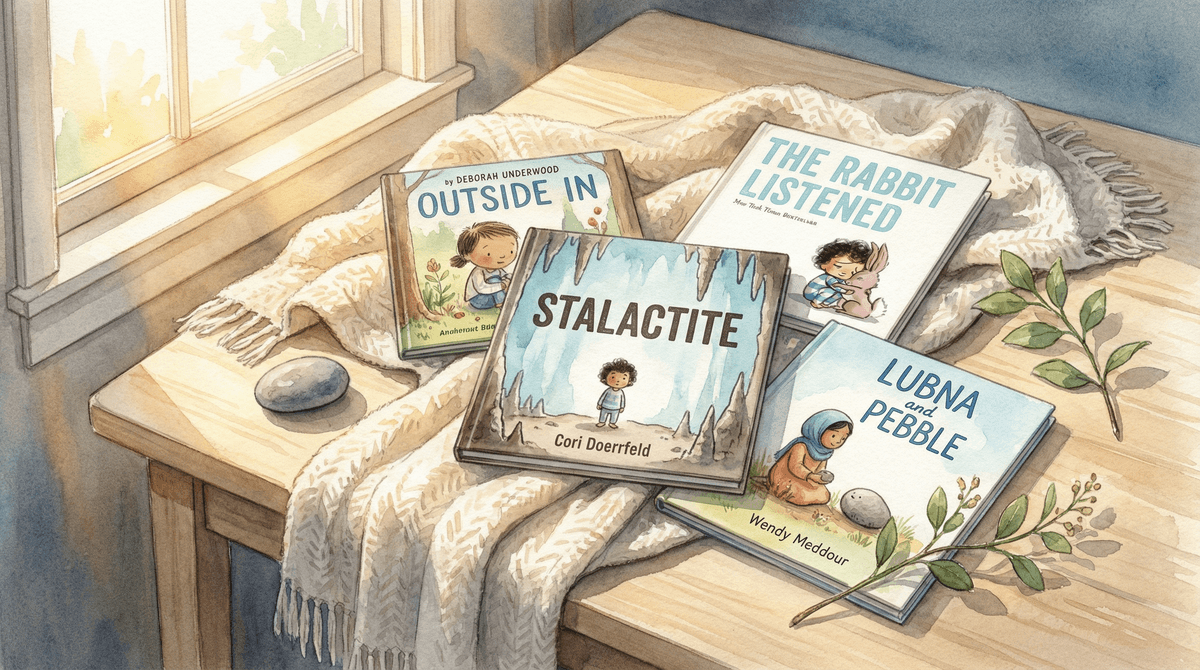
- The Rabbit Listened by Cori Doerrfeld (Ages 3-7)
- Outside In by Deborah Underwood (Ages 5-9)
- Lubna and Pebble by Wendy Meddour (Ages 5-10)
- The Bench by Corinna Luyken (Ages 4-8)
Screenwise Parents
See allDrew Beckmeyer's Stalactite hit differently for a lot of parents in 2026-26. It's a picture book about a stalactite who feels lonely hanging from a cave ceiling, separated from the stalagmite growing up from the floor below. Over thousands of years, they slowly grow toward each other until they finally connect.
That's it. That's the whole book.
And it's devastating in the best way.
What makes it work is the restraint. There's no forced lesson, no "and the moral is..." moment. Just quiet longing, patience, and eventual connection. It trusts kids (and adults) to sit with feelings without needing them explained or resolved quickly. In a media landscape where even picture books often feel like they're shouting for attention, Stalactite whispers—and somehow that makes it unforgettable.
If you're looking for more books like this, you're essentially looking for what researchers call "contemplative media"—content that invites kids to slow down and feel rather than consume and move on. This matters more than ever when our Screenwise community data shows kids averaging 4.2 hours of screen time daily, much of it fast-paced, algorithmically-optimized content designed to keep eyeballs glued.
These books are the counter-programming your family needs.
Ages 3-7
This one absolutely nails the "quiet emotional intelligence" vibe of Stalactite. When Taylor's block tower crashes, a parade of well-meaning animals show up with advice: the chicken wants to talk about it, the bear wants to get angry, the elephant wants to remember. But only the rabbit just... sits and listens.
What I love here is how it validates that sometimes kids (and adults) don't need solutions or explanations—they need presence. The illustrations are soft and uncluttered, giving emotional space the same way Stalactite gives physical space to those formations growing toward each other.
Perfect for: Kids who've experienced disappointment or loss and need permission to just feel without fixing.
Ages 5-9
A boy is stuck inside (relatable content for 2026 kids), but outside, nature keeps showing up: a bird at the window, rain on the glass, eventually snow and spring. The relationship between inside and outside becomes this beautiful meditation on connection even when separated.
The parallel to Stalactite is obvious—two entities separated by circumstance, finding ways to connect across distance. But Outside In adds layers about seasonal changes and patience that make it feel both timely (hello, post-pandemic processing) and timeless.
Underwood's illustrations use negative space brilliantly. This is a book that earns its page turns.
Ages 5-10
Lubna is a refugee who finds a pebble and makes it her friend—she tells it stories, keeps it safe, helps it feel less scared. When she meets a younger boy who's even more frightened, she makes the hardest choice: she gives him her pebble.
This book absolutely wrecked me the first time I read it. It has that same ache as Stalactite—the understanding that love sometimes means letting go, that connection can be both temporary and profound. The watercolor illustrations by Daniel Egnéus are stunning without being precious.
Real talk: This deals with displacement and refugee experiences, so it's heavier than some picture books. But it does so with such gentleness that it opens up conversations rather than overwhelming kids. It's heartwarming without being sentimental, which is a rare gift.
Ages 4-8
(Not Meghan Markle's book—different bench entirely!)
Luyken's bench sits in a park and witnesses moments of connection: a boy sketching, friends reuniting, a grandmother resting. Eventually the bench breaks, gets moved, becomes a different kind of gathering place. It's about how objects hold our stories and how communities form around shared spaces.
The genius here is similar to Stalactite's geological time scale—the bench operates on human time, but spans seasons and years, giving kids a sense of continuity and change happening simultaneously. The charcoal and pencil illustrations feel sketchy and immediate while telling a story that unfolds slowly.
Why it works for screen-weary families: It celebrates noticing. In a world where our kids are averaging 4+ hours daily on devices (and 70% of Screenwise families report struggles with bedtime screen use), books that teach observation and presence are genuinely radical.
Ages 4-8
This is technically a non-fiction picture book about polar bears, but it has the emotional resonance of the best fiction. A child reads about polar bears and imagines what it would be like to be one—to swim in icy water, to wait patiently for seals, to care for cubs in the harshest environment on Earth.
The connection to Stalactite? Both books ask readers to imagine existence from a completely different perspective. One asks you to feel what it's like to be a rock formation; the other asks you to inhabit a polar bear's experience. Both create empathy through imagination rather than instruction.
Desmond's illustrations are gorgeous—detailed enough to be informative but painterly enough to feel warm despite the Arctic setting. And the framing device (a child reading and imagining) makes it accessible for younger kids while still being substantial for older elementary readers.
All of these books work across a pretty wide age range because they operate on multiple levels:
Ages 3-5: The illustrations and basic emotional arcs work beautifully. Kids this age get the feelings even if they don't catch every nuance.
Ages 6-8: Prime territory. These readers are developing empathy and can sit with more complex emotions. They're also starting to understand concepts like time passing, which makes books like Stalactite and Outside In especially powerful.
Ages 9-12: Don't sleep on picture books for this age group! These books offer sophisticated emotional content in an accessible format. They're perfect for kids who are overwhelmed by chapter books or who need a break from the intensity of middle-grade novels. Plus, they're great conversation starters about bigger themes.
For adults: Honestly? These books hit hard when you're a parent dealing with your own stuff. Read them for yourself too.
These Are "Slow Media" By Design
In our Screenwise community, parents report that their kids consume an average of 4.2 hours of screen content daily—much of it optimized for rapid dopamine hits. These books are the opposite. They require patience. Some kids used to fast-paced content might initially resist.
Try this: Read these books at bedtime, when the day is winding down anyway. About 70% of Screenwise families report keeping screens out of bedtime routines, which creates the perfect environment for these contemplative reads.
They're Conversation Starters, Not Lectures
None of these books are preachy. They don't explain their themes or spell out morals. This means you might need to sit with silence after reading them. That's okay! That's actually the point. If your kid wants to talk, great. If they just want to think, that's equally valuable.
They're Genuinely Multicultural Without Being Performative
Books like Lubna and Pebble deal with refugee experiences; others show diverse characters without making it A Thing. These books model inclusion naturally, which is how kids should encounter it.
Physical Books Hit Different
I know, I know—digital books are convenient. But there's something about the physicality of these particular books that matters. The weight of the pages, the texture of the illustrations, the ability to flip back and linger on a spread... it all contributes to that "slow media" experience. If you're trying to reduce screen time (and most parents are), investing in physical books is one of the highest-ROI moves you can make.
Stalactite resonated because it trusted readers to sit with longing, time, and eventual connection without needing everything explained. These five books do the same thing—they're antidotes to the frenetic pace of most kids' media consumption.
In a world where algorithms are designed to keep kids scrolling, books that require patience and presence are genuinely counter-cultural. They're also some of the most emotionally satisfying reading experiences you'll share with your kids.
Next steps:
- Check your local library for these titles (librarians LOVE recommendations like this)
- Explore more contemplative picture books
- Consider starting a "slow reading" bedtime routine—one book, no rushing, space for questions or silence
- If your kid loves these, try poetry books for children next—they operate on similar principles
These books won't go viral on BookTok. They won't have merchandise tie-ins or movie adaptations. But they'll stick with your kids (and you) in ways that louder, flashier content never could. That's the whole point.