

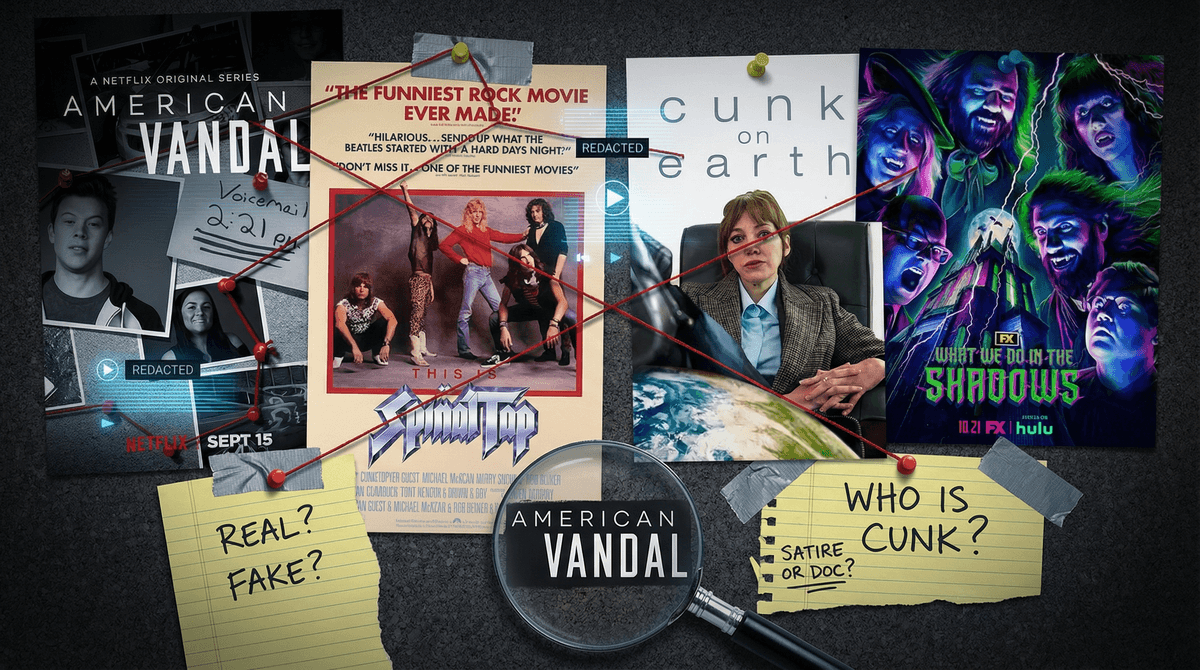
Mockumentaries are fake documentaries that use the documentary format—talking heads, archival footage, serious narration—to tell completely fictional stories. Think The Office meets actual PBS. They're parodies that look and feel like real documentaries but are totally made up, and honestly? They're kind of brilliant for teens right now.
The format itself is the joke. These shows and movies mimic the aesthetic of serious documentary filmmaking so convincingly that part of the fun is spotting what's real and what's absurd. And in 2026, when your teen is scrolling through TikTok where actual news sits next to elaborate pranks sits next to AI-generated nonsense, the ability to question "wait, is this real?" is genuinely a superpower.
Screenwise Parents
See allHere's the thing: mockumentaries are accidentally perfect training wheels for critical thinking about media.
When teens watch something like American Vandal—a Netflix series that investigates who spray-painted penises on teachers' cars with the gravitas of Making a Murderer—they're learning to identify the techniques that make content feel authoritative. The dramatic music. The expert interviews. The way footage is edited to create narrative tension. The serious narrator voice that makes everything sound important.
And then they realize it's all fake. Which means they start asking: what makes something seem true? What are the signals we use to trust information? How does presentation shape our perception of facts?
This isn't abstract. Teens are encountering deepfakes, AI-generated "documentaries," influencer misinformation, and politically motivated content that all use these exact same techniques. Mockumentaries give them a low-stakes way to develop their BS detector.
Beyond the media literacy gold, mockumentaries are just really funny when done well. They take ridiculous premises seriously, which is peak teen humor. The format lets creators go deep on absurd details—like spending 30 minutes analyzing cafeteria surveillance footage to determine who committed a prank—and that commitment to the bit is genuinely entertaining.
There's also something satisfying about being in on the joke. Teens get to feel smart for recognizing the parody, for catching the subtle ways the show is winking at them. It's humor that rewards attention and cultural knowledge, which feels more sophisticated than a lot of comedy aimed at their age group.
American Vandal (Netflix, Ages 14+)
Two seasons of true-crime parody that investigates high school pranks with absurd seriousness. Season 1 is about spray-painted penises, Season 2 is about a poop-related incident called "The Brownout." Yes, really. But underneath the juvenile humor is genuinely smart commentary about social media, reputation, and how we construct narratives. The profanity and sexual references are there, but it's actually pretty thoughtful.
What We Do in the Shadows (Hulu, Ages 15+)
A documentary crew follows vampire roommates in Staten Island. It's silly, clever, and surprisingly wholesome for a show about bloodsucking monsters. Some violence and adult themes, but the mockumentary format makes everything feel less intense.
Cunk on Earth (Netflix, Ages 13+)
British comedian Diane Morgan plays Philomena Cunk, an aggressively clueless documentary presenter who interviews real experts about human history. She asks questions like "What is the moon for?" with complete sincerity. It's a masterclass in how editing and framing create meaning—the experts are real, the questions are absurd, and the result is hilarious.
Spinal Tap (Movie, Ages 13+)
The OG mockumentary about a fictional rock band. It's from 1984 but still holds up, and teens who are into music will appreciate how it skewers rock star egos and industry nonsense.
Not all mockumentaries are created equal, and some lean harder into adult content than others. The format doesn't automatically make something appropriate—Borat is a mockumentary, but it's definitely not for most teens.
Check for:
- Sexual content and language: Many mockumentaries are made for adult audiences and include mature themes
- Mean-spiritedness: Some mockumentaries punch down rather than up—make sure the humor isn't just cruelty dressed up as satire
- Your teen's media literacy baseline: If they're still figuring out how to spot misinformation online, starting with something clearly absurd (like American Vandal) works better than something more subtle
The best part about mockumentaries is they basically beg for conversation. After watching together (or after your teen finishes an episode), try:
"What made it feel like a real documentary?"
This gets them thinking about filmmaking techniques—music, pacing, interview style, graphics, narration.
"When did you realize it was fake?"
Some teens catch on immediately, others take a few minutes. There's no wrong answer, and it opens up discussion about what signals we use to determine credibility.
"Have you seen anything online that uses these same tricks?"
Connect it to their actual media diet. That TikTok that looked like news? That YouTube video with dramatic music and a serious voice? Same techniques.
"What's the difference between this and actual misinformation?"
Mockumentaries are transparent about being fake (eventually). Misinformation pretends to be real. But they use the same toolbox, which is the point.
Mockumentaries aren't going to single-handedly solve the misinformation crisis, but they're a genuinely useful tool for helping teens understand how media manipulates emotion and perception. Plus they're funny, which makes them an easier sell than sitting your teen down for a lecture about media literacy.
If your teen is 13+ and you're looking for something to watch together that's both entertaining and secretly educational, mockumentaries are a solid choice. Start with American Vandal if your teen can handle some crude humor, or Cunk on Earth if you want something a bit lighter.
And hey, if nothing else, at least they'll stop believing everything they see on TikTok just because it has a serious voiceover and some B-roll footage. That alone is worth the watch.
Want more shows that sneak in critical thinking? Check out our guide to TV shows that teach media literacy.
Concerned about your teen's ability to spot misinformation? Learn how to talk to teens about deepfakes and AI-generated content .
.
Looking for more age-appropriate comedy? Browse our recommendations for teen-friendly comedy shows.