

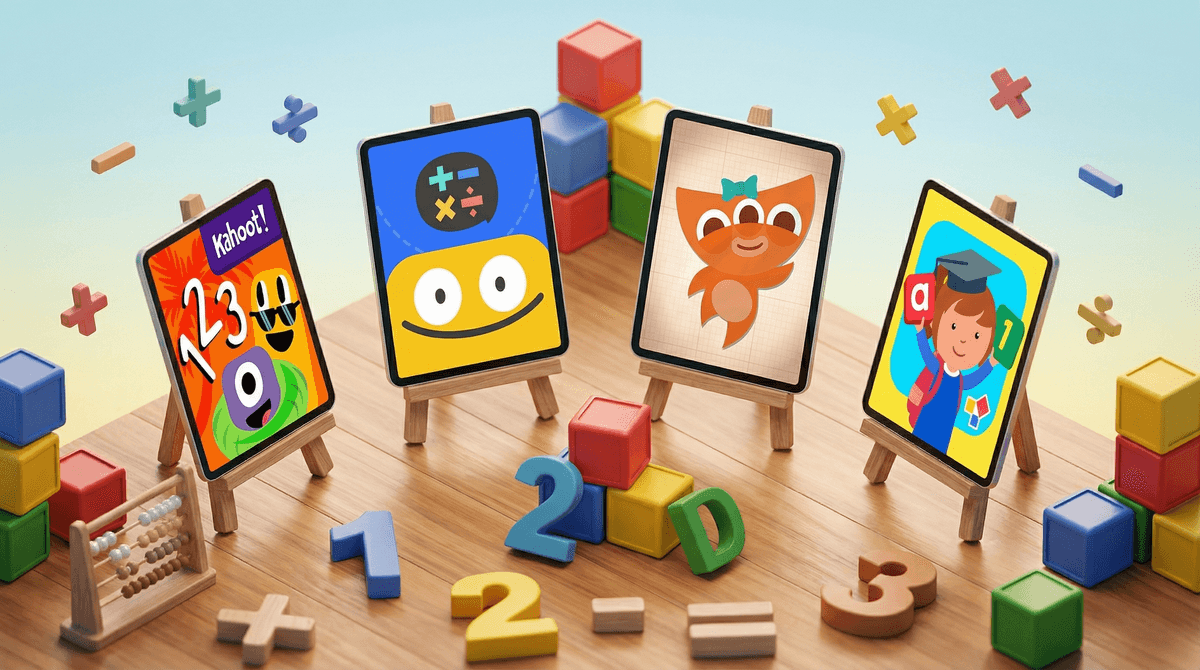
We're talking about digital games and apps designed to help 5-6 year olds build foundational math skills—counting, number recognition, basic addition and subtraction, pattern recognition, and spatial reasoning. Think colorful, interactive experiences where kids tap, drag, and swipe their way through math concepts while cartoon characters cheer them on.
The market is flooded with these apps. Some are genuinely excellent teaching tools built by educators. Others are thinly-veiled ad delivery systems with a number slapped on them. And many fall somewhere in between—not harmful, but not particularly valuable either.
Here's the thing parents need to understand upfront: kindergarten math doesn't require a screen. Full stop. Your kid can build incredible number sense with blocks, card games, cooking measurements, and literally just counting stuff around the house. Digital math games are a supplement, not a requirement, and definitely not a replacement for hands-on exploration.
That said, used intentionally, the right math games can be engaging practice tools that some kids genuinely enjoy. The key word being some—not all kindergarteners are motivated by gamified learning, and that's completely normal.
When done well, digital math games offer instant feedback and celebration that can be really motivating for early learners. Answer correctly? Confetti! Unlock a new level! Your character does a dance!
For kids who are already interested in screens (let's be real, most of them), math games can make practice feel less like work. Some kids will happily spend 15 minutes on Prodigy Math who would fight you tooth and nail over a worksheet.
The interactivity matters too. Dragging numbers into place, watching animations that demonstrate concepts, hearing numbers spoken aloud—these multisensory elements can help concepts click for some learners in ways that pencil and paper don't.
Here's where we need to be honest. The research on educational apps for young children is... mixed. Some studies show modest gains in specific skills. Others show no significant advantage over traditional methods. And almost all of them emphasize that the quality of the app matters enormously, and that apps work best when used with adult guidance, not as solo screen time.
What we know for sure:
- Passive screen time (watching videos) doesn't teach math skills effectively
- Interactive apps where kids actively problem-solve can support learning
- Apps are most effective when parents co-play and talk through the concepts
- No app can replace hands-on manipulation of physical objects for building number sense
- Kindergarteners need WAY more physical movement and creative play than screen time
The American Academy of Pediatrics recommends no more than one hour of high-quality screen time per day for kids ages 2-5, and that includes everything—shows, games, FaceTime with grandma, all of it. Math games should be a small slice of that pie, if they're included at all.
Not all math apps are created equal. Here's what to look for:
The good stuff:
- Clear learning objectives tied to kindergarten standards (counting to 20, simple addition within 10, shape recognition)
- No ads or in-app purchases that interrupt learning or tempt kids
- Adaptive difficulty that adjusts to your child's level
- Minimal extraneous stimulation—not every correct answer needs fireworks and three different sound effects
- Parent dashboards so you can actually see what they're working on
Red flags:
- Aggressive monetization (pay to unlock levels, constant prompts to buy stuff)
- Rewards systems that feel more like slot machines than learning tools
- "Educational" games that are 80% ads and 20% content
- Overly complex interfaces that require adult help constantly
- Content that's way too advanced or too simple for the age range
Montessori Numbers (app) — Clean, focused, based on actual Montessori principles. No bells and whistles, just solid number work. Great for kids who don't need the gamification.
Endless Numbers (app) — Adorable monsters teach number recognition and basic sequences. Very gentle, no pressure, good for reluctant learners.
DragonBox Numbers (app) — Uses "Nooms" (little creatures that represent numbers) to build number sense through play. Surprisingly deep conceptual learning.
PBS Kids Games (app) — Free, ad-free, includes multiple math games featuring characters kids already love. Not the most sophisticated, but trustworthy and accessible.
Prodigy Math (game) — More appropriate for kids already reading fluently, but some kindergarteners can navigate it. Free version is solid; paid version adds features you probably don't need. Fair warning: it's designed to be addictive, so set clear boundaries.
[Todo Math](https://screenwiseapp.com/media/todo-math-game (app) — Comprehensive, well-designed, covers multiple concepts. Subscription-based but frequently goes on sale.
For what it's worth, plenty of kindergarteners are also building math skills through games like Minecraft (spatial reasoning, resource management) even though it's not explicitly educational. Don't discount the learning that happens in open-ended digital play.
Set a timer. Seriously. Ten to fifteen minutes is plenty for a kindergartener. These apps are designed to keep kids playing longer, so you need to be the boundary.
Co-play when possible. Sit with them sometimes. Ask questions: "How did you know that was 7?" "What happens if we add one more?" This turns screen time into actual learning time.
Balance with physical math play. For every session with an app, make sure they're also counting LEGO bricks, sorting buttons, measuring ingredients, playing Uno, or doing literally anything that involves touching and moving real objects.
Don't use it as a reward or punishment. Math games shouldn't become a treat they're desperate for or a chore they resent. They're just one tool among many.
Check in on what they're actually learning. If they're just tapping randomly to get to the next level, it's not helping. If they can't explain what they did or apply it to real-world situations, the app isn't working.
Digital math games for kindergarten can be a useful supplement to hands-on learning, but they're absolutely not necessary. If your kid loves them and you're using them intentionally within reasonable screen time limits, great. If your kid would rather build with blocks or play outside, even better.
The best "math game" for a kindergartener is still probably a deck of cards, a pile of buttons to count, or baking cookies together and talking about halves and doubles. But if you're going to use apps, choose ones that are actually educational, not just dressed up as educational, and use them as one small piece of a much bigger learning picture.
No app will teach your kindergartener math better than you counting stairs together, sorting laundry by color, or playing board games as a family. The screen is the supplement, not the main course.
If you're looking for more ways to build math skills without screens, Find hands-on math activities for kindergarten . If you're trying to figure out appropriate screen time limits for your family, learn more about screen time recommendations for 5-6 year olds.
And if your kindergartener is already obsessed with a particular game or app and you're wondering if it's actually educational or just marketing itself that way, come ask. We'll give you the straight answer.